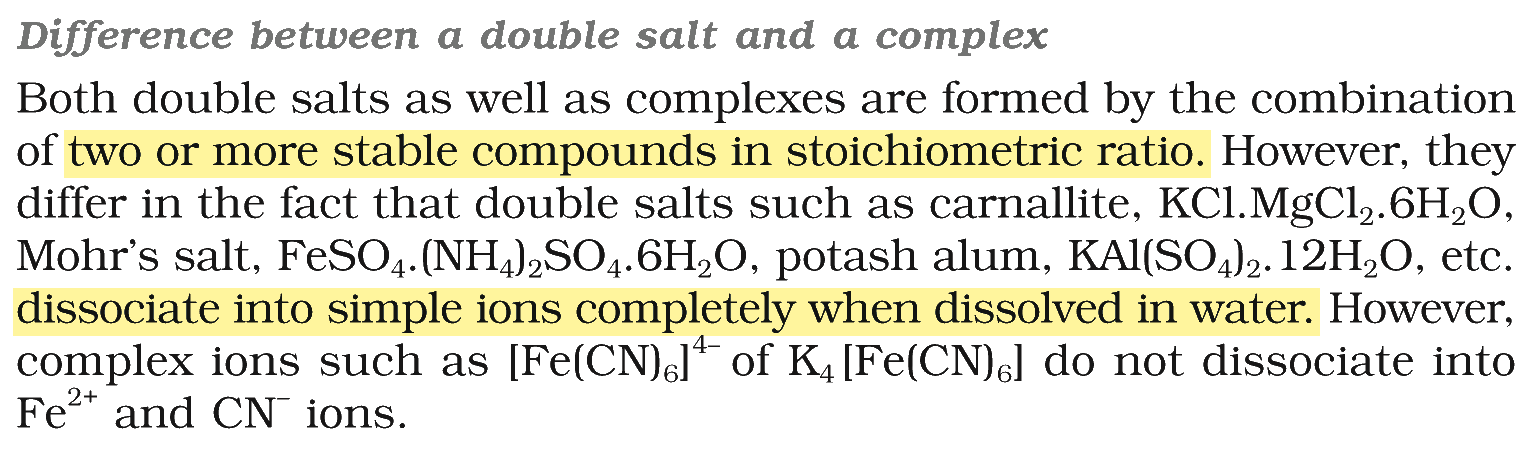
Which of the following statements are correct?
A. Carnallite, Mohr's salt, and potash alum are double salts.
B. Double salts dissociate into simple ions completely when dissolved in water
C. Double salts are non-stoichiometric compounds.
D. Double salts have both primary and secondary valences.
Choose the correct answer from the options given below:
Answer & explanation
Correct answer: option 4
The correct answer is Option (4) → A and B only
Werner explained coordination compounds, not double salts, with primary and secondary valences.
A. Carnallite, Mohr's salt, and potash alum are double salts. — Correct. Carnallite is KCl·\( \ce{MgCl2} \)·\( \ce{6H2O} \), Mohr’s salt is \( \ce{FeSO4} \)·\( \ce{(NH4)2SO4} \)·\( \ce{6H2O} \) and potash alum is \( \ce{K2SO4} \)·\( \ce{Al2(SO4)3} \)·\( \ce{24H2O} \).
B. Double salts dissociate into simple ions completely when dissolved in water — Correct. For example, Mohr’s salt gives only simple ions:
\( \displaystyle \ce{FeSO4.(NH4)2SO4.6H2O -> Fe^2+ + 2NH4^+ + 2SO4^2- + 6H2O} \)
C. Double salts are non-stoichiometric compounds. — Incorrect. Double salts are formed in a fixed (stoichiometric) ratio, as the formulae above show.
D. Double salts have both primary and secondary valences. — Incorrect. Primary and secondary valences belong to Werner’s theory of coordination compounds; a double salt has no complex ion held by secondary valences.
NCERT (2026-27 edition):
Difference between a Double Salt and a Complex