
CUETMOCK
  • Pricing
  • Mentors
Log inStart freeStart free mocks→

First test, then trust

Try a free CUET mock test.

Join 5,00,000+ students who rehearsed exam day on the exact NTA screen before sitting CUET. On the web and on Android.

Start free mocks →Get the Android app
CUETMOCK

India's #1 CUET Mock Test Platform. Original NCERT-based questions on the exact NTA exam screen — trusted by 5,00,000+ students since CUET 2022.

Get it onGoogle PlayScan to download the CUETMOCK app

Mock tests

  • CUET mock test series
  • Browse all papers
  • Commerce mocks
  • Humanities (Arts) mocks
  • Science mocks
  • Languages & GAT mocks
  • Free practice questions
  • Pricing

Resources

  • CUET exam guide
  • CUET syllabus
  • Universities accepting CUET
  • Expert blogs
  • News & notifications
  • Webinars & counselling
  • CUET score calculator
  • How we estimate your rank
  • FAQs

Company

  • About us
  • Our leadership & team
  • Our toppers
  • Mentors
  • For schools
  • Contact us
  • Terms
  • Privacy
  • Refund policy

Talk to us

+91 7696 6630 56info@cuetmock.comWhatsApp us

Our other platforms

  • JEE Mock — For IIT-JEE aspirants
  • NEET Mock — For NEET aspirants

Newsletter

Exam updates, study material and offers — no spam.

© 2026 NYC Ventures Pvt. Ltd.

701-702, Royal Business Park, Zirakpur, Punjab - 140603

  • Terms of use
  • Privacy policy
  • Refund policy
  • Contact us

iCUETMOCK is an independent preparation platform, not affiliated with the National Testing Agency (NTA). Always check exam details on the official NTA website.

  • Home
  • Mock tests
  • CUET guide
  • Pricing
  • Log in
Home/Practice questions/Chemistry
ChemistryOrganic: Alcohols, Phenols and Ethers

In the following reaction, the major products [A] and [B], respective…

In the following reaction, the major products [A] and [B], respectively, are
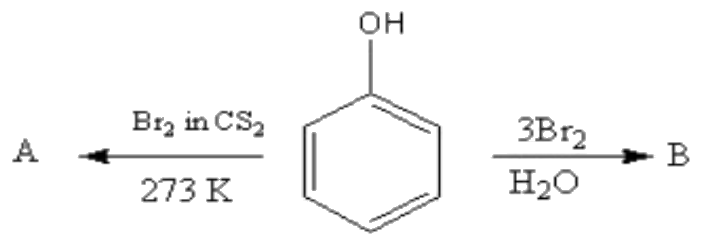
Figure for Q33

Answer & explanation+

Correct answer: option 1

The correct answer is Option (1) → [A] = p-bromophenol [B] 2,4,6-tribromophenol

The –OH group of phenol is strongly activating and ortho/para directing: its lone pair pushes electron density into the ring by resonance. So phenol undergoes bromination even without a Lewis acid, and the solvent decides how far the reaction goes:

  • Br2 in a non-polar solvent (CS2 or CHCl3) at low temperature (273 K): phenol hardly ionises, and the \( \ce{Br2} \) molecule is only weakly polarised. The reaction is mild and gives monobromophenols, mainly the para isomer (the ortho positions are more hindered).

        \( \displaystyle \ce{C6H5OH} \xrightarrow[\text{273 K}]{\ce{Br2}\text{ in }\ce{CS2}} \text{p-bromophenol (major)} + \text{o-bromophenol (minor)} + \ce{HBr} \)

  • Bromine water: in water, phenol partly ionises to the phenoxide ion, which is even more strongly activated, and water polarises \( \ce{Br2} \). All three ortho and para positions are substituted at once, giving a white precipitate of 2,4,6-tribromophenol.

        \( \displaystyle \ce{C6H5OH + 3Br2} \xrightarrow{\ce{H2O}} \ce{C6H2Br3OH v + 3HBr} \)

In the given scheme, A is formed with \( \ce{Br2} \) in \( \ce{CS2} \) at 273 K and B with \( \ce{3Br2} \)/\( \ce{H2O} \). So A is p-bromophenol and B is 2,4,6-tribromophenol.

Why the other options are incorrect

  • Option (2) [B] = o-bromophenol [A] 2,4,6-tribromophenol — Incorrect. Tribromination needs the strong activation available in water, not the milder conditions in \( \ce{CS2} \); and in water all three positions are substituted, so B cannot be a monobromo compound.

  • Option (3) [A] = p-bromophenol [B] o-bromophenol — Incorrect. A is right, but in bromine water all three ortho and para positions are substituted, so B is 2,4,6-tribromophenol, not a monobromophenol.

  • Option (4) [A] = 2,4,6-tribromophenol [B] p-bromophenol — Incorrect. The two products are interchanged. Tribromination does not occur in \( \ce{CS2} \) at low temperature.

NCERT (2026-27 edition):
Halogenation
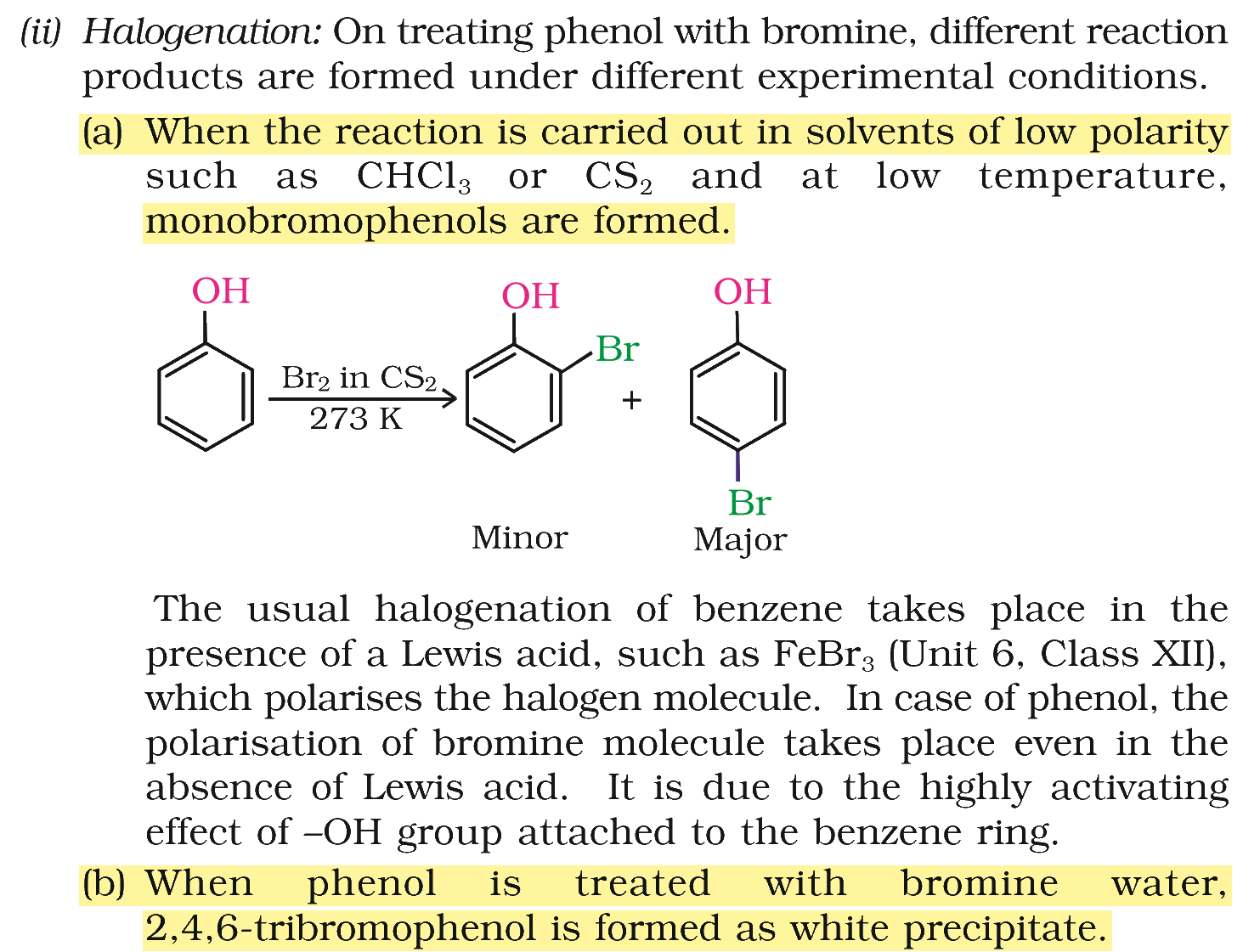
Textbook extract

Note: The same/similar question has been asked in different years by NTA as per the details given below:

20262025202420232022
20-05 S2
12-05 S2
––––

Advertisement

Practise more on Organic: Alcohols, Phenols and Ethers

Chapter-wise mocks on the real NTA exam screen, with solutions and your rank. Your first mocks are free.

Start free mocks →

Advertisement

Next questions

  1. Ibrahim II of Bijapur was an expert in Indian music. Which book did he write on this subject?Fine Arts · The Deccani Schools of Painting
  2. The particular solution of the differential equation displaystyledy/dx = -6xy^2 satisfying y(1) = displaystyle1/4 isMaths. Section A · Differential Equations
  3. The de Broglie wavelength of the electron revolving in the 4th orbit of a hydrogen atom is λ . What is its de Broglie wavelength in the 2nd…Physics · Atoms
  4. Mahavir Jayanti is celebrated in the month of __________.General Aptitude Test · General Knowledge
  5. A rectangular water tank is 1.5 m high, 3 m long and 3.5 m wide. How much water (in litres) can it hold?General Aptitude Test · Quantitative Reasoning
  6. The Hardy - Weinberg Principle says:(A) Allele frequency in a population is stable and constant.(B) Allele frequency in a population is uns…Biology · Evolution
  7. Which animal is the most useful for the Arabs in the desert?English · Comprehension - (Narrative / Factual)
  8. The most commonly cited defining features of Caste system in India : A. Caste groups are endogamous B. Caste is a matter of choice C. Segme…Sociology · Indian Society: Continuity and Change
  9. Cotton is called a 'pure' raw material because _________.Geography · India-People and Economy: Manufacturing Industries
  10. In the following question, select the odd letter/letters from the given alternatives.General Aptitude Test · General Ability