
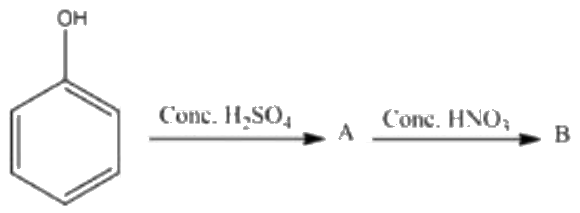
In the following conversion reaction, the major product B is
Answer & explanation
Correct answer: option 4
The correct answer is Option (4) → 2,4,6-trinitrophenol (picric acid)
The –OH group of phenol strongly activates the benzene ring and directs incoming groups to the ortho and para positions. The ring is so electron rich that concentrated nitric acid, a strong oxidising agent, attacks it directly and gives mostly tarry oxidation products and a poor yield of picric acid.
To avoid this, phenol is first sulphonated. Concentrated \( \ce{H2SO4} \) gives phenol-2,4-disulphonic acid (A). The two –\( \ce{SO3H} \) groups withdraw electrons and protect the ring from oxidation. Concentrated \( \ce{HNO3} \) then replaces both –SO3H groups by –NO2 and also nitrates the remaining free ortho position:
\( \displaystyle \ce{C6H5OH + 2H2SO4} \xrightarrow{\text{conc.}} \ce{C6H3(OH)(SO3H)2 + 2H2O}\quad(\text{A}) \)
\( \displaystyle \ce{C6H3(OH)(SO3H)2 + 3HNO3} \xrightarrow{\text{conc.}} \ce{C6H2(OH)(NO2)3 + 2H2SO4 + H2O}\quad(\text{B}) \)
So B is 2,4,6-trinitrophenol, known as picric acid.
Why the other options are incorrect
Option (1) 3,4-dinitrophenol — Incorrect. It has a nitro group at C-3, a meta position. The –OH group does not direct substitution to the meta position.
Option (2) 3-nitrophenol — Incorrect. It has a single nitro group at the meta position, which the –OH group does not favour.
Option (3) 2,4-dinitrophenol — Incorrect. It has only two nitro groups. With concentrated \( \ce{HNO3} \), all three ortho and para positions are substituted.
NCERT (2026-27 edition):
Nitration – “… With concentrated nitric acid, phenol is converted to 2,4,6-trinitrophenol. The product is commonly known as picric acid. The yield of the reaction product is poor. … Nowadays picric acid is prepared by treating phenol first with concentrated sulphuric acid which converts it to phenol-2,4-disulphonic acid, and then with concentrated nitric acid to get 2,4,6-trinitrophenol.”