Spermatogenesis
Read the following passage carefully and answer the given questions.
As you are aware, humans are sexually reproducing and viviparous. The reproductive events in humans include formation of gametes (gametogenesis), i.e., sperms in males and ovum in females. Male reproductive system is composed of a pair of testes, the male sex accessory ducts, accessory glands, and external genitalia. Each testicular lobule contains one to three highly coiled seminiferous tubules in which sperms are produced. Each seminiferous tubule is lined on its inside by two types of cells called male germ cells (spermatogonia) and Sertoli cells. The male germ cells undergo meiotic divisions finally leading to sperm formation, while Sertoli cells provide nutrition to the germ cells. The regions outside the seminiferous tubules called interstitial spaces, contain small blood vessels and interstitial cells or Leydig cells. The male sex accessory ducts include rete testis, vasa efferentia, epididymis and vas deferens. The male accessory glands include paired seminal vesicles, a prostate and paired bulbourethral glands. Secretions of these glands constitute the seminal plasma which is rich in fructose, calcium and certain enzymes.
In the context of spermatogenesis, identify the correct statement.
Answer & explanation
Correct answer: option 2
The correct answer is Option (2) → Secondary spermatocytes undergo the second meiotic division to form spermatids.
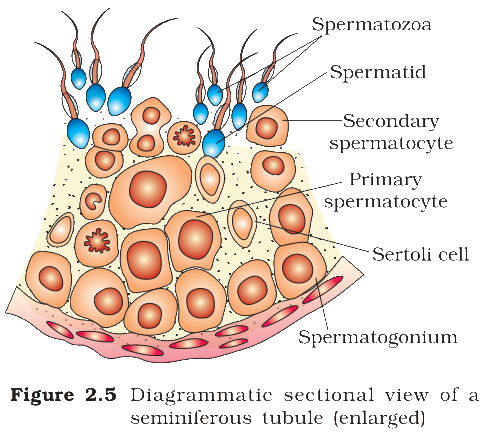
In spermatogenesis a spermatogonium (diploid, 46 chromosomes) multiplies by mitosis. Some spermatogonia grow into primary spermatocytes. A primary spermatocyte completes the first meiotic division and gives two secondary spermatocytes (haploid, 23 chromosomes). Each secondary spermatocyte then completes the second meiotic division. In all, four spermatids are made. The spermatids change into sperms by spermiogenesis.
(1) In testis, spermatids form primary spermatocytes. — Incorrect statement. The direction is the reverse. Primary spermatocytes lead to spermatids, and spermatids change into sperms.
(2) Secondary spermatocytes undergo the second meiotic division to form spermatids. — Correct statement. This is the second meiotic division of spermatogenesis.
(3) Spermatogonia are transformed into ovum through the process of spermiogenesis. — Incorrect statement. The male gamete is a sperm. An ovum is made in the female by oogenesis. Spermiogenesis is the change of spermatids into sperms.
(4) Primary spermatocytes are formed during the first meiotic division. — Incorrect statement. Primary spermatocytes are formed from spermatogonia before meiosis begins. The first meiotic division is the one that produces secondary spermatocytes from them.
Note: The passage is taken from NCERT. NTA has put lines of the NCERT text together to make it. Most CUET (UG) questions come straight from NCERT, so study the book line by line, including figures and their titles.
NCERT Extract:
Gametogenesis – “… Some of the spermatogonia called primary spermatocytes periodically undergo meiosis. A primary spermatocyte completes the first meiotic division (reduction division) leading to formation of two equal, haploid cells called secondary spermatocytes, which have only 23 chromosomes each. The secondary spermatocytes undergo the second meiotic division to produce four equal, haploid spermatids (Figure 2.5).”