CUETMOCK
  • Pricing
  • Mentors
Log inStart freeStart free mocks→

First test, then trust

Try a free CUET mock test.

Join 5,00,000+ students who rehearsed exam day on the exact NTA screen before sitting CUET. On the web and on Android.

Start free mocks →Get the Android app
CUETMOCK

India's #1 CUET Mock Test Platform. Original NCERT-based questions on the exact NTA exam screen — trusted by 5,00,000+ students since CUET 2022.

Get it onGoogle PlayScan to download the CUETMOCK app

Mock tests

  • CUET mock test series
  • Browse all papers
  • Commerce mocks
  • Humanities (Arts) mocks
  • Science mocks
  • Languages & GAT mocks
  • Free practice questions
  • Pricing

Resources

  • CUET exam guide
  • CUET syllabus
  • Universities accepting CUET
  • Expert blogs
  • News & notifications
  • Webinars & counselling
  • CUET score calculator
  • How we estimate your rank
  • FAQs

Company

  • About us
  • Our leadership & team
  • Our toppers
  • Mentors
  • For schools
  • Contact us
  • Terms
  • Privacy
  • Refund policy

Talk to us

+91 7696 6630 56info@cuetmock.comWhatsApp us

Our other platforms

  • JEE Mock — For IIT-JEE aspirants
  • NEET Mock — For NEET aspirants

Newsletter

Exam updates, study material and offers — no spam.

© 2026 NYC Ventures Pvt. Ltd.

701-702, Royal Business Park, Zirakpur, Punjab - 140603

  • Terms of use
  • Privacy policy
  • Refund policy
  • Contact us

iCUETMOCK is an independent preparation platform, not affiliated with the National Testing Agency (NTA). Always check exam details on the official NTA website.

  • Home
  • Mock tests
  • CUET guide
  • Pricing
  • Log in
Home/Practice questions/Economics
EconomicsMicro Economics: Theory of Firms under Perfect Competition

Which one of the following fulfills for supply curve of a firm under…

Which one of the following fulfills for supply curve of a firm under perfectly competitive market in the long run?

Answer & explanation+

Correct answer: option 1

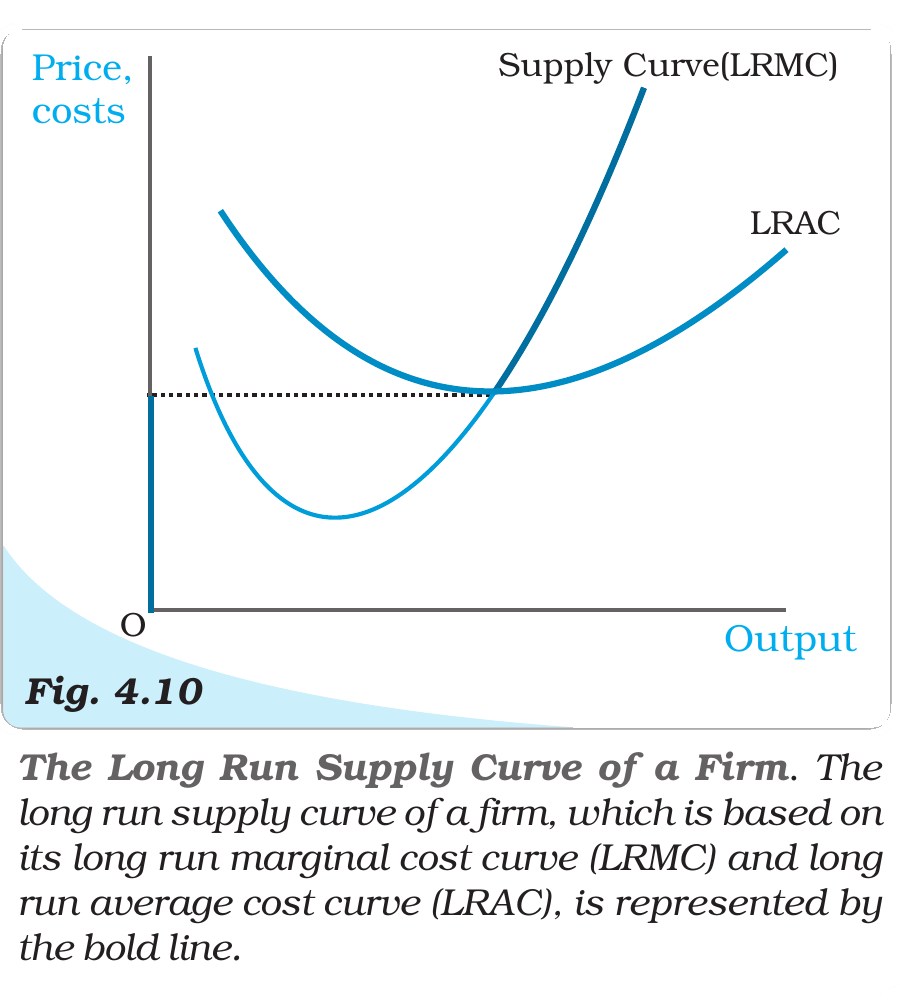
The correct answer is Option (1) → Rising part of the LRMC curve from and above the minimum point of LRAC

A firm’s supply curve shows how much it will produce at each price. A perfectly competitive firm takes the price as given, and in the long run, when all its inputs can be varied, two cost curves decide its choice:

  • Long run marginal cost (LRMC) is the extra cost of one more unit. Profit is largest where price equals LRMC on the rising part of the curve: up to that point each extra unit adds more to revenue than to cost, and beyond it each extra unit costs more than the price it fetches.

  • Long run average cost (LRAC) is the cost per unit. In the long run the firm is free to leave the industry, so it stays only if the price covers its LRAC. The U-shaped LRAC curve is lowest where the LRMC curve cuts it.

Putting the two together: at any price at or above the minimum point of LRAC, the firm supplies the output read off the rising part of LRMC; at a price below it, the firm would make a loss at every positive output and produces nothing. The long run supply curve is therefore the rising part of LRMC from and above the minimum of LRAC.

Why the other options are incorrect

  • Option (2) Falling part of the LRAC curve from and above the minimum point of LRMC — Incorrect. The supply curve comes from the marginal cost curve, because output is set where price equals marginal cost, and on its rising part; a falling curve cannot be a supply curve.

  • Option (3) Rising part of the LRMC curve from and below the minimum point of LRAC — Incorrect. Below the minimum LRAC the firm makes losses at every positive output, so in the long run it supplies nothing there.

  • Option (4) Rising part of the LRMC curve from and above the maximum point of LRAC — Incorrect. The U-shaped LRAC curve has a minimum point, which marks the lowest price at which the firm will produce; it has no maximum point from which supply could begin.


NCERT (2025-26): “Long Run Supply Curve of a Firm … Combining cases 1 and 2, we reach an important conclusion. A firm’s long run supply curve is the rising part of the LRMC curve from and above the minimum LRAC together with zero output for all prices less than the minimum LRAC. In Figure 4.10, the bold line represents the long run supply curve of the firm.”

NCERT extract

Advertisement

Practise more on Micro Economics: Theory of Firms under Perfect Competition

Chapter-wise mocks on the real NTA exam screen, with solutions and your rank. Your first mocks are free.

Start free mocks →

Advertisement

Next questions

  1. Why do transition elements exhibit higher enthalpies of atomisation?Chemistry · Inorganic: D and F Block Elements
  2. If ∫displaystyle1/(√((x-1)(x-2))) dx=log≤ft|(x-m)+√(ax^2+bx+n)|+C where c is an arbitrary constant and m,n,a and b are constant, then 2m+n+…Maths. Section A · Indefinite Integration
  3. Which one of the followings is the correct equation for describing Verhulst-Pearl Logistic Growth?Biology · Organisms and Populations
  4. A point charge +Q is placed inside a conducting slab. Choose the correct statements:(A) The induced charge on the inner surface of the slab…Physics · Electric Charges and Fields
  5. When did India join the UN?Political Science · Contemporary World Politics: International Organisations
  6. For the following data:Year (xi)2000200120022003200420052006Production (in tonnes) (yi)40454642475046The equation of the straight line tren…Applied Maths. Section B2 · Time Based Data
  7. Consider the magnetic properties of the following complexes and select the correct statements:[NiCl4]2−, [Ni(CN)4]2− and [Ni(CO)4].A. [Ni(C…Chemistry · Inorganic: Coordination Compounds
  8. Consider the following statements:Which is/are true?(A) The sum of any two sides of a triangle is greater than the third side.(B) The media…General Aptitude Test · Quantitative Reasoning
  9. Match List-I with List-IIList-IList-II(Approaches of Human Geography)(Period)(A)Areal differentiation(I)1970s(B)Spatial organisation(II)199…Geography · Fundamentals of Human Geography: Human Geography-Nature and Scope
  10. In the following conversion reaction, the major product B isChemistry · Organic: Alcohols, Phenols and Ethers