Discontentment with the quantitative revolution is NOT associated with which of the following?
Answer & explanation
Correct answer: option 2
The correct answer is Option (2) → Post-Modernism in Geography
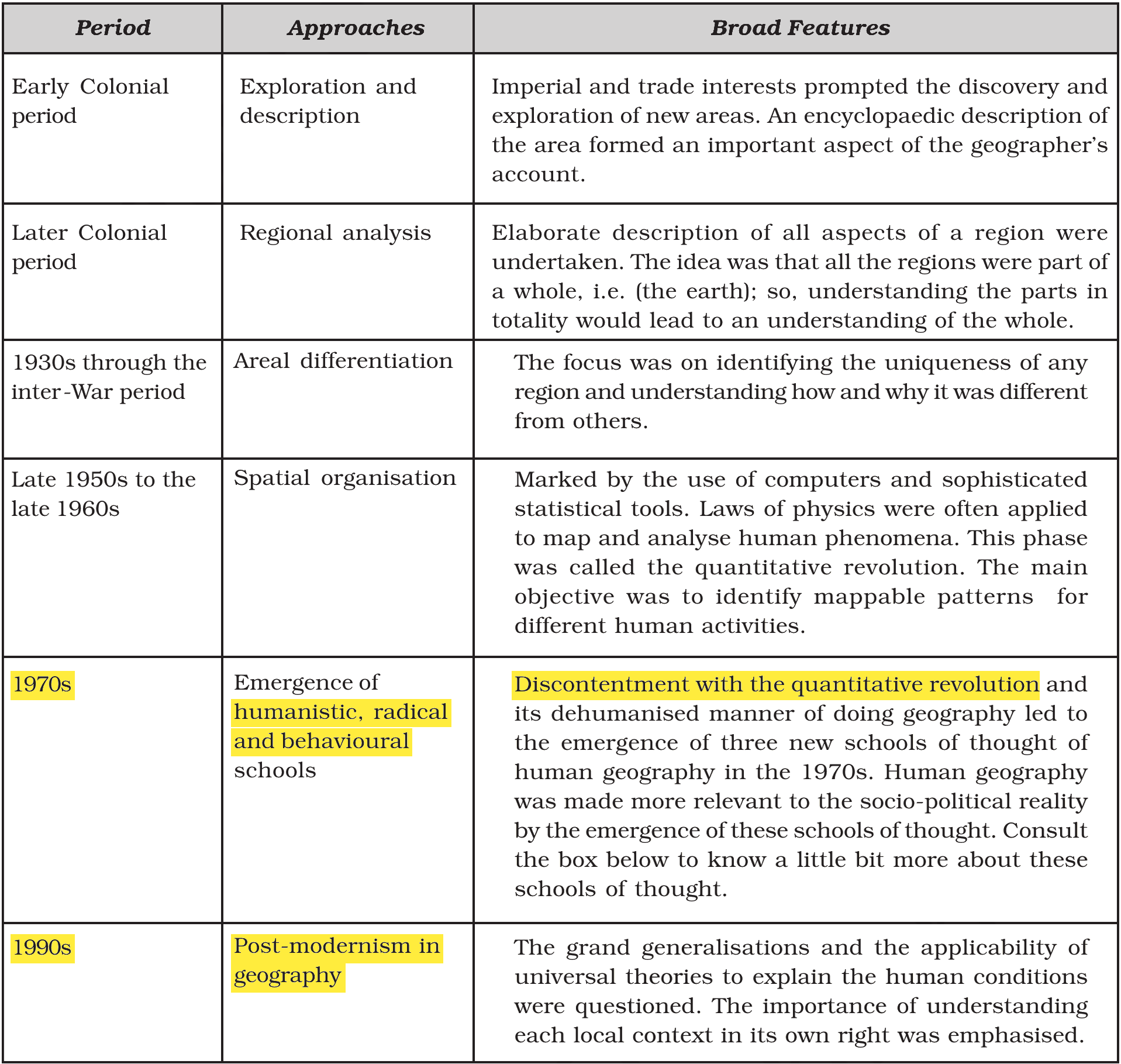
In the 1970s, discontentment with the quantitative revolution and its dehumanised manner of doing geography led to three new schools of thought: humanistic, radical and behavioural.
Option (1) Humanistic Geography — Associated with the discontentment. The humanistic (welfare) school dealt with the social well-being of people, such as housing, health and education.
Option (2) Post-Modernism in Geography — Not associated with the discontentment. Post-modernism came later, in the 1990s. It questioned grand generalisations and universal theories and stressed each local context.
Option (3) Radical Geography — Associated with the discontentment. The radical school used Marxian theory to explain poverty, deprivation and social inequality.
Option (4) Behavioural Geography — Associated with the discontentment. The behavioural school laid stress on lived experience and on the perception of space.
NCERT (2026-27):
Table 1.1: Broad Stages and Thrust of Human Geography |