
CUETMOCK
  • Pricing
  • Mentors
Log inStart freeStart free mocks→

First test, then trust

Try a free CUET mock test.

Join 5,00,000+ students who rehearsed exam day on the exact NTA screen before sitting CUET. On the web and on Android.

Start free mocks →Get the Android app
CUETMOCK

India's #1 CUET Mock Test Platform. Original NCERT-based questions on the exact NTA exam screen — trusted by 5,00,000+ students since CUET 2022.

Get it onGoogle PlayScan to download the CUETMOCK app

Mock tests

  • CUET mock test series
  • Browse all papers
  • Commerce mocks
  • Humanities (Arts) mocks
  • Science mocks
  • Languages & GAT mocks
  • Free practice questions
  • Pricing

Resources

  • CUET exam guide
  • CUET syllabus
  • Universities accepting CUET
  • Expert blogs
  • News & notifications
  • Webinars & counselling
  • CUET score calculator
  • How we estimate your rank
  • FAQs

Company

  • About us
  • Our leadership & team
  • Our toppers
  • Mentors
  • For schools
  • Contact us
  • Terms
  • Privacy
  • Refund policy

Talk to us

+91 7696 6630 56info@cuetmock.comWhatsApp us

Our other platforms

  • JEE Mock — For IIT-JEE aspirants
  • NEET Mock — For NEET aspirants

Newsletter

Exam updates, study material and offers — no spam.

© 2026 NYC Ventures Pvt. Ltd.

701-702, Royal Business Park, Zirakpur, Punjab - 140603

  • Terms of use
  • Privacy policy
  • Refund policy
  • Contact us

iCUETMOCK is an independent preparation platform, not affiliated with the National Testing Agency (NTA). Always check exam details on the official NTA website.

  • Home
  • Mock tests
  • CUET guide
  • Pricing
  • Log in
Home/Practice questions/Biology
BiologyEvolution

In organisms, the same structure developed along different directions…

In organisms, the same structure developed along different directions due to adaptations to different needs. This refers to:

Answer & explanation+

Correct answer: option 2

The correct answer is Option (2) → Divergent evolution

Option (1) Convergent evolution — Incorrect. Convergent evolution is the opposite case. Different structures come to do the same job, as the wings of a butterfly and of a bird. Such organs are analogous.

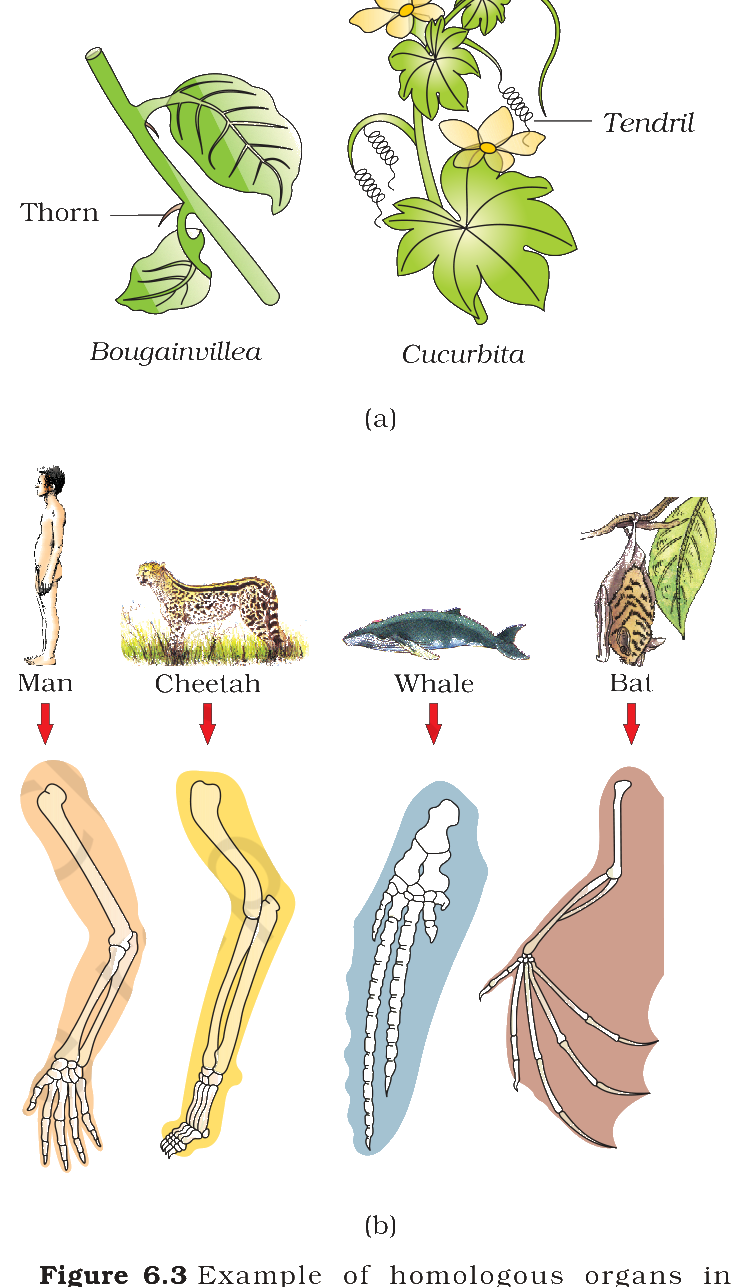
Option (2) Divergent evolution — Correct. The forelimbs of whales, bats, cheetahs and humans have the same set of bones but do different jobs: swimming, flying, running and grasping. One structure has spread out in different directions, and such structures are homologous.

Option (3) Evolution by anthropogenic action — Incorrect. This is evolution caused by human activity. The excess use of herbicides, pesticides and antibiotics has selected resistant varieties of organisms in a short time. It is not about one structure taking different forms.

Option (4) Natural selection — Incorrect. Natural selection is the process by which the better-fitted individuals leave more offspring. It drives evolution, but it is not the name for this pattern of one structure developing in different directions.

NCERT Extract:
What Are the Evidences for Evolution? – “… Comparative anatomy and morphology shows similarities and differences among organisms of today and those that existed years ago. Such similarities can be interpreted to understand whether common ancestors were shared or not. For example whales, bats, Cheetah and human (all mammals) share similarities in the pattern of bones of forelimbs (Figure 6.3b). Though these forelimbs perform different functions in these animals, they have similar anatomical structure – all of them have humerus, radius, ulna, carpals, metacarpals and phalanges in their forelimbs. Hence, in these animals, the same structure developed along different directions due to adaptations to different needs. This is divergent evolution and these structures are homologous.”
Textbook figure

Figure 6.3 Example of homologous organs in (a) Plants and (b) Animals

Advertisement

Practise more on Evolution

Chapter-wise mocks on the real NTA exam screen, with solutions and your rank. Your first mocks are free.

Start free mocks →

Advertisement

Next questions

  1. Under the rule of which Mughal emperor 'Chahar taslim' and 'zaminbos' were practised?History · Medieval India: Kings and Chronicles
  2. Match List I with List II LIST I (Interpersonal Physical distance)LIST II (Description)A.Public distanceI.Distance maintained when talking…Psychology · Psychology and Life
  3. In which of the following states of India, the reserves of silver are NOT found?General Aptitude Test · General Knowledge
  4. 'Digboi oil' field is located in _________.Geography · India-People and Economy: Mineral and Energy resources
  5. Select the correct option that represents the given Venn diagram.General Aptitude Test · Verbal Reasoning
  6. If 100 fruit flies die in a laboratory population of 1,000 during a month, the death rate in the population is ________ individual per frui…Biology · Organisms and Populations
  7. A beam of α particles projected along the +x axis in a magnetic field experiences a force along the +y axis. The direction of the magnetic…Physics · Moving Charges and Magnetism
  8. Match List I with List II LIST ILIST IIA. India signed and ratified the Kyoto ProtocolI. 2001B. Energy Conservation ActII. 1992C. Electrici…Political Science · Contemporary World Politics: Environment and Natural Resources
  9. Raman purchases 2 pens and 3 pencils and pays ₹36 to the shopkeeper. Her friend Siya purchases 3 pens and 2 pencils and pays ₹49. What is t…General Aptitude Test · Quantitative Reasoning
  10. Who was elected as President of the Constituent Assembly of Pakistan on 11 August 1947?History · Modern India: Framing the Constitution