
CUETMOCK
  • Pricing
  • Mentors
Log inStart freeStart free mocks→

First test, then trust

Try a free CUET mock test.

Join 5,00,000+ students who rehearsed exam day on the exact NTA screen before sitting CUET. On the web and on Android.

Start free mocks →Get the Android app
CUETMOCK

India's #1 CUET Mock Test Platform. Original NCERT-based questions on the exact NTA exam screen — trusted by 5,00,000+ students since CUET 2022.

Get it onGoogle PlayScan to download the CUETMOCK app

Mock tests

  • CUET mock test series
  • Browse all papers
  • Commerce mocks
  • Humanities (Arts) mocks
  • Science mocks
  • Languages & GAT mocks
  • Free practice questions
  • Pricing

Resources

  • CUET exam guide
  • CUET syllabus
  • Universities accepting CUET
  • Expert blogs
  • News & notifications
  • Webinars & counselling
  • CUET score calculator
  • How we estimate your rank
  • FAQs

Company

  • About us
  • Our leadership & team
  • Our toppers
  • Mentors
  • For schools
  • Contact us
  • Terms
  • Privacy
  • Refund policy

Talk to us

+91 7696 6630 56info@cuetmock.comWhatsApp us

Our other platforms

  • JEE Mock — For IIT-JEE aspirants
  • NEET Mock — For NEET aspirants

Newsletter

Exam updates, study material and offers — no spam.

© 2026 NYC Ventures Pvt. Ltd.

701-702, Royal Business Park, Zirakpur, Punjab - 140603

  • Terms of use
  • Privacy policy
  • Refund policy
  • Contact us

iCUETMOCK is an independent preparation platform, not affiliated with the National Testing Agency (NTA). Always check exam details on the official NTA website.

  • Home
  • Mock tests
  • CUET guide
  • Pricing
  • Log in
Home/Practice questions/Chemistry
ChemistryPhysical: Solutions

The depressions in freezing point of 0.1 M aqueous solutions of HCl,…

The molar masses determined from the colligative properties of substances that associate or dissociate in solution are abnormal and are called abnormal molar masses. Ionic substances such as NaCl, BaCl2 and AlCl3 dissociate into ions in solution. Their colligative properties are higher than those of solutions of non-electrolytes such as glucose of the same concentration, because the number of particles in solution increases. When molecules of a substance such as ethanoic acid (acetic acid) associate in benzene to form dimers, the number of particles decreases and the colligative properties also decrease. The van’t Hoff factor, i, accounts for the extent of dissociation or association:

\(\displaystyle i = \frac{\text{Normal molar mass}}{\text{Abnormal molar mass}} = \frac{\text{Observed colligative property}}{\text{Calculated colligative property}}\)

\(\displaystyle i = \frac{\text{Total number of moles of particles after association/dissociation}}{\text{Number of moles of particles before association/dissociation}}\)

The value of i is greater than 1 for ionic substances and less than 1 for substances that associate in solution.

The depressions in freezing point of 0.1 M aqueous solutions of HCl, CuSO4 and K2SO4 (assuming complete dissociation) are:

Answer & explanation+

Correct answer: option 3

The correct answer is Option (3) → In the ratio 1:1:1.5

Depression of freezing point is a colligative property: it depends on the number of solute particles. For an electrolyte the van’t Hoff factor i counts the particles each formula unit gives on complete dissociation:

    \( \displaystyle \Delta T_f=i\,K_f\,m \)

All three solutions have the same concentration in the same solvent, so ΔTf is in the ratio of the i values.

  • \( \ce{HCl} \) — \( \ce{HCl -> H^+ + Cl^-} \), so i = 2.

  • \( \ce{CuSO4} \) — \( \ce{CuSO4 -> Cu^2+ + SO4^2-} \), so i = 2.

  • \( \ce{K2SO4} \) — \( \ce{K2SO4 -> 2K^+ + SO4^2-} \), so i = 3.

ΔTf(HCl) : ΔTf(CuSO4) : ΔTf(K2SO4) = 2 : 2 : 3 = 1 : 1 : 1.5.

NCERT (2026-27 edition):
1.7 Abnormal Molar Masses – “Table 1.4 depicts values of the factor, i for several strong electrolytes. For KCl, NaCl and MgSO4, i values approach 2 as the solution becomes very dilute. As expected, the value of i gets close to 3 for K2SO4.”

Table 1.4: Values of van’t Hoff factor, i, at Various Concentrations for NaCl, KCl, MgSO4 and K2SO4.
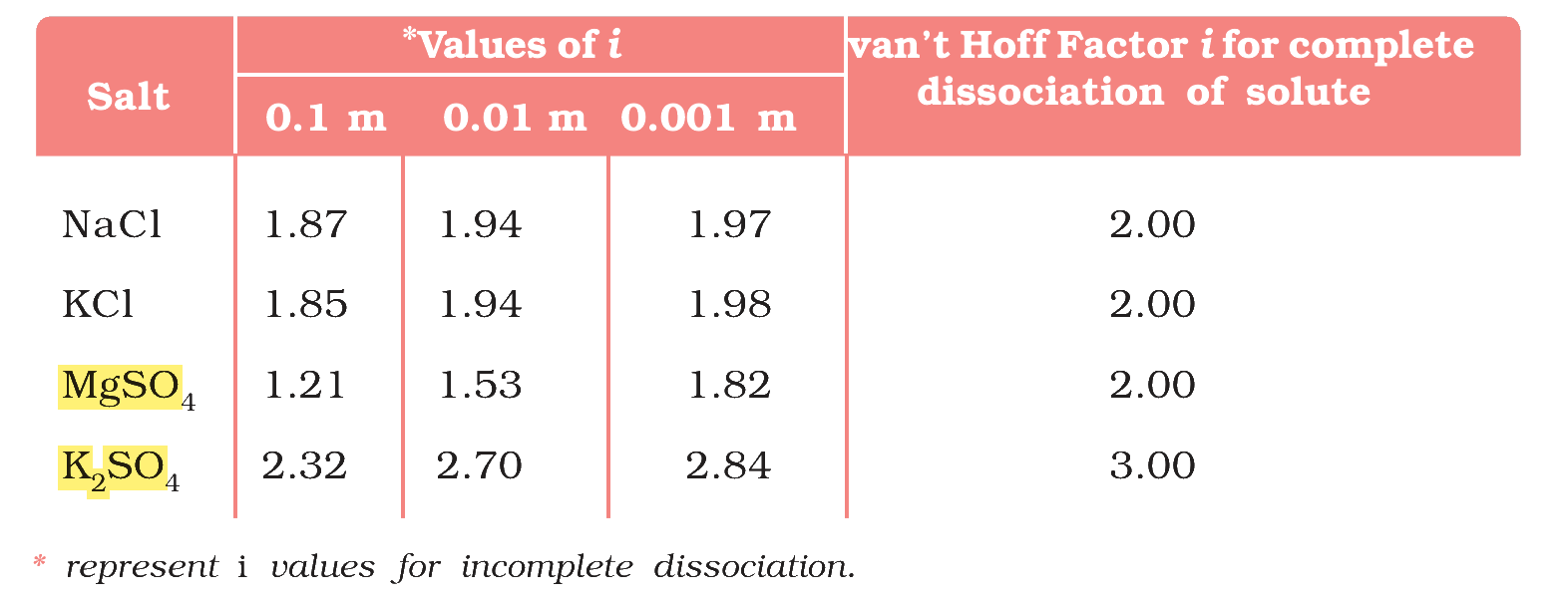
Table 1.4

Advertisement

Practise more on Physical: Solutions

Chapter-wise mocks on the real NTA exam screen, with solutions and your rank. Your first mocks are free.

Start free mocks →

Advertisement

Next questions

  1. British attempts to recover Delhi in 1857 led to heavy fighting and losses on both sides. Which of the following was one reason for this?History · Modern India: Rebels and the Raj
  2. Which of the following letter-clusters will replace the question mark (?) in the given series? PL, RO, TS, VX, XD, ?General Aptitude Test · General Ability
  3. 'बुढ़िया मरी तो मरी, आगरा तो देखा' — प्रस्तुत पंक्ति क्या है?Hindi · लोकोक्ति
  4. ∫(sin x)/(sin 2x) dx is equal toMaths. Section B1 · Indefinite Integration
  5. A Sanskrit text describes a forest-dwelling community, for whom hunting and gathering is the main means of subsistence, as odd, uncivilised…History · Ancient India: Kinship, Caste and Class
  6. 'दिनानुदिन' सामासिक पद का सही विग्रह है -Hindi · व्याकरण - ससमास
  7. Which of the following matrix is not skew symmetric matrix?Maths. Section A · Matrices (Section A)
  8. The value of the integral ∫limits_0^π (x sin x)/(1+cos ^2 x) d x, isMaths. Section A · Definite Integration
  9. Read the following statements and choose the correct option.Statement I: Under moral justification, a business must avoid unfair trade prac…Business Studies · Consumer Protection
  10. Read the information given below carefully and answer the question that follows:Aditi, a salesgirl is appointed at a basic salary of ₹1200…General Aptitude Test · Numerical Ability