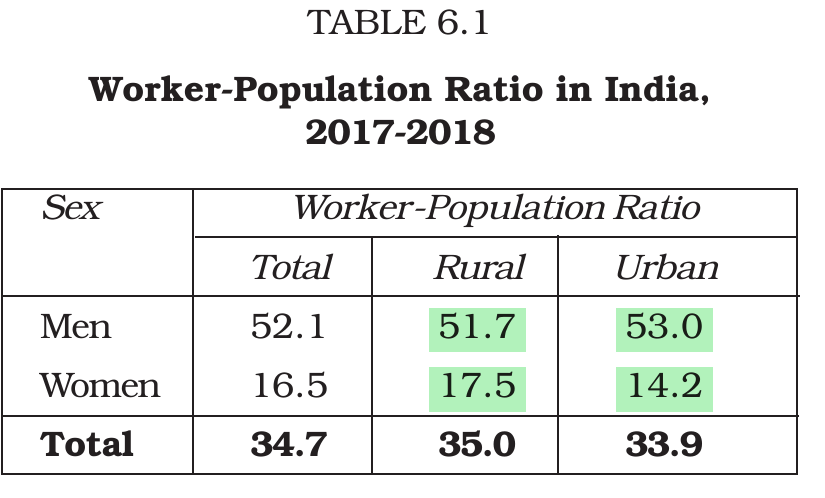
Consider the table:
Worker population ratio in India
2017-18
| Sex | Worker Population Ratio | ||
| Total | Rural | Urban | |
| Men | 52.1 | 51.7 | 53.0 |
| Women | 16.5 | 17.5 | 14.2 |
| Total | 34.7 | 35.0 | 33.9 |
Identify the incorrect statement.
Answer & explanation
Correct answer: option 2
The correct answer is Option (2) → The difference in participation rate between men and women is larger in rural areas.
The gap between men and women is larger in urban areas, so this statement is false.
Option (1) In India, compared to females, more males are found to be working. — True. The ratio is 52.1 for men and 16.5 for women.
Option (2) The difference in participation rate between men and women is larger in rural areas. — False. The rural gap is 51.7 − 17.5 = 34.2. The urban gap is 53.0 − 14.2 = 38.8. So the urban gap is larger.
Option (3) In India, compared to rural men, more urban men are found to be working. — True. The ratio is 53.0 for urban men and 51.7 for rural men.
Option (4) In India, compared to urban women, more rural women are found to be working. — True. The ratio is 17.5 for rural women and 14.2 for urban women.
NCERT (2026-27): “6.3 Participation of People in Employment … Compared to females, more males are found to be working. The difference in participation rates is very large in urban areas: for every 100 urban females, only about 21 are engaged in some economic activities. In rural areas, for every 100 rural women about 35 participate in the employment market. … It is common to find that where men are able to earn high incomes, families discourage female members from taking up jobs.…” NCERT (2023-24): Indian Economic Development — Chapter 6: Employment: Growth, Informalisation and Other Issues
|