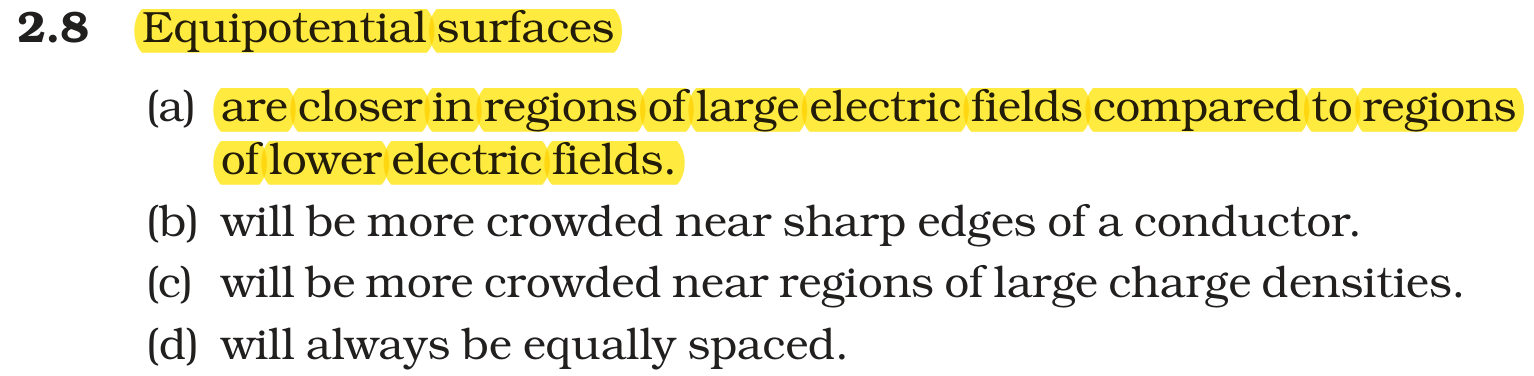
Equipotential surfaces
Answer & explanation
Correct answer: option 1
The correct answer is Option (1) → are closer in regions of large electric fields compared to regions of lower electric fields.
An equipotential surface joins points at the same potential, and the electric field is perpendicular to it. The field is the potential gradient, so for surfaces drawn at equal steps of potential \( \Delta V \), the spacing between neighbouring surfaces is
\( \displaystyle E = \left|\frac{\Delta V}{\Delta r}\right| \Rightarrow \Delta r = \frac{\Delta V}{E} \)
A strong field gives a small spacing: the surfaces crowd together where the field is large.
Option (1) are closer in regions of large electric fields compared to regions of lower electric fields. — Correct. As shown above, \( \Delta r \) is inversely proportional to E.
Option (2) are closer in regions of lower electric fields compared to regions of large electric fields. — Incorrect. This reverses the relation; in weak fields the surfaces are farther apart.
Option (3) will always be concentric spherical surfaces. — Incorrect. Concentric spheres are the equipotentials of a point charge only; a uniform field has parallel plane equipotentials, and a dipole has neither.
Option (4) will always be equally spaced. — Incorrect. Equal spacing occurs only in a uniform field; around a point charge the spacing grows with distance.
NCERT Exemplar:
Electrostatic Potential and Capacitance – …