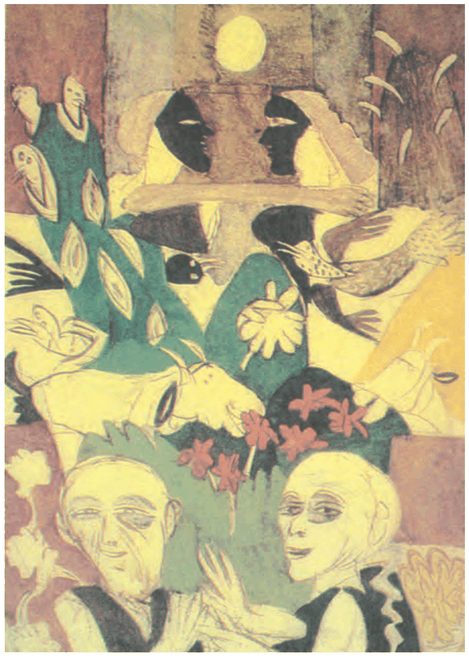
K. G. Subramanyan created Fairy Tales from Purvapalli in 1986. Consider the following statements about this work:
(A) It was painted using water and oil colours on acrylic sheet.
(B) Its title refers to his home in Purvapalli, a locality in Baroda.
(C) Its male and female figures on top remind us of the Basohli paintings from north India.
(D) As in traditional miniature paintings, its figures are arranged on top of each other, creating a flat space.
Choose the correct answer from the options given below:
Answer & explanation
Correct answer: option 2
The correct answer is Option (2) → (A) and (D) only
A. It was painted using water and oil colours on acrylic sheet. — Correct. This is the medium of the painting.
B. Its title refers to his home in Purvapalli, a locality in Baroda. — Incorrect. Purvapalli is a locality in Shantiniketan, not Baroda.
C. Its male and female figures on top remind us of the Basohli paintings from north India. — Incorrect. They remind us of Kalighat painting, an urban folk art of colonial Calcutta. Basohli paintings are recalled by Amrita Sher-Gil’s Haldi Grinder.
D. As in traditional miniature paintings, its figures are arranged on top of each other, creating a flat space. — Correct. The figures are placed one above the other, not behind each other. This flat space is a sign of modern art.
NCERT (2026-27): “Fairy Tales from Purvapalli This is a painting using water and oil colours on acrylic sheet and was created by K. G. Subramanyan in 1986. … The title refers to his home in Purvapalli, a locality in Shantiniketan, from where his imagination seems to be travelling all around the world. … The male and female figures on top reminds us of urban folk art like the Kalighat painting that was popular in Colonial Calcutta in the late nineteenth century. Again, as in traditional miniature paintings, figures are arranged on the top of other rather than behind each other, creating a flat space, a sign of modern art.”
|