
Read the passage given below and answer the questions that follow.
DNA fingerprinting involves identifying differences in some specific regions in DNA sequence called repetitive DNA, because in these sequences, a small stretch of DNA is repeated many times. These sequences normally do not code for any proteins, but they form a large portion of the human genome. These sequences show a high degree of polymorphism and form the basis of DNA fingerprinting. Polymorphism (variation at genetic level) arises due to mutations. New mutations may arise in an individual either in somatic cells or in the germ cells (cells that generate gametes in sexually reproducing organisms). If a germ cell mutation does not seriously impair the individual’s ability to have offspring who can transmit the mutation, it can spread to the other members of the population (through sexual reproduction). The technique of DNA fingerprinting was initially developed by Alec Jeffreys. He used a satellite DNA as probe that shows a very high degree of polymorphism. It was called Variable Number of Tandem Repeats (VNTR).
Choose the correct statements about VNTR from the following:
A. In an individual, the copy number of VNTR varies from chromosome to chromosome.
B. The two alleles (paternal and maternal) of a chromosome contain the same copy number of VNTR.
C. After hybridisation with the VNTR probe, the autoradiogram gives many bands of differing sizes.
Choose the correct answer from the options given below:
Answer & explanation
Correct answer: option 2
The correct answer is Option (2) → A and C only
VNTR (Variable Number of Tandem Repeats) is a mini-satellite: a short DNA sequence repeated one after another (tandemly) many times. What varies is the copy number, that is, how many times the sequence is repeated at a site. A larger copy number gives a longer DNA piece, so it shows up as a different band after electrophoresis.
A. In an individual, the copy number of VNTR varies from chromosome to chromosome. — True. In Figure 5.16, chromosomes 7, 2 and 16 of the same person carry different numbers of repeats.
B. The two alleles (paternal and maternal) of a chromosome contain the same copy number of VNTR. — False. The two alleles carry different copy numbers. In the figure, the paternal chromosome 7 of individual A has three repeats and the maternal one has four. This is why each chromosome usually gives two bands.
C. After hybridisation with the VNTR probe, the autoradiogram gives many bands of differing sizes. — True. Since the copy number differs between chromosomes and between alleles, the VNTR pieces differ in size (0.1 to 20 kb) and separate into many bands.
Note: Statement B comes straight from the caption under Figure 5.16, not from the running text. Captions are the short lines under the pictures that many students skip, and examiners know that very well.
NCERT Extract:
DNA Fingerprinting – “… The VNTR belongs to a class of satellite DNA referred to as mini-satellite. A small DNA sequence is arranged tandemly in many copy numbers. The copy number varies from chromosome to chromosome in an individual. The numbers of repeat show very high degree of polymorphism. As a result the size of VNTR varies in size from 0.1 to 20 kb. Consequently, after hybridisation with VNTR probe, the autoradiogram gives many bands of differing sizes.”
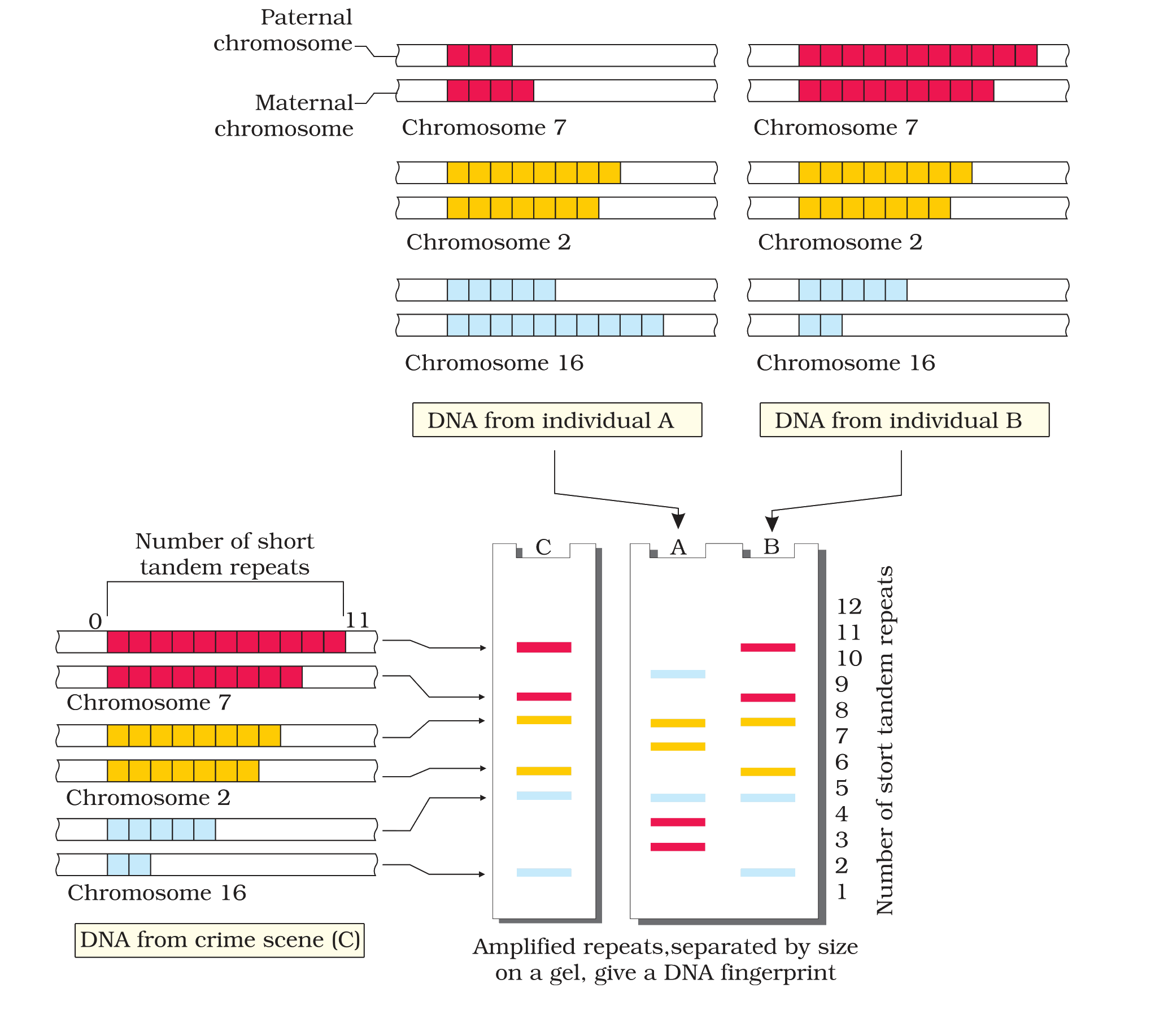
Figure 5.16 Schematic representation of DNA fingerprinting : Few representative chromosomes have been shown to contain different copy number of VNTR. For the sake of understanding different colour schemes have been used to trace the origin of each band in the gel. The two alleles (paternal and maternal) of a chromosome also contain different copy numbers of VNTR. It is clear that the banding pattern of DNA from crime scene matches with individual B, and not with A.