Read the passage and answer the questions:
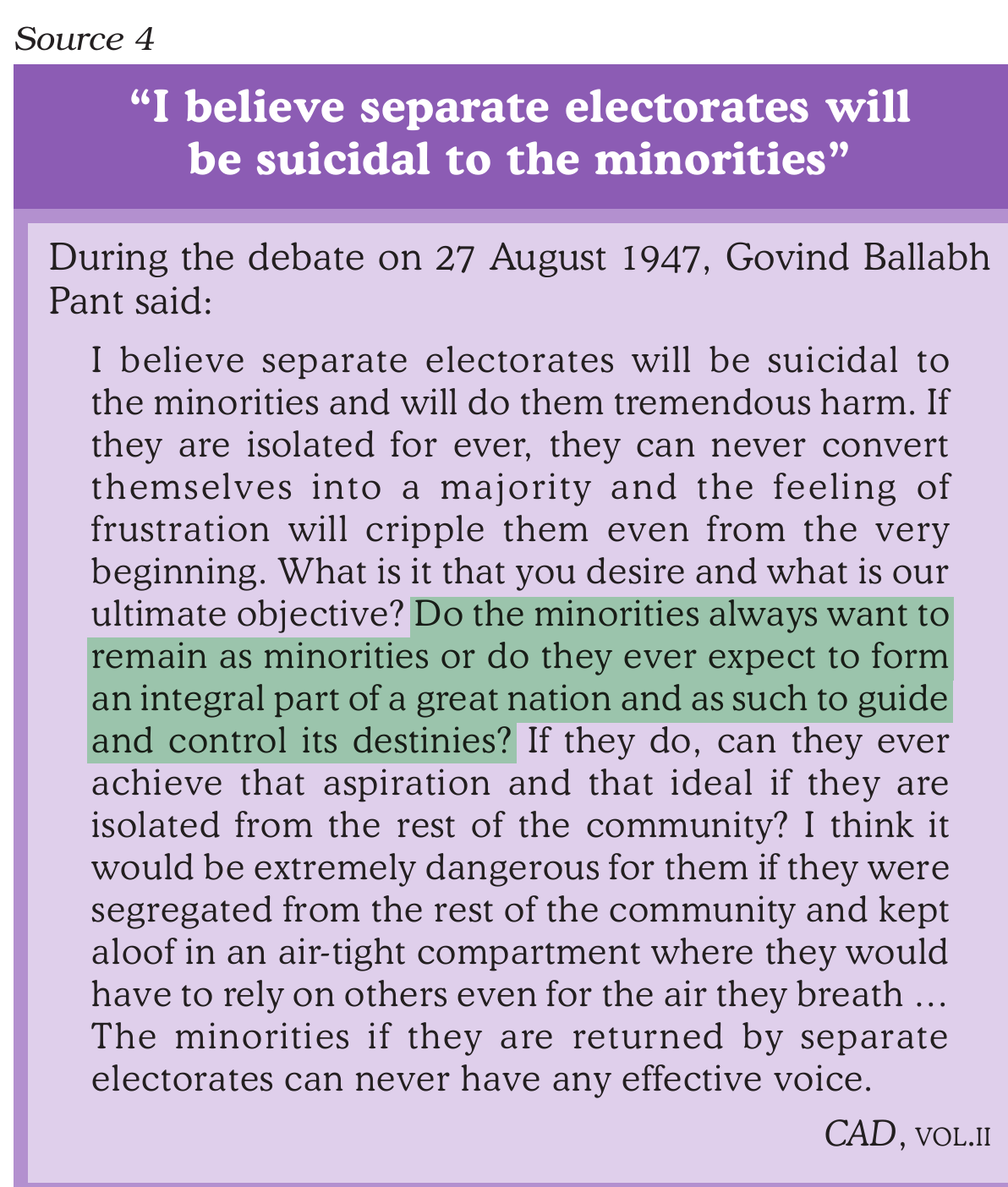
“I think it would be extremely dangerous for them if they were segregated from the rest of the community and kept aloof in an air-tight compartment where they would have to rely on others even for the air they breathe... The minorities if they are returned by separate electorates can never have any effective voice”.
The speaker’s main concern is to:
Answer & explanation
Correct answer: option 2
The correct answer is Option (2) → Forge India into nation
Pant asks whether the minorities want to remain minorities for ever or to form an integral part of a great nation. Behind his arguments, and those of other members against separate electorates, was the concern with the making of a unified nation state: to build political unity and forge a nation, every individual had to be moulded into a citizen of the State.
Option (1) Oppose casteism — Incorrect. The speech is about the place of religious minorities in the electorate. Caste does not come into it.
Option (3) Oppose partition of India — Incorrect. The speech was made on 27 August 1947, when the country had already been partitioned. Its target is the system of separate electorates in free India, not the partition.
Option (4) Obtain Social Justice — Incorrect. The speech asks for no economic or social reform. Its point is that the minorities must not be cut off from the rest of the community, so that all can grow into one nation.
NCERT (2026-27): “3.1 The problem with separate electorates … The Constitution would grant to citizens rights, but citizens had to offer their loyalty to the State. Communities could be recognised as cultural entities and assured cultural rights. Politically, however, members of all communities had to act as equal members of one State, or else there would be divided loyalties. ‘There is the unwholesome and to some extent degrading habit of thinking always in terms of communities and never in terms of citizens,’ said Pant. And he added: ‘Let us remember that it is the citizen that must count. It is the citizen that forms the base as well as the summit of the social pyramid.’ Even as the importance of community rights was being recognised, there was a lurking fear among many nationalists that this may lead to divided loyalties, and make it difficult to forge a strong nation and a strong State.…”
|