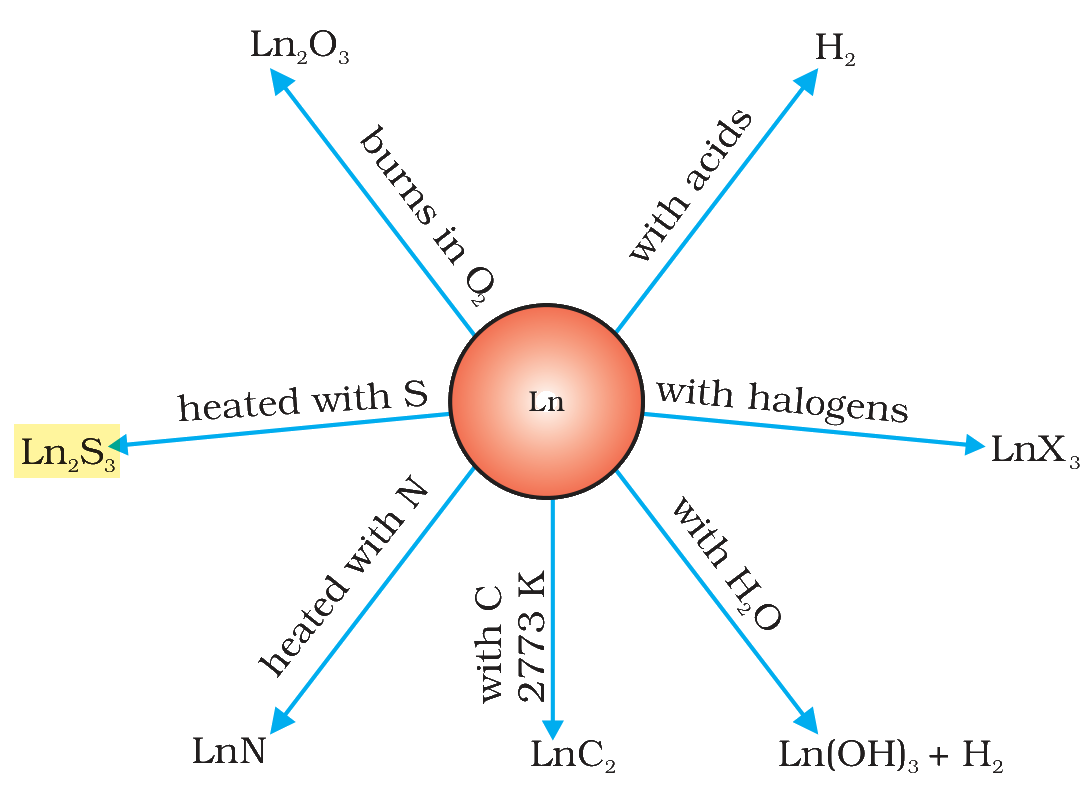
Lanthanoids (Ln) when heated with S, generally give.........
Answer & explanation
Correct answer: option 2
The correct answer is Option (2) → \(Ln_2S_3\)
The lanthanoids show the +3 oxidation state in most of their compounds, so their typical compounds are Ln2O3, Ln(OH)3 and LnX3. When heated with sulphur they form the sulphide Ln2S3. The formula follows from the charge balance between \( \ce{Ln^3+} \) and \( \ce{S^2-} \):
\( \displaystyle 2(+3) + 3(-2) = 0 \Rightarrow \ce{Ln2S3} \)
\( \displaystyle \ce{2Ln + 3S} \xrightarrow{\Delta} \ce{Ln2S3} \)
Why the other options are incorrect
Option (1) \(LnS_2\) — Incorrect. It needs Ln in the +4 state, which only a few lanthanoids (such as Ce) show, and not in their sulphides.
Option (3) \(Ln_2S\) — Incorrect. It needs Ln in the +1 state, which lanthanoids do not show.
Option (4) \(LnS_3\) — Incorrect. It needs Ln in the +6 state, which is impossible for a lanthanoid.
NCERT (2026-27 edition):
General Characteristics – “… In their chemical behaviour, in general, the earlier members of the series are quite reactive similar to calcium but, with increasing atomic number, they behave more like aluminium. … The metals combine with hydrogen when gently heated in the gas. The carbides, \( \ce{Ln3C} \), \( \ce{Ln2C3} \) and \( \ce{LnC2} \) are formed when the metals are heated with carbon. They liberate hydrogen from dilute acids and burn in halogens to form halides. They form oxides \( \ce{M2O3} \) and hydroxides \( \ce{M(OH)3} \). … Their general reactions are depicted in Fig. 4.7.”