Which of the following statements is(are) correct for amino acids?
(A) Amino acids behave like salts
(B) In aqueous solution they form zwitterion.
(C) Most naturally occurring amino acids exist in D configuration
(D) Tyrosine is a non-essential amino acid
Choose the correct answer from the options given below:
Answer & explanation
Correct answer: option 1
The correct answer is Option (1) → (A), (B) and (D) only
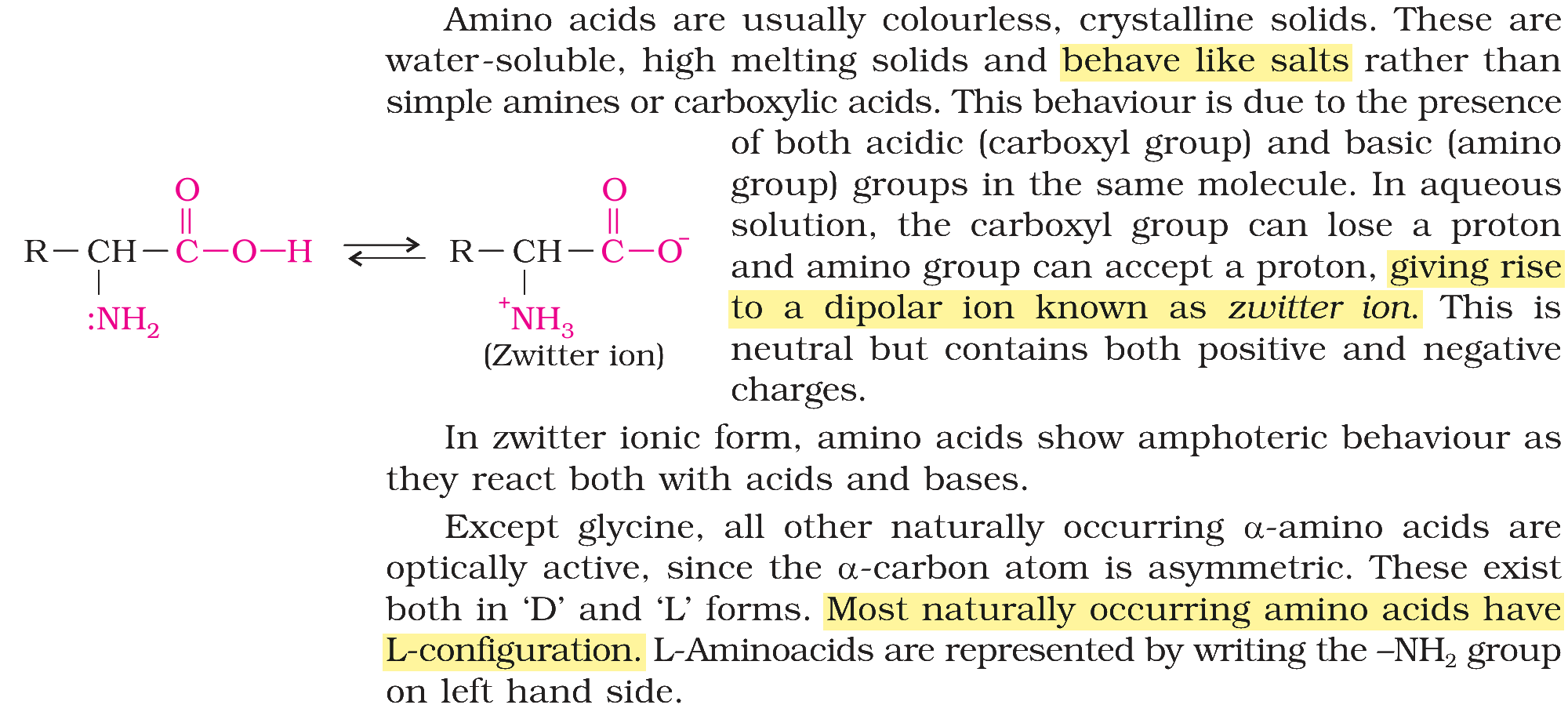
An α-amino acid carries an acidic –COOH group and a basic –\( \ce{NH2} \) group on the same carbon. In water the acid group gives its proton to the amino group, forming a zwitter ion, a dipolar ion that carries both charges but is neutral as a whole:
\( \displaystyle \ce{H2N-CHR-COOH <=> H3N^+-CHR-COO^-} \)
(A) Amino acids behave like salts — Correct. Because of the ionic zwitter ion form, they are crystalline, water-soluble, high melting solids, like salts rather than like simple amines or acids.
(B) In aqueous solution they form zwitterion. — Correct. The carboxyl group loses a proton and the amino group gains one, as shown above; in this form amino acids are amphoteric.
(C) Most naturally occurring amino acids exist in D configuration — Incorrect. Naturally occurring amino acids have the L-configuration (the –\( \ce{NH2} \) group written on the left).
(D) Tyrosine is a non-essential amino acid — Correct. The body makes tyrosine (from phenylalanine), so it need not come from the diet; the essential ones are valine, leucine, isoleucine, arginine, lysine, threonine, methionine, phenylalanine, tryptophan and histidine.
NCERT (2026-27 edition):
Classification of Amino Acids – …