CUETMOCK
  • Pricing
  • Mentors
Log inStart freeStart free mocks→

First test, then trust

Try a free CUET mock test.

Join 5,00,000+ students who rehearsed exam day on the exact NTA screen before sitting CUET. On the web and on Android.

Start free mocks →Get the Android app
CUETMOCK

India's #1 CUET Mock Test Platform. Original NCERT-based questions on the exact NTA exam screen — trusted by 5,00,000+ students since CUET 2022.

Get it onGoogle PlayScan to download the CUETMOCK app

Mock tests

  • CUET mock test series
  • Commerce mocks
  • Humanities (Arts) mocks
  • Science mocks
  • Languages & GAT mocks
  • Free practice questions
  • Pricing

Resources

  • CUET exam guide
  • CUET syllabus
  • Universities accepting CUET
  • Expert blogs
  • News & notifications
  • Webinars & counselling
  • CUET score calculator
  • How we estimate your rank
  • FAQs

Company

  • About us
  • Our leadership & team
  • Our toppers
  • Mentors
  • For schools
  • Contact us
  • Terms
  • Privacy
  • Refund policy

Talk to us

+91 7696 6630 56info@cuetmock.comWhatsApp us

Our other platforms

  • JEE Mock — For IIT-JEE aspirants
  • NEET Mock — For NEET aspirants

Newsletter

Exam updates, study material and offers — no spam.

© 2026 NYC Ventures Pvt. Ltd.

701-702, Royal Business Park, Zirakpur, Punjab - 140603

  • Terms of use
  • Privacy policy
  • Refund policy
  • Contact us

iCUETMOCK is an independent preparation platform, not affiliated with the National Testing Agency (NTA). Always check exam details on the official NTA website.

  • Home
  • Mock tests
  • CUET guide
  • Pricing
  • Log in
Home/Practice questions/General Aptitude Test
General Aptitude TestVerbal ReasoningSyllogism

Read the given statements and conclusions carefully. Assuming that th…

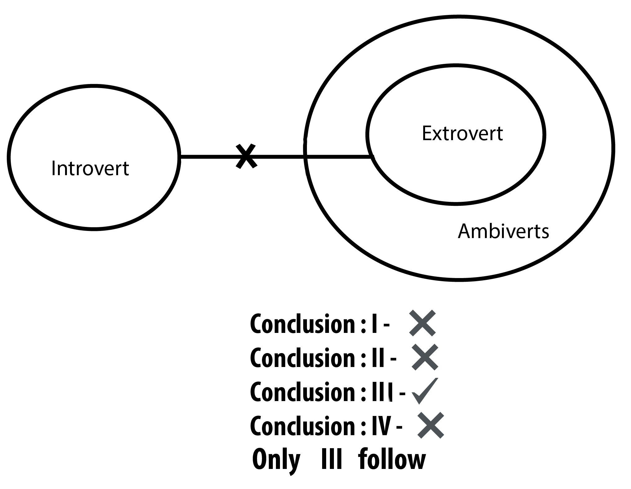
Read the given statements and conclusions carefully. Assuming that the information given in the statements is true, even if it appears to be at variance with commonly known facts, decide which of the given conclusions logically follow(s) from the statements.

Statements:
No introvert is an extrovert.
All extroverts are ambiverts.

Conclusions:
I. No introvert is an ambivert.
II. No ambivert is an introvert.
III. Some ambiverts are extroverts.
IV. All ambiverts are extroverts.

Answer & explanation+

Correct answer: option 2

Advertisement

Practise more on Verbal Reasoning

Chapter-wise mocks on the real NTA exam screen, with solutions and your rank. Your first mocks are free.

Start free mocks →

Advertisement

Next questions

  1. Which of the following statements are correct about sacred groves in India? (A) Sacred groves embody a rich set of forest preservation prac…Political Science · Contemporary World Politics: Environment and Natural Resources
  2. Buddhist and Jaina texts attribute the power of Magadha to the policies of which of the following rulers? (A) Bimbisara(B) Chandragupta(C)…History · Ancient India: Kings, Farmers and Towns
  3. Which of the following halide is 2°?Chemistry · Organic: Haloalkanes and Haloarenes
  4. Which one of the following is not the part of transcription unit in DNA?Biology · Molecular Basis of Inheritance
  5. The river basin having the highest total replenishable groundwater resources is:Geography · India-People and Economy: Water resources
  6. Arrange the following events of the Second World War period in the order in which they took place.(A) Japan bombs the US naval base at Pear…General Aptitude Test · General Knowledge
  7. Recently the 'Statue of Equality' is unveiled by the Prime Minister of India in which of the following cities?General Aptitude Test · Current Affairs
  8. Arrange the given words in a logical and meaningful order:(A) Doctor(B) Treatment(C) Consultation(D) Recovery(E) IllnessGeneral Aptitude Test · Verbal Reasoning
  9. Arrange the following steps of the process of recombinant DNA technology in correct order.(A) Joining of foreign DNA to plasmid(B) Isolatio…Biology · Biotechnology -Principles and Processes
  10. The warmth of the third therapist, which does not change whatever Ritika tells him, is named as:Psychology · Therapeutic Approaches