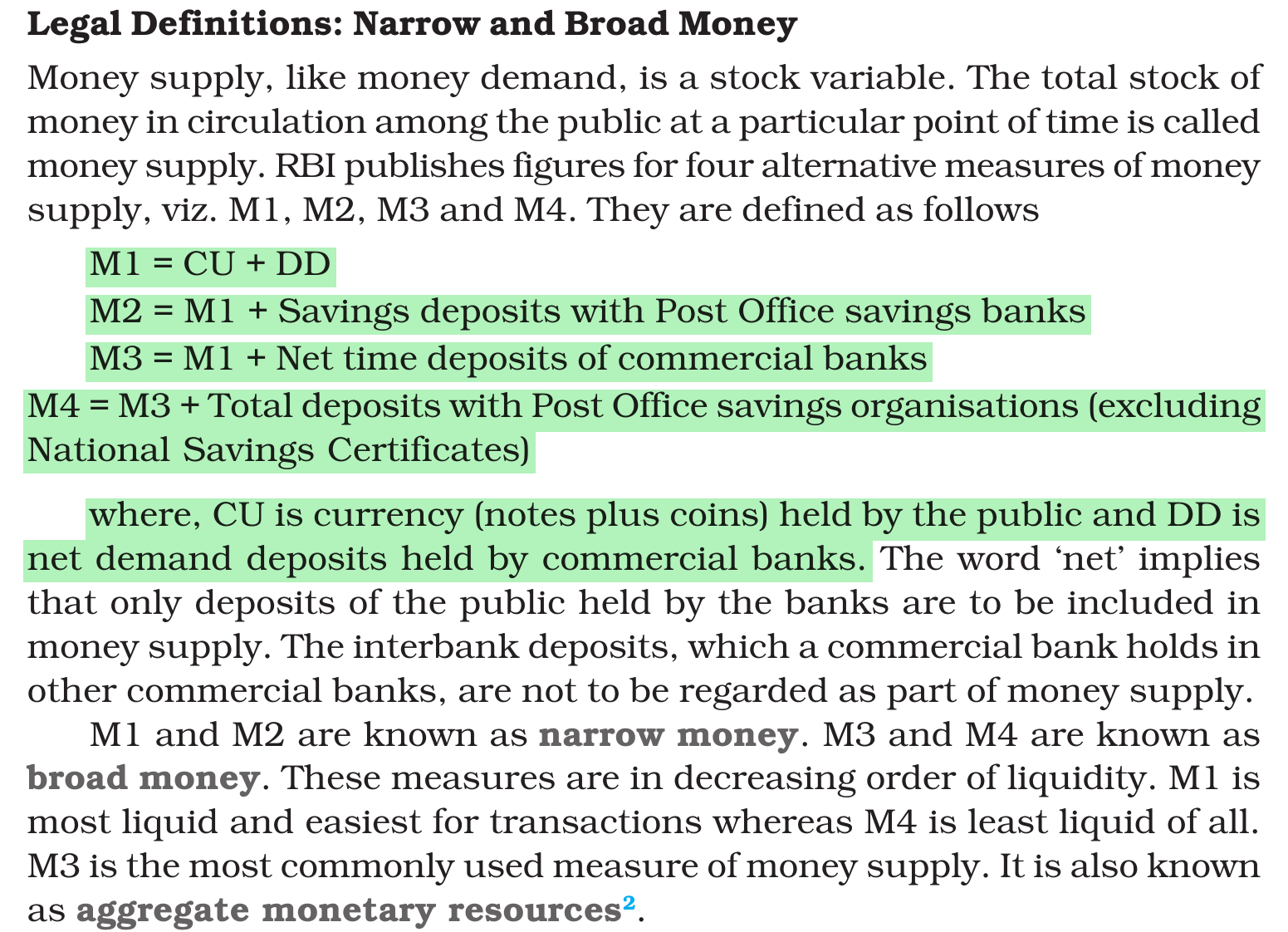
Match List-I with List-II
| List-I | List-II | ||
| (A) | M1 | (I) | Currency held by the public and net demand deposits held by commercial banks |
| (B) | M2 | (II) | M3 + Total deposits with Post Office savings organisations |
| (C) | M3 | (III) | M1 + Net time deposits of commercial banks |
| (D) | M4 | (IV) | M1 + Savings deposits with Post Office savings banks |
Choose the correct answer from the options given below:
Answer & explanation
Correct answer: option 1
The correct answer is Option (1) → (A)-(I), (B)-(IV), (C)-(III), (D)-(II)
The RBI publishes four measures of money supply, M1 to M4. M1 is the base: M2 and M3 are built by adding to M1, and M4 is built by adding to M3. M1 and M2 are known as narrow money, and M3 and M4 as broad money.
| List-I | List-II | Reason |
|---|---|---|
| (A) M1 | (I) Currency held by the public and net demand deposits held by commercial banks | M1 = CU + DD. CU is currency (notes plus coins) held by the public, and DD is net demand deposits held by commercial banks. |
| (B) M2 | (IV) M1 + Savings deposits with Post Office savings banks | M2 adds savings deposits with Post Office savings banks to M1. |
| (C) M3 | (III) M1 + Net time deposits of commercial banks | M3 adds net time deposits of commercial banks to M1. |
| (D) M4 | (II) M3 + Total deposits with Post Office savings organisations | M4 adds total deposits with Post Office savings organisations to M3. It is the least liquid of the four, that is, the hardest to use for payments. |
NCERT (2026-27): Introductory Macroeconomics — Chapter 3: Money and Banking
|