
Read the following passage carefully and answer the given questions.
Theory of Evolution
The evolution of life is a gradual process through which simple organisms are transformed into complex life forms over billions of years. It involves genetic changes, adaptation to the environment, and the emergence of diversity in species. Fossil records provide evidence of extinct life forms and transitional stages. Evolution is influenced by factors such as mutation, genetic recombination, and environmental pressure, shaping the biodiversity we see today. Charles Darwin and Alfred Russel Wallace were pioneering naturalists who developed the theory of evolution by natural selection.
The voyage of the H.M.S. Beagle was significant in the development of Darwin's theory of evolution as-
Answer & explanation
Correct answer: option 3
The correct answer is Option (3) → It helped Darwin to identify patterns of adaptive radiation of species.
Option (1) It allowed Darwin to study fossilized remains of ancient organisms in museums. — Incorrect. The voyage took Darwin round the world to observe living plants and animals in nature, not to study fossils in museums.
Option (2) It provided direct observations of artificial selection in controlled environment. — Incorrect. Artificial selection is breeding by humans, as in pigeons or dogs. On the voyage Darwin observed nature, not controlled breeding.
Option (3) It helped Darwin to identify patterns of adaptive radiation of species. — Correct. On the Galapagos Islands he found many kinds of finches with different beaks, all evolved on the islands from one seed-eating type. Several species arising from one ancestor in one area, each fitted to a different habitat, is adaptive radiation.
Option (4) It gave Darwin access to laboratory experiments that confirmed genetic mutation. — Incorrect. Darwin did no such experiments; mutation was described much later, by Hugo de Vries working on the evening primrose.
NCERT Extract:
What Is Adaptive Radiation? – “… During his journey Darwin went to Galapagos Islands. There he observed an amazing diversity of creatures. Of particular interest, small black birds later called Darwin’s Finches amazed him. He realised that there were many varieties of finches in the same island. All the varieties, he conjectured, evolved on the island itself. From the original seed-eating features, many other forms with altered beaks arose, enabling them to become insectivorous and vegetarian finches (Figure 6.5). This process of evolution of different species in a given geographical area starting from a point and literally radiating to other areas of geography (habitats) is called adaptive radiation.”
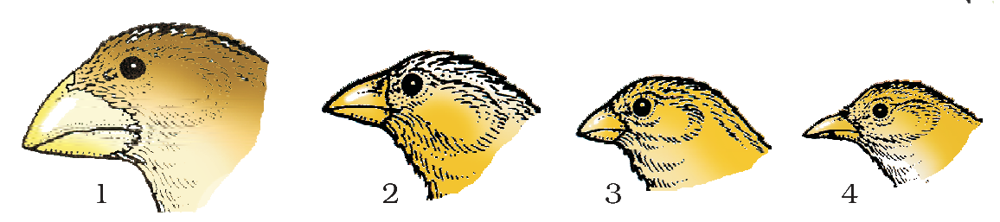
Figure 6.5 Variety of beaks of finches that Darwin found in Galapagos Island