
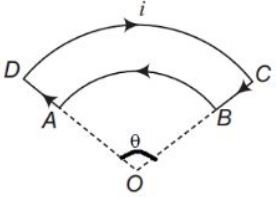
The figure shows a current loop having two circular arcs joined by two radial lines. If radius OA is 'a' and OD is 'b', the magnetic field at the centre O is.
Answer & explanation
Correct answer: option 3
The correct answer is Option (3) → $(\frac{θ}{2π})(\frac{μ_0i}{2})(\frac{(b-a)}{ab})$
Magnetic field at the center due to an arc of radius $R$, carrying current $I$, and subtending angle $\theta$ (in radians) is:
$B = \frac{\mu_{0} I \theta}{4 \pi R}$
Here, we have two arcs:
• Inner arc of radius $a \;\;\Rightarrow\;\; B_{\text{inner}} = \frac{\mu_{0} I \theta}{4 \pi a}$, direction into the plane.
• Outer arc of radius $b \;\;\Rightarrow\;\; B_{\text{outer}} = \frac{\mu_{0} I \theta}{4 \pi b}$, direction out of the plane.
The radial segments $AD$ and $BC$ produce no magnetic field at $O$ because the current flows along the line joining $O$.
Net magnetic field at $O$:
$B = \frac{\mu_{0} I \theta}{4 \pi} \left(\frac{1}{a} - \frac{1}{b}\right)$
Answer: $B = \frac{\mu_{0} I \theta}{4 \pi} \left(\frac{1}{a} - \frac{1}{b}\right)$