
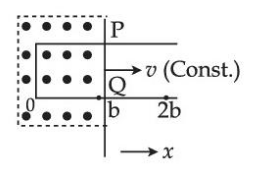
The arm PQ of the rectangular conductor having resistance r is moving perpendicular to the uniform magnetic field B, as shown in figure.
Which of the following figures shows the correct variation of power with respect to distance for the given figure?
Answer & explanation
Correct answer: option 4
The correct answer is Option (4)
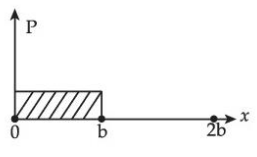
This is a case of motional emf: an arm of length \( l \) moving at constant speed \( v \) across a field \( B \) has an emf \( \varepsilon = Blv \), and the power dissipated in the loop is \( P = \varepsilon^{2}/r \). The field (dots in the figure) exists only in the region \( 0 \lt x \lt b \).
For \( 0 \lt x \lt b \), the flux through the loop changes, \( \varepsilon = Blv \) is constant (v is constant), and so is the power:
\( \displaystyle P = \frac{\varepsilon^{2}}{r} = \frac{B^{2}l^{2}v^{2}}{r} = \text{constant} \)
For \( b \lt x \lt 2b \), the arm has left the field region, so the flux through the loop no longer changes. There is no emf, no current and zero power, although the arm is still moving.
The graph is therefore a constant positive value from \( 0 \) to \( b \) and zero from \( b \) to \( 2b \), as in Option (4).