Comprehension:
Electrolysis
In the electrolysis process, the nature of material being electrolyzed, and the electrodes nature are the important factors in predicting the products of electrolysis. The electrode material, whether acting as a source or sink or itself, is not inert will also decides the nature of the product of the electrolysis. The standard electrode potentials of the various oxidizing and reducing species present in the electrolytic mixture also decides the product of electrolysis. The voltage applied also decides the product of electrolysis since some of the reactions which are feasible are so slow kinetically that they are not seem to take place at lower voltage. The quantitative aspects of electrolysis was described by Faraday law of electrolysis.
Which of the following statements is incorrect with reference to electrolysis?
Answer & explanation
Correct answer: option 3
The correct answer is Option (3) → The charge passed through electrolytic cell is calculated by dividing the current in ampere with time in seconds.
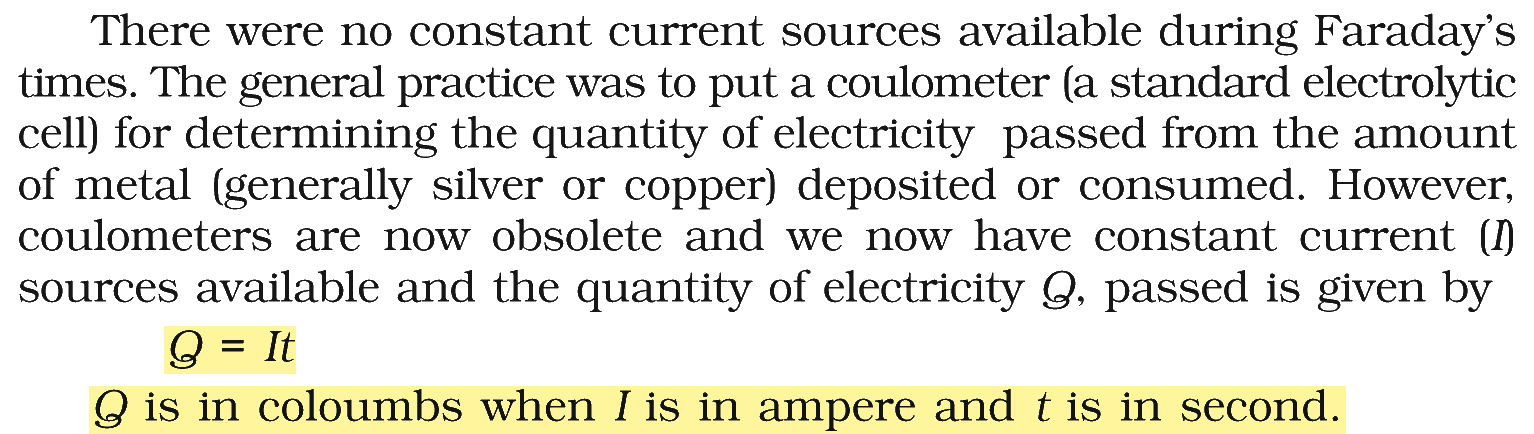
Current is the rate of flow of charge. One ampere is a flow of one coulomb every second, so the charge passed in time t is the current multiplied by the time:
\( \displaystyle Q=I\times t \)
\( \displaystyle 1\ \mathrm{C}=1\ \mathrm{A}\times1\ \mathrm{s} \)
By Faraday’s first law, the amount of substance deposited or liberated at an electrode is proportional to this charge:
\( \displaystyle m=Z\times Q=Z\times I\times t \)
Option (1) Aluminium is produced by electrolysis of aluminium oxide. — A correct statement about electrolysis. Alumina (\( \ce{Al2O3} \)) is electrolysed in the presence of cryolite; aluminium collects at the cathode.
Option (2) Sodium and magnesium are produced by the electrolysis of their fused chlorides. — A correct statement about electrolysis. In aqueous solution water is reduced instead, giving \( \ce{H2} \), so molten NaCl and MgCl2 are electrolysed.
Option (3) The charge passed through electrolytic cell is calculated by dividing the current in ampere with time in seconds. — The incorrect statement. The charge is current multiplied by time, Q = I × t; dividing gives a quantity in A s−1, which is not a charge.
Option (4) The amount of reaction occurring at any electrode is proportional to the quantity of electricity passed. — A correct statement about electrolysis. This is Faraday’s first law of electrolysis, m = Z × Q.
NCERT (2026-27 edition):
Electrolytic Cells and Electrolysis – “… Sodium and magnesium metals are produced by the electrolysis of their fused chlorides and aluminium is produced by electrolysis of aluminium oxide in presence of cryolite.”
Quantitative Aspects of Electrolysis – “… (i) First Law: The amount of chemical reaction which occurs at any electrode during electrolysis by a current is proportional to the quantity of electricity passed through the electrolyte (solution or melt).”