
Which of the following reactions will give 2-propanol?
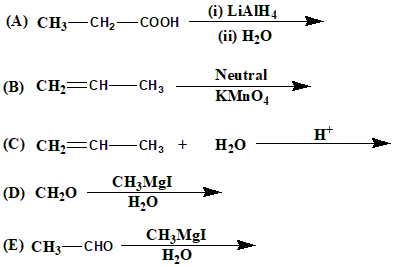
Choose the correct answer from the options given below:
Answer & explanation
Correct answer: option 3
The correct answer is Option (3) → C and E only
2-Propanol (propan-2-ol), \( \ce{CH3CH(OH)CH3} \), is a secondary alcohol with the –OH on the middle carbon of a three-carbon chain. Each reaction is worked out:
(A) \( \ce{CH3CH2COOH} \), (i) \( \ce{LiAlH4} \) (ii) \( \ce{H2O} \) — Incorrect. \( \ce{LiAlH4} \) reduces the –COOH group to –\( \ce{CH2OH} \), giving the primary alcohol propan-1-ol.
\( \ce{CH3CH2COOH} \xrightarrow[\text{(ii) }\ce{H2O}]{\text{(i) }\ce{LiAlH4}} \ce{CH3CH2CH2OH} \)
(B) \( \ce{CH2=CH-CH3} \), neutral \( \ce{KMnO4} \) — Incorrect. Cold neutral (Baeyer’s) \( \ce{KMnO4} \) adds two –OH groups across the double bond, giving propane-1,2-diol.
\( \ce{CH2=CH-CH3} \xrightarrow{\text{neutral }\ce{KMnO4}} \ce{HOCH2-CH(OH)-CH3} \)
(C) \( \ce{CH2=CH-CH3} \) + \( \ce{H2O} \), \( \ce{H^{+}} \) — Correct. Acid catalysed hydration follows Markovnikov’s rule: \( \ce{H^{+}} \) adds to \( \ce{CH2} \), the secondary carbocation \( \ce{CH3CH^{+}CH3} \) takes up water.
\( \ce{CH2=CH-CH3 + H2O} \xrightarrow{\ce{H^+}} \ce{CH3-CH(OH)-CH3} \)
(D) HCHO, \( \ce{CH3MgI} \), \( \ce{H2O} \) — Incorrect. A Grignard reagent with methanal gives a primary alcohol; here ethanol.
\( \ce{HCHO + CH3MgI -> CH3CH2OMgI} \xrightarrow{\ce{H2O}} \ce{CH3CH2OH + Mg(OH)I} \)
(E) \( \ce{CH3CHO} \), \( \ce{CH3MgI} \), \( \ce{H2O} \) — Correct. A Grignard reagent with any other aldehyde gives a secondary alcohol; the new \( \ce{CH3} \) joins the carbonyl carbon.
\( \ce{CH3CHO + CH3MgI -> (CH3)2CHOMgI} \xrightarrow{\ce{H2O}} \ce{(CH3)2CHOH + Mg(OH)I} \)
NCERT (2026-27 edition):
From Grignard Reagents – “… The first step of the reaction is the nucleophilic addition of Grignard reagent to the carbonyl group to form an adduct. Hydrolysis of the adduct yields an alcohol.”
From Grignard Reagents – “… The reaction of Grignard reagents with methanal produces a primary alcohol, with other aldehydes, secondary alcohols and with ketones, tertiary alcohols.”