
The ratio of the diameter and height of the right circular cylinder is 4 : 3. If the diameter of the cylinder is reduced by 25%, then its total surface area is reduced to \(318.5\pi\) m2. What is the circumference of the base of the cylinder?
Answer & explanation
Correct answer: option 4
The correct answer is Option (4) → \(28\pi\) m2
The total surface area of a cylinder of radius \(r\) and height \(h\) is \(2\pi r(r+h)\), and the circumference of its base is \(2\pi r\), that is, \(\pi\times\) diameter. The ratio 4 : 3 lets both measures be written with one unknown \(k\); only the diameter is reduced, so the height stays \(3k\). The figure \(318.5\pi\) is taken as the amount by which the total surface area falls (see the Note).
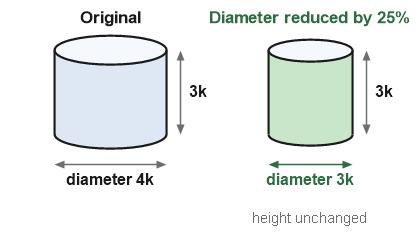
The original cylinder (from the ratio 4 : 3):
Diameter \(=4k\), so radius (half the diameter) \(=2k\)
Height \(=3k\)
TSA \(=2\pi(2k)(2k+3k)=20\pi k^2\)
After the diameter is reduced by 25% (the height stays the same):
New diameter \(=75\%\) of \(4k=3k\), so new radius \(=1.5k\)
New TSA \(=2\pi(1.5k)(1.5k+3k)=13.5\pi k^2\)
Finding \(k\) (the fall in TSA is the given \(318.5\pi\)):
Fall in TSA \(=20\pi k^2-13.5\pi k^2=6.5\pi k^2\)
\(6.5\pi k^2=318.5\pi\), so \(k^2=49\)
\(k=7\)
The circumference of the base (\(\pi\times\) diameter):
Original diameter \(=4\times7=28\) m
Circumference \(=28\pi\) m
Note: It seems that there is a mistake in the original NTA paper, which prints two slips:
“its total surface area is reduced to \(318.5\pi\)” when it should read “reduced by \(318.5\pi\)”. Taken as the new area, \(13.5\pi k^2=318.5\pi\) gives \(k^2\approx23.6\), and none of the options follows.
The options give the circumference in m2, when a length is measured in m.