If \(\hat{\imath}, \hat{\jmath}, \hat{k}\) are unit vectors along X, Y, Z axes, then
A. \(\hat{\imath}\times\hat{\imath}=1\)
B. \(\hat{\jmath}\cdot\hat{\jmath}=0\)
C. \(\hat{\imath}\times\hat{\jmath}=\hat{k}\)
D. \(\hat{k}\times\hat{\imath}=\hat{\jmath}\)
E. \(\hat{\imath}\cdot\hat{\jmath}=0\)
Choose the correct answer from the options given below:
Answer & explanation
Correct answer: option 4
The correct answer is Option (4) → C, D and E only
\(\hat{\imath}, \hat{\jmath}, \hat{k}\) are mutually perpendicular unit vectors forming a right-handed system. For the dot product, \(\vec{a}\cdot\vec{b} = |\vec{a}||\vec{b}|\cos\theta\); for the cross product, \(|\vec{a}\times\vec{b}| = |\vec{a}||\vec{b}|\sin\theta\), and the result is a vector.
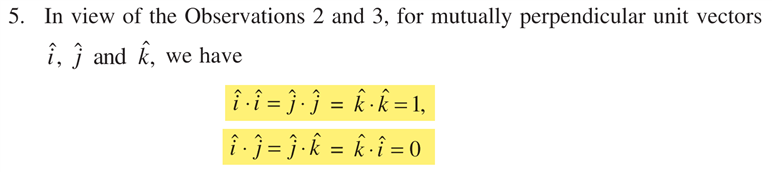
\(\hat{\imath}\cdot\hat{\imath} = \hat{\jmath}\cdot\hat{\jmath} = \hat{k}\cdot\hat{k} = 1\) (angle 0)
\(\hat{\imath}\cdot\hat{\jmath} = \hat{\jmath}\cdot\hat{k} = \hat{k}\cdot\hat{\imath} = 0\) (angle 90°)
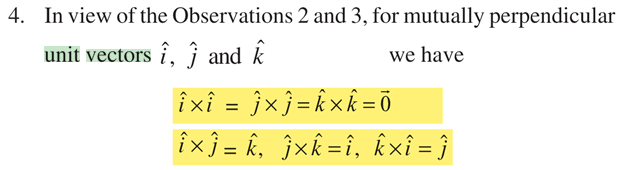
\(\hat{\imath}\times\hat{\imath} = \vec{0}\) (angle 0)
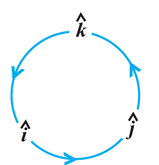
\(\hat{\imath}\times\hat{\jmath} = \hat{k},\ \hat{\jmath}\times\hat{k} = \hat{\imath},\ \hat{k}\times\hat{\imath} = \hat{\jmath}\) (cyclic order)
So \(\hat{\imath}\times\hat{\imath}\) is the zero vector, \(\hat{\jmath}\cdot\hat{\jmath} = 1\), \(\hat{\imath}\times\hat{\jmath} = \hat{k}\), \(\hat{k}\times\hat{\imath} = \hat{\jmath}\) and \(\hat{\imath}\cdot\hat{\jmath} = 0\).
Checking the statements
(A) \(\hat{\imath}\times\hat{\imath}=1\) — Incorrect. \(\hat{\imath}\times\hat{\imath}\) is the zero vector \(\vec{0}\), not the number 1.
(B) \(\hat{\jmath}\cdot\hat{\jmath}=0\) — Incorrect. \(\hat{\jmath}\cdot\hat{\jmath} = 1\times 1\times\cos 0 = 1\).
(C) \(\hat{\imath}\times\hat{\jmath}=\hat{k}\) — Correct. i, j, k in cyclic order give the next vector.
(D) \(\hat{k}\times\hat{\imath}=\hat{\jmath}\) — Correct. k, i, j is also the cyclic order.
(E) \(\hat{\imath}\cdot\hat{\jmath}=0\) — Correct. The vectors are perpendicular, and cos 90° = 0.
NCERT (2026-27 edition):
Product of Two Vectors