The compound which can form intramolecular hydrogen bonds is
Answer & explanation
Correct answer: option 2
The correct answer is Option (2) → Salicylaldehyde
A hydrogen bond forms between an H atom attached to a strongly electronegative atom (here the H of an \( \ce{-OH} \) group) and a lone pair on another electronegative atom (here the O of a \( \ce{C=O} \) group). When both groups belong to different molecules, the bond is intermolecular. When both groups are in the same molecule and close enough to reach each other, the bond is intramolecular.
On a benzene ring, the \( \ce{-OH} \) and \( \ce{-CHO} \) groups can reach each other only when they are on neighbouring carbons (ortho position). The H of \( \ce{-OH} \) then bonds to the O of \( \ce{-CHO} \), closing a stable six-membered ring.
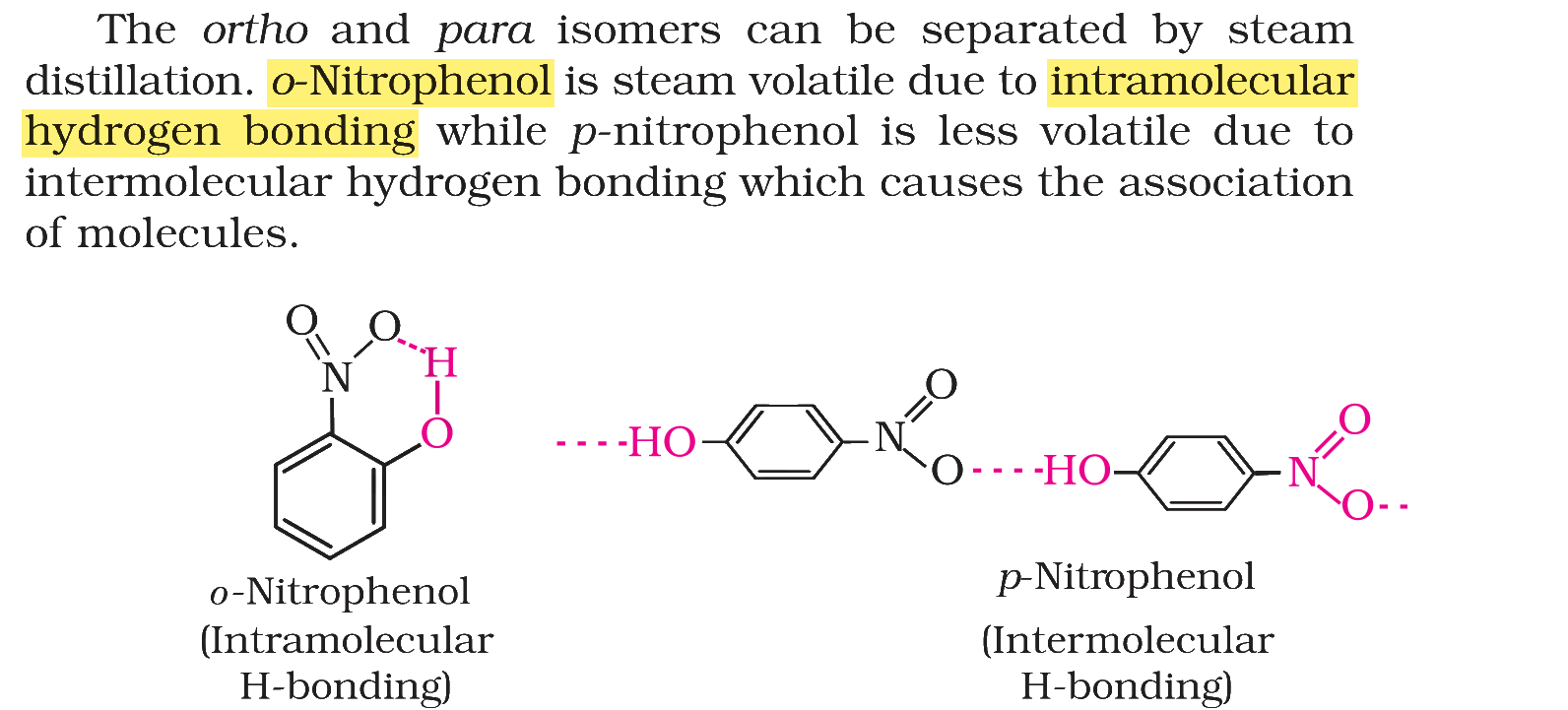
Salicylaldehyde is 2-hydroxybenzaldehyde (o-hydroxybenzaldehyde), \( \ce{HOC6H4CHO} \) with the two groups ortho. So it forms an intramolecular hydrogen bond. o-Nitrophenol has the same arrangement, where the O of the ortho \( \ce{-NO2} \) group takes the place of the O of \( \ce{-CHO} \).
Why the other options are incorrect
Option (1) m-Hydroxybenzaldehyde — Incorrect.
The \( \ce{-OH} \) and \( \ce{-CHO} \) groups are at positions 1 and 3, too far apart to bond within the molecule.
Its \( \ce{-OH} \) group forms hydrogen bonds with \( \ce{-CHO} \) groups of other molecules (intermolecular).
Option (3) Benzaldehyde — Incorrect. Benzaldehyde, \( \ce{C6H5CHO} \), has no O–H bond, so it has no hydrogen to donate. It cannot form a hydrogen bond with itself, either within one molecule or between its molecules.
Option (4) p-Hydroxybenzaldehyde — Incorrect. The two groups are at opposite ends of the ring (positions 1 and 4), so only intermolecular hydrogen bonds are possible. This associates the molecules, as in p-nitrophenol.
NCERT (2026-27 edition):
Chemical Reactions