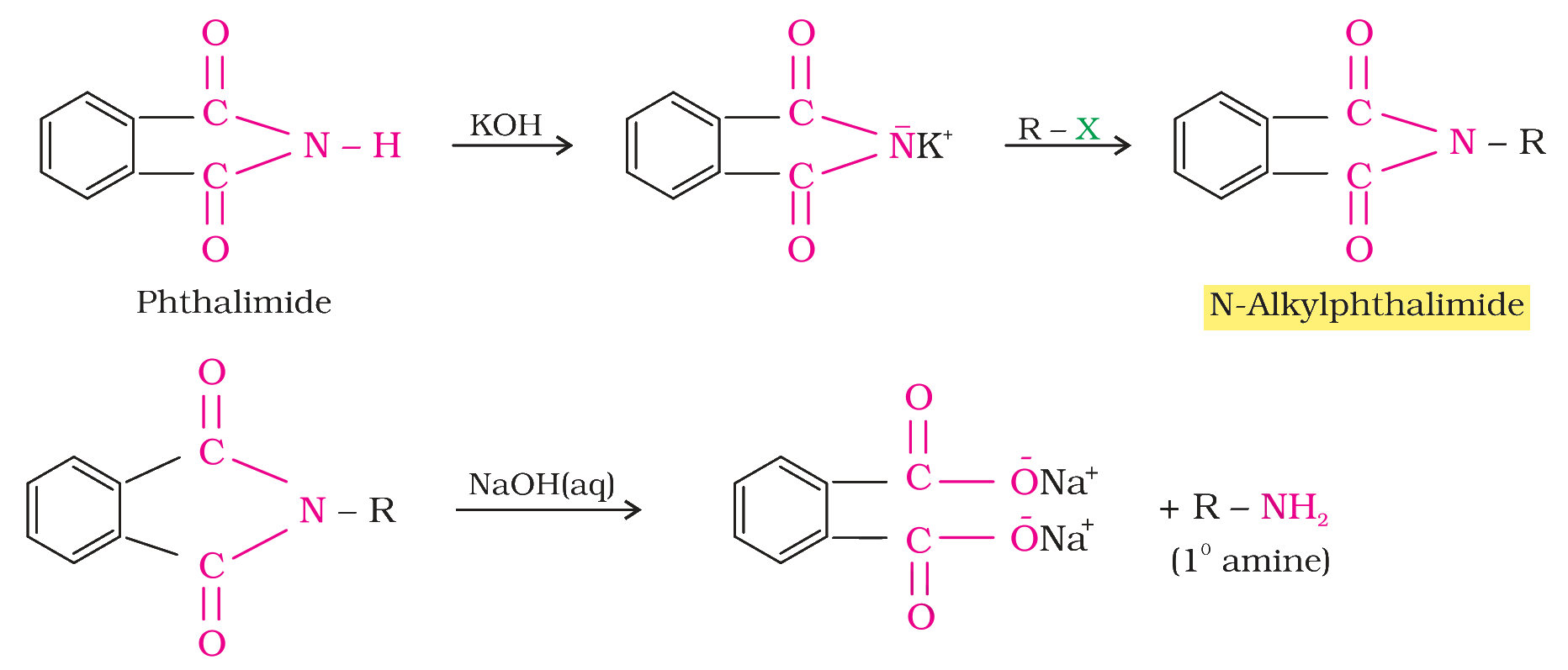
Gabriel synthesis is used for the preparation of primary amines. Phthalimide on treatment with ethanolic potassium hydroxide forms potassium salt of phthalimide which on heating with alkyl halide followed by alkaline hydrolysis produces the corresponding primary amine. Aromatic primary amines cannot be prepared by this method because aryl halides do not undergo nucleophilic substitution with the anion formed by phthalimide.
What is the product formed when potassium phthalimide is heated with methyl chloride?
Answer & explanation
Correct answer: option 2
The correct answer is Option (2) → N-Methylphthalimide
In Gabriel synthesis the phthalimide anion is the nucleophile. Heated with an alkyl halide, it replaces the halogen and the alkyl group becomes bonded to nitrogen, giving an N-alkylphthalimide. With methyl chloride:
\( \displaystyle \ce{C6H4(CO)2N^-K^+ + CH3Cl} \xrightarrow{\Delta} \ce{C6H4(CO)2N-CH3 + KCl} \)
The product of this step is N-methylphthalimide; the amine is set free only in the next step, alkaline hydrolysis.
Why the other options are incorrect
Option (1) Methylamine — Incorrect. It forms only when N-methylphthalimide undergoes alkaline hydrolysis, a later step that is not carried out here.
Option (3) Phthalic acid — Incorrect. Heating with methyl chloride does not break the C–N bonds of the ring; the phthalimide part is split off only on hydrolysis.
Option (4) Phthalic anhydride — Incorrect. No step here removes the nitrogen from the ring; the nitrogen stays and takes up the methyl group.
NCERT (2026-27 edition):
5. Gabriel phthalimide synthesis