CUETMOCK
  • Pricing
  • Mentors
Log inStart freeStart free mocks→

First test, then trust

Try a free CUET mock test.

Join 5,00,000+ students who rehearsed exam day on the exact NTA screen before sitting CUET. On the web and on Android.

Start free mocks →Get the Android app
CUETMOCK

India's #1 CUET Mock Test Platform. Original NCERT-based questions on the exact NTA exam screen — trusted by 5,00,000+ students since CUET 2022.

Get it onGoogle PlayScan to download the CUETMOCK app

Mock tests

  • CUET mock test series
  • Browse all papers
  • Commerce mocks
  • Humanities (Arts) mocks
  • Science mocks
  • Languages & GAT mocks
  • Free practice questions
  • Pricing

Resources

  • CUET exam guide
  • CUET syllabus
  • Universities accepting CUET
  • Expert blogs
  • News & notifications
  • Webinars & counselling
  • CUET score calculator
  • How we estimate your rank
  • FAQs

Company

  • About us
  • Our leadership & team
  • Our toppers
  • Mentors
  • For schools
  • Contact us
  • Terms
  • Privacy
  • Refund policy

Talk to us

+91 7696 6630 56info@cuetmock.comWhatsApp us

Our other platforms

  • JEE Mock — For IIT-JEE aspirants
  • NEET Mock — For NEET aspirants

Newsletter

Exam updates, study material and offers — no spam.

© 2026 NYC Ventures Pvt. Ltd.

701-702, Royal Business Park, Zirakpur, Punjab - 140603

  • Terms of use
  • Privacy policy
  • Refund policy
  • Contact us

iCUETMOCK is an independent preparation platform, not affiliated with the National Testing Agency (NTA). Always check exam details on the official NTA website.

  • Home
  • Mock tests
  • CUET guide
  • Pricing
  • Log in
Home/Practice questions/History
HistoryAncient India: Kings, Farmers and Towns

Which rulers issued the largest hoards of gold coins in c. first-cent…

Which rulers issued the largest hoards of gold coins in c. first-century CE?

Answer & explanation+

Correct answer: option 1

The correct answer is Option (1) → Kushanas

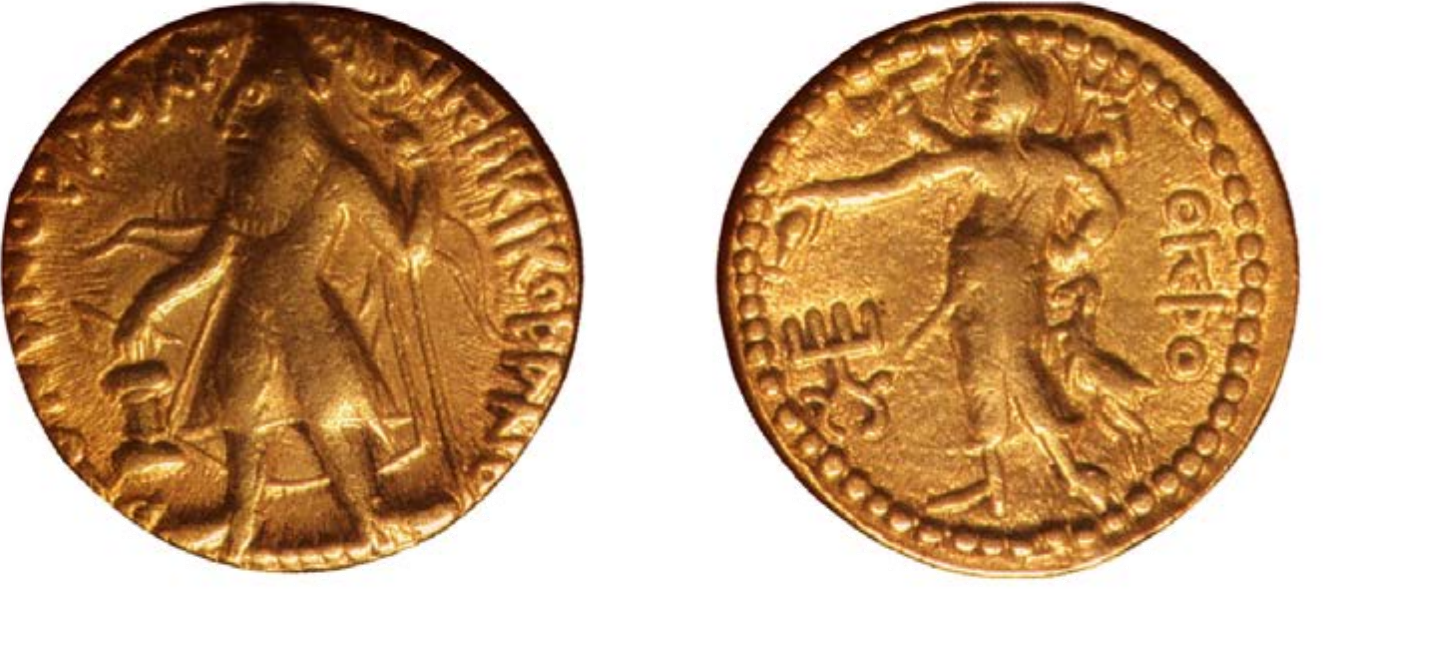
Coins in the subcontinent began with punch-marked coins of silver and copper (c. sixth century BCE onwards). The Indo-Greeks were the first to issue coins bearing the names and images of rulers, c. second century BCE. The Kushanas went a step further: they issued the largest hoards of gold coins, c. first century CE. These coins were almost identical in weight with those of the Roman emperors and the Parthian rulers of Iran, and they have been found at several sites in north India and Central Asia, a sign of the enormous value of the trade of the time.

Note: A same/similar question was asked in CUET (UG) in the papers below.

20262025202420232022
23-05 S2
24-05 S2*
––––

* A similar question.


NCERT (2025-26): “6.4 Coins and kings … Punch-marked coins made of silver and copper (c. sixth century BCE onwards) were amongst the earliest to be minted and used. These have been recovered from excavations at a number of sites throughout the subcontinent. Numismatists have studied these and other coins to reconstruct possible commercial networks. Attempts made to identify the symbols on punchmarked coins with specific ruling dynasties, including the Mauryas, suggest that these were issued by kings. It is also likely that merchants, bankers and townspeople issued some of these coins. The first coins to bear the names and images of rulers were issued by the Indo-Greeks, who established control over the north-western part of the subcontinent c. second century BCE. The kushanas, however, issued the largest hoards of gold coins first gold coins c. first century CE. These were virtually identical in weight with those issued by contemporary Roman emperors and the Parthian rulers of Iran, and have been found from several sites in north India and Central Asia.…”

NCERT extract

Fig. 2.4 A Kushana coin
Obverse: King Kanishka
Reverse: A deity

Advertisement

Practise more on Ancient India: Kings, Farmers and Towns

Chapter-wise mocks on the real NTA exam screen, with solutions and your rank. Your first mocks are free.

Start free mocks →

Advertisement

Next questions

  1. The osmotic pressure of a solution is directly proportional toChemistry · Physical: Solutions
  2. What is the primary role of the red team in cybersecurity?English · Comprehension - (Narrative / Factual)
  3. Consider the 15th term of the following Arithmetic Progression (AP).A. 2, 7, 12, ...B. 10, 7, 4, ...C. 3, 8, 13, ..., 253D. 1, −1, −3, −5,…General Aptitude Test · Quantitative Reasoning
  4. Which of the following features are not a part of fully mature and functional insulin?(A) A peptide(B) B peptide(C) C peptide(D) Pro-insuli…Biology · Biotechnology and its Applications
  5. Choose the correct figure of speech used in the sentence from the options given below:-The daffodils bade the fly goodbye.English · Figure of Speech
  6. For the function f(x)=displaystyle1/(x^2+2x+2) which of the following statements are TRUE?A. f(x) is increasing on (-∞,-1) B. f(x) is decre…Maths. Section A · Applications of Derivatives (Section A)
  7. In 2003, the ASEAN Community was established. Which one of the following is not a part of it?Political Science · Contemporary World Politics: Contemporary Centres of power
  8. A_________ not only commits his followers to organisational goals but also pools needed resources, guides and motivates subordinates to rea…Business Studies · Directing
  9. Which of the following statements are correct in reference to the linear programming problem (LPP)Maximise Z = 50x + 40 ySubject to the con…Applied Maths. Section B2 · Linear Programming
  10. Given below are two statements:Statement I: Jan-Dhan account holders need not keep a minimum bank balance.Statement II: Under the Jan-Dhan…Economics · Indian Economic Development: Rural Development