Thalassemia is:
Answer & explanation
Correct answer: option 4
The correct answer is Option (4) → Autosome-linked recessive disease
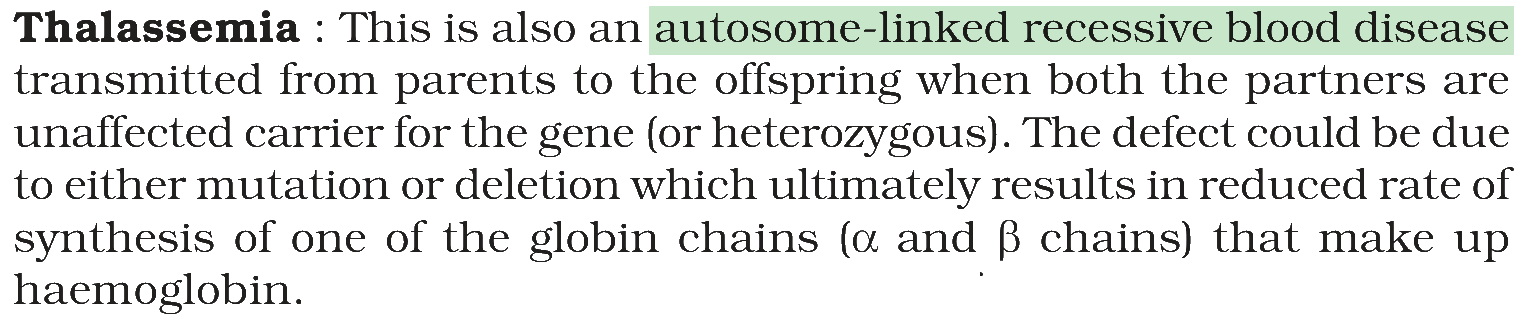
Thalassemia is a Mendelian blood disorder in which the body makes too little of one of the globin chains of haemoglobin. It passes from parents to children when both parents are unaffected carriers (heterozygous) of the gene. A disease needing two copies of the defective gene, on a non-sex chromosome, is called autosome-linked recessive.
(1) Autosome-linked dominant disease — Incorrect. A dominant disease shows even when one copy of the gene is present. Thalassemia needs both partners to be carriers, so it is not dominant. Myotonic dystrophy is an example of an autosomal dominant trait.
(2) Sex linked recessive disease — Incorrect. Sex-linked recessive diseases are carried on the X chromosome, as in colour blindness and haemophilia. The thalassemia genes lie on chromosomes 16 and 11, which are autosomes.
(3) Sex linked dominant disease — Incorrect. Thalassemia is neither sex-linked nor dominant.
(4) Autosome-linked recessive disease — Correct. Thalassemia is autosome-linked and recessive, like sickle-cell anaemia.
Note: The same question was also asked in CUET (UG) 2025 on 20-05-2025 (Slot 1), and a similar question in CUET (UG) 2026 on 31-05-2026 (Slot 2), and in CUET (UG) 2025 on 23-05-2025 (Slot 2).
NCERT Extract:
Mendelian Disorders – …