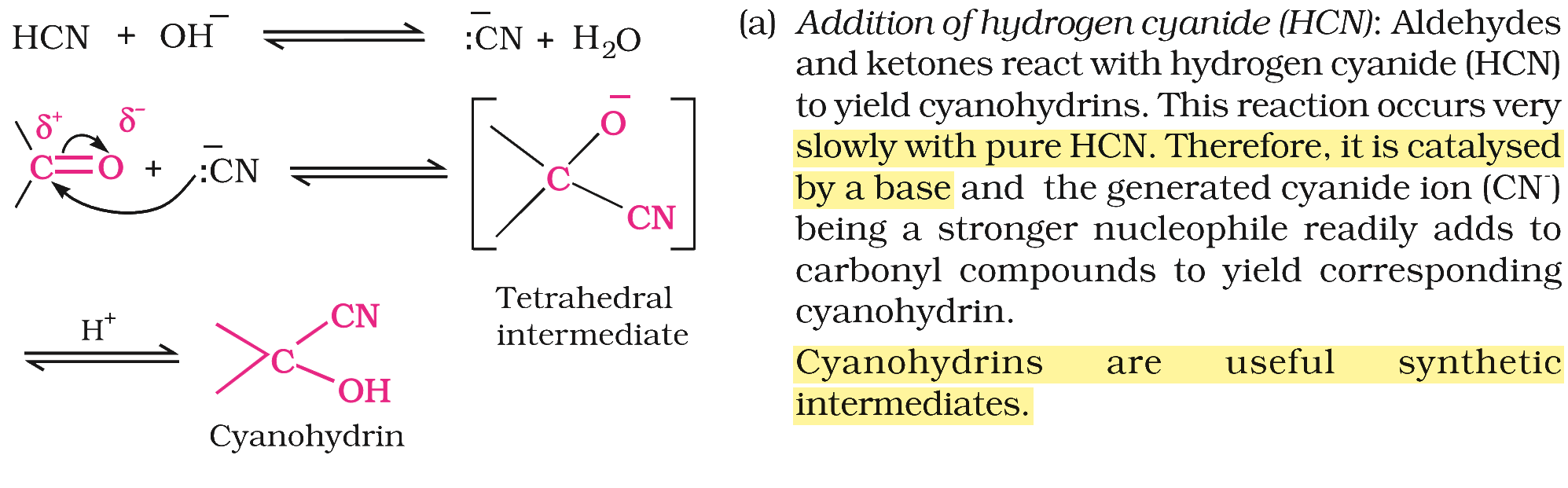
The addition of hydrogen cyanide to carbonyl carbon is an example of a nucleophilic addition reaction. Identify the CORRECT statements from the following:
A. The hybridization of carbonyl carbon changes from sp2 to sp3 after the attack of CN− to the carbonyl center.
B. It results in the formation of tetrahedral intermediate.
C. The reaction is acid catalysed.
D. Cyanohydrins are formed, which are useful synthetic intermediates.
Choose the correct answer from the options given below:
Answer & explanation
Correct answer: option 1
The correct answer is Option (1) → A, B and D only
The carbonyl carbon is electrophilic because the C=O bond is polarised (Cδ+–Oδ−). In nucleophilic addition a nucleophile attacks this carbon, the π bond breaks, and the carbon changes from trigonal planar sp2 to tetrahedral sp3. With HCN the nucleophile is the cyanide ion, produced by a base.
A. The hybridization of carbonyl carbon changes from sp2 to sp3 after the attack of CN− to the carbonyl center. — Correct. The carbon gains a fourth σ bond (to CN) and becomes tetrahedral.
B. It results in the formation of tetrahedral intermediate. — Correct. The alkoxide ion \( \ce{R2C(O^-)CN} \) is a tetrahedral intermediate.
C. The reaction is acid catalysed. — Incorrect. It is base catalysed: the base produces \( \ce{CN-} \) from HCN. An acid would hold back the ionisation of HCN and slow the reaction down.
D. Cyanohydrins are formed, which are useful synthetic intermediates. — Correct. Cyanohydrins can be hydrolysed to α-hydroxy acids or reduced to amino alcohols.
NCERT (2026-27 edition):
Addition of Hydrogen Cyanide (HCN)