
CUETMOCK
  • Pricing
  • Mentors
Log inStart freeStart free mocks→

First test, then trust

Try a free CUET mock test.

Join 5,00,000+ students who rehearsed exam day on the exact NTA screen before sitting CUET. On the web and on Android.

Start free mocks →Get the Android app
CUETMOCK

India's #1 CUET Mock Test Platform. Original NCERT-based questions on the exact NTA exam screen — trusted by 5,00,000+ students since CUET 2022.

Get it onGoogle PlayScan to download the CUETMOCK app

Mock tests

  • CUET mock test series
  • Commerce mocks
  • Humanities (Arts) mocks
  • Science mocks
  • Languages & GAT mocks
  • Free practice questions
  • Pricing

Resources

  • CUET exam guide
  • CUET syllabus
  • Universities accepting CUET
  • Expert blogs
  • News & notifications
  • Webinars & counselling
  • CUET score calculator
  • How we estimate your rank
  • FAQs

Company

  • About us
  • Our leadership & team
  • Our toppers
  • Mentors
  • For schools
  • Contact us
  • Terms
  • Privacy
  • Refund policy

Talk to us

+91 7696 6630 56info@cuetmock.comWhatsApp us

Our other platforms

  • JEE Mock — For IIT-JEE aspirants
  • NEET Mock — For NEET aspirants

Newsletter

Exam updates, study material and offers — no spam.

© 2026 NYC Ventures Pvt. Ltd.

701-702, Royal Business Park, Zirakpur, Punjab - 140603

  • Terms of use
  • Privacy policy
  • Refund policy
  • Contact us

iCUETMOCK is an independent preparation platform, not affiliated with the National Testing Agency (NTA). Always check exam details on the official NTA website.

  • Home
  • Mock tests
  • CUET guide
  • Pricing
  • Log in
Home/Practice questions/Chemistry
ChemistryInorganic: D and F Block Elements

The pair in which both species have the same spin-only magnetic momen…

The pair in which both species have the same spin-only magnetic moment is:

Answer & explanation+

Correct answer: option 2

The correct answer is Option (2) → [Cr(H2O)6]2+ and [Fe(H2O)6]2+

The spin-only magnetic moment depends only on the number of unpaired electrons n: \( \mu=\sqrt{n(n+2)} \) BM. Two species have the same moment when they have the same n.

  • \( \ce{[Cr(H2O)6]^2+} \): Cr (Z = 24) is [Ar]3d54s1; \( \ce{Cr^2+} \) is 3d4; water is a weak field ligand for these hydrated ions (high spin: Table 4.7 gives 4 unpaired electrons for hydrated \( \ce{Cr^2+} \)), so the four d electrons stay unpaired, n = 4 and μ = √24 = 4.90 BM.

  • \( \ce{[Fe(H2O)6]^2+} \): Fe (Z = 26) is [Ar]3d64s2; \( \ce{Fe^2+} \) is 3d6; with water it is also high spin, so one d orbital holds a pair and four hold single electrons, so n = 4 and μ = 4.90 BM.

  • \( \ce{[Mn(H2O)6]^2+} \): Mn (Z = 25) is [Ar]3d54s2; \( \ce{Mn^2+} \) is 3d5; n = 5 and μ = √35 = 5.92 BM.

  • \( \ce{[CoCl4]^2-} \): x + 4(−1) = −2, so Co is +2; Co (Z = 27) is [Ar]3d74s2, so \( \ce{Co^2+} \) is 3d7. In a tetrahedral complex the splitting is too small to force pairing, so n = 3 and μ = √15 = 3.87 BM.

Only \( \ce{[Cr(H2O)6]^2+} \) and \( \ce{[Fe(H2O)6]^2+} \) both have 4 unpaired electrons and the same moment, 4.90 BM.

NCERT (2026-27 edition):
4.3.9 Magnetic Properties – “Paramagnetism arises from the presence of unpaired electrons, each such electron having a magnetic moment associated with its spin angular momentum and orbital angular momentum. … For these, the magnetic moment is determined by the number of unpaired electrons and is calculated by using the ‘spin-only’ formula, i.e., \( \mu=\sqrt{n(n+2)} \) where n is the number of unpaired electrons and μ is the magnetic moment in units of Bohr magneton (BM).”

“The magnetic moment increases with the increasing number of unpaired electrons. … The magnetic moments calculated from the ‘spin-only’ formula and those derived experimentally for some ions of the first row transition elements are given in Table 4.7. The experimental data are mainly for hydrated ions in solution or in the solid state.”

Table 4.7: Calculated and Observed Magnetic Moments (BM)
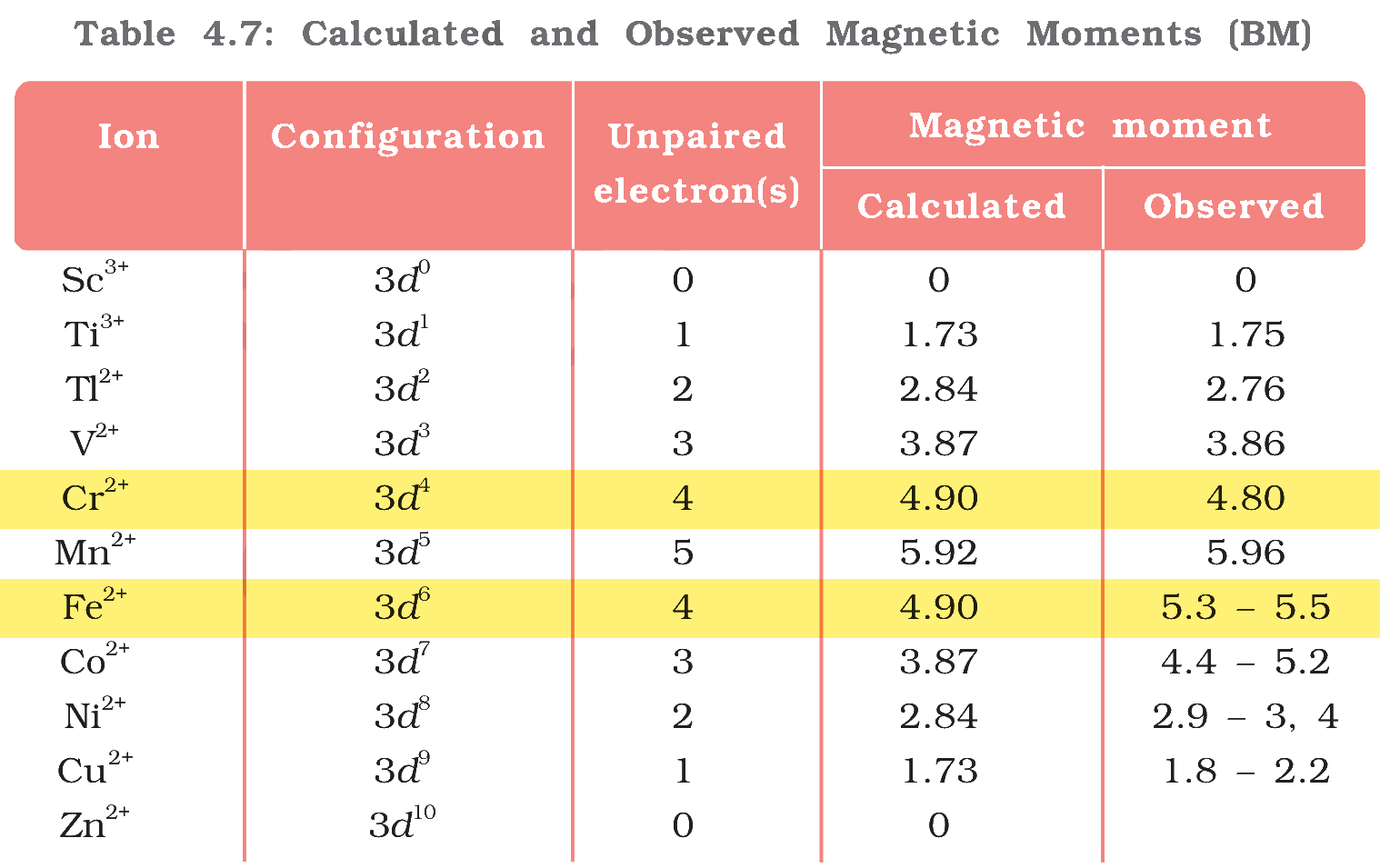
Table 4.7

Advertisement

Practise more on Inorganic: D and F Block Elements

Chapter-wise mocks on the real NTA exam screen, with solutions and your rank. Your first mocks are free.

Start free mocks →

Advertisement

Next questions

  1. X and Y are partners, having capital of ₹5,00,000 and ₹1,30,000 respectively shared the profit in the ratio 1:2. Interest on partner's capi…Accountancy Part A · Accounting for Partnership
  2. निम्नलिखित में से कौन-सा वर्ण उच्चारण की दृष्टी से दंत्य नहीं है?Hindi · Alphabet Tests
  3. Find the total surface area (in cm2) of a right circular cylinder of diameter 7 cm and height 6 cm.General Aptitude Test · Quantitative Reasoning
  4. Assertion: In the present legal system of most of the countries, justice is not given but sold. Reasoning: The consumers of justice have to…Legal Studies · Legal Services
  5. Who was/is a successful Indian business tycoon and was the founder of Reliance Industries?General Aptitude Test · General Knowledge
  6. In a 0.2 molal aqueous solution of a weak acid HX, the degree of dissociation is 0.3. Taking Kf for water as 1.85 K kg mol−1, the freezing…Chemistry · Physical: Solutions
  7. Which of the following is a non-finite verb in the sentence given below?Meera practises every morning, dreaming that she will one day run f…English · Grammar: Verb
  8. Choose the correct synonym of the word: OstentationEnglish · Synonyms
  9. Rohit is married to Kavya. Tarun is Kavya’s brother, and Sameer is Tarun’s brother. How is Rohit related to Sameer?General Aptitude Test · Verbal Reasoning
  10. Which of the following statements is/are true?Economics · Indian Economic Development: Environment and Sustainable Development