Fertilization and implantation
Read the following passage carefully and answer the given questions.
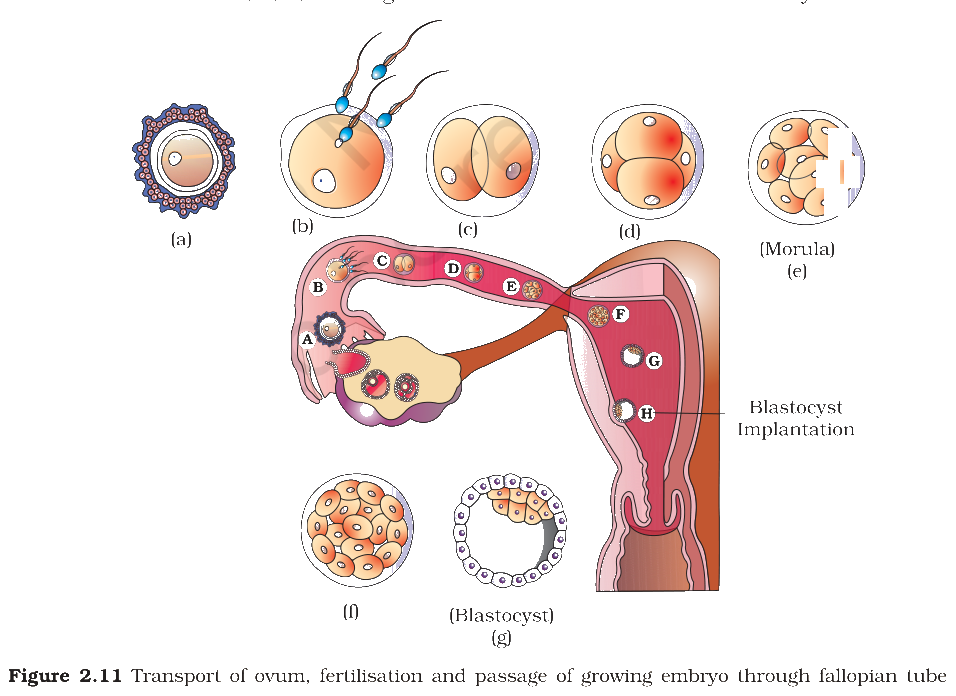
During copulation semen is released by the penis into the vagina. The motile sperms swim rapidly, pass through the cervix, enter into the uterus and finally reach the ampullary region of the fallopian tube. The ovum released by the ovary is also transported to the ampullary region where fertilisation takes place. During fertilization, a sperm comes in contact with the zona pellucida layer of the ovum and induces changes in the membrane that block the entry of additional sperms. This induces the completion of the meiotic division of the secondary oocyte. The second meiotic division is also unequal and results in the formation of a second polar body and a haploid ovum (ootid). Soon the haploid nucleus of the sperms and that of the ovum fuse together to form a diploid zygote. The zygote undergoes cleavage and forms a blastocyst, which gets implanted in the endometrium of the uterus after about 6-7 days of fertilization. Successful fertilization leads to pregnancy.
Where does fertilization normally occur in humans?
Answer & explanation
Correct answer: option 3
The correct answer is Option (3) → Ampulla of oviduct
The oviduct (fallopian tube) has three parts. The infundibulum is the funnel-shaped part near the ovary, with finger-like fimbriae at its edge. The ampulla is the wider middle part. The isthmus is the narrow part that joins the uterus. Sperms swim up to the ampulla, and the ovum is carried there too, so the two meet in this region.
(1) Infundibulum of oviduct — Incorrect. This is the funnel-shaped opening that receives the ovum from the ovary. Fertilisation does not take place here.
(2) Isthmus of oviduct — Incorrect. This is the narrow part. The zygote passes through it later, while it divides, on its way to the uterus.
(3) Ampulla of oviduct — Correct. Fertilisation takes place here.
(4) Fimbriae of oviduct — Incorrect. These finger-like projections help to collect the ovum after ovulation. They are not the site of fertilisation.
Note: The passage is taken from NCERT. NTA has put lines of the NCERT text together to make it. Most CUET (UG) questions come straight from NCERT, so study the book line by line, including figures and their titles.
NCERT Extract:
Fertilisation and Implantation – …