
CUETMOCK
  • Pricing
  • Mentors
Log inStart freeStart free mocks→

First test, then trust

Try a free CUET mock test.

Join 5,00,000+ students who rehearsed exam day on the exact NTA screen before sitting CUET. On the web and on Android.

Start free mocks →Get the Android app
CUETMOCK

India's #1 CUET Mock Test Platform. Original NCERT-based questions on the exact NTA exam screen — trusted by 5,00,000+ students since CUET 2022.

Get it onGoogle PlayScan to download the CUETMOCK app

Mock tests

  • CUET mock test series
  • Commerce mocks
  • Humanities (Arts) mocks
  • Science mocks
  • Languages & GAT mocks
  • Free practice questions
  • Pricing

Resources

  • CUET exam guide
  • CUET syllabus
  • Universities accepting CUET
  • Expert blogs
  • News & notifications
  • Webinars & counselling
  • CUET score calculator
  • How we estimate your rank
  • FAQs

Company

  • About us
  • Our leadership & team
  • Our toppers
  • Mentors
  • For schools
  • Contact us
  • Terms
  • Privacy
  • Refund policy

Talk to us

+91 7696 6630 56info@cuetmock.comWhatsApp us

Our other platforms

  • JEE Mock — For IIT-JEE aspirants
  • NEET Mock — For NEET aspirants

Newsletter

Exam updates, study material and offers — no spam.

© 2026 NYC Ventures Pvt. Ltd.

701-702, Royal Business Park, Zirakpur, Punjab - 140603

  • Terms of use
  • Privacy policy
  • Refund policy
  • Contact us

iCUETMOCK is an independent preparation platform, not affiliated with the National Testing Agency (NTA). Always check exam details on the official NTA website.

  • Home
  • Mock tests
  • CUET guide
  • Pricing
  • Log in
Home/Practice questions/Chemistry
ChemistryOrganic: Haloalkanes and Haloarenes

What will happen in the following reaction if -NO2 group is introduce…

What will happen in the following reaction if -NO2 group is introduced at para position to -Cl?
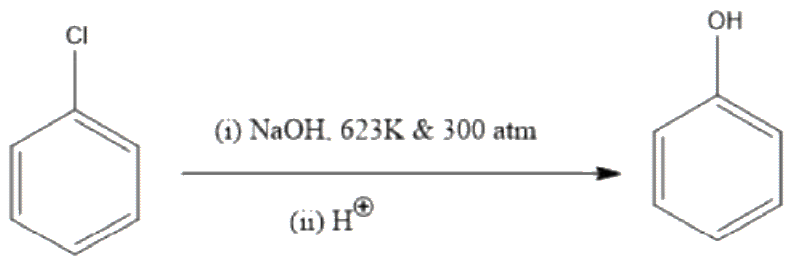
Figure for Q20

Answer & explanation+

Correct answer: option 3

The correct answer is Option (3) → Reaction will occur at comparatively lower temperatures.

Aryl halides are very unreactive towards nucleophilic substitution. The C–Cl bond has partial double bond character (resonance with the ring), the carbon is sp2, and the electron-rich ring repels the incoming nucleophile. So chlorobenzene gives phenol only under drastic conditions, 623 K and 300 atm.

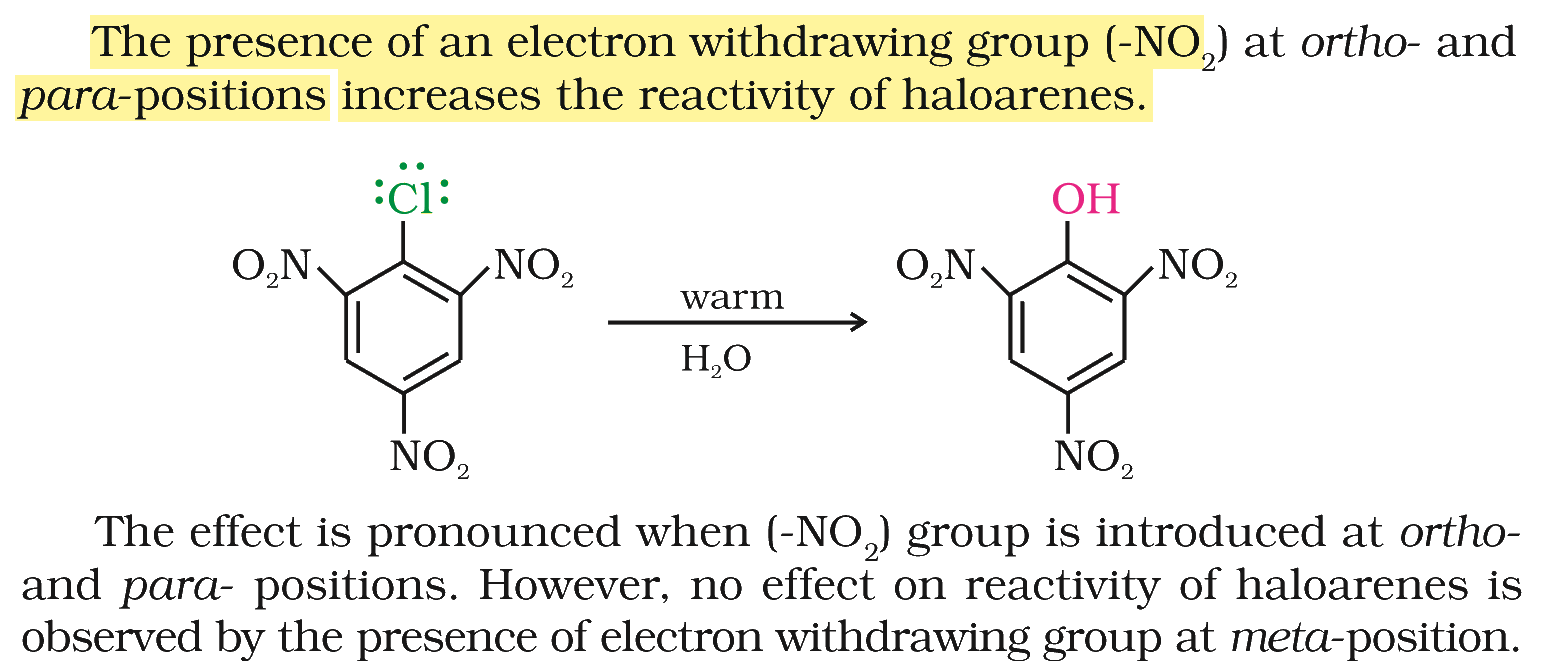
A para –\( \ce{NO2} \) group delocalises the negative charge of the intermediate onto its own oxygen atoms and so stabilises it.

With –\( \ce{NO2} \) para to –Cl, sodium hydroxide replaces the chlorine at 443 K, and acidification gives 4-nitrophenol:

    \( \displaystyle \ce{O2N-C6H4-Cl + 2NaOH} \xrightarrow{443\ \mathrm{K}} \ce{O2N-C6H4-ONa + NaCl + H2O} \)

    \( \displaystyle \ce{O2N-C6H4-ONa + HCl -> O2N-C6H4-OH + NaCl} \)

So with –\( \ce{NO2} \) para to –Cl, the reaction occurs at a comparatively lower temperature (443 K instead of 623 K).

Why the other options are incorrect

  • Option (1) Reaction will not take place — Incorrect. The nitro group does not stop the reaction; it makes it easier.

  • Option (2) Reaction will occur at comparatively higher temperatures — Incorrect. A higher temperature would be needed for an electron releasing group, not for an electron withdrawing one.

  • Option (4) Reaction will occur at the same temperature — Incorrect. The para –\( \ce{NO2} \) group stabilises the intermediate, so the conditions change markedly.

NCERT (2026-27 edition):
Reactions of Haloarenes – …
Textbook extract

Advertisement

Practise more on Organic: Haloalkanes and Haloarenes

Chapter-wise mocks on the real NTA exam screen, with solutions and your rank. Your first mocks are free.

Start free mocks →

Advertisement

Next questions

  1. In the graph for Linear Programming Problem, with objective function Z=3x+4y having shaded region as feasible region then, the maximum valu…Applied Maths. Section A · Linear Programming (Section A)
  2. Let A = […] and let I be the identity matrix of order 2. Which of the following statements are correct? (A) A^2 = -I (B) A^3 = A (C) A^4 =…Applied Maths. Section B2 · Algebra
  3. Two sides of a triangle have lengths 6 cm and 8 cm, and the angle between them can vary. The maximum possible area of the triangle isMaths. Section B1 · Applications of Derivatives
  4. I expect you to complete this work before the evening.English · Grammar: Active Passive Voice
  5. Which Constitutional Amendment Act included Fundamental Duties in the Indian Constitution?General Aptitude Test · General Knowledge
  6. Which of the following statements about tensions and conflicts in former Soviet Republics are correct? (A) In Russia, Chechnya and Dagestan…Political Science · Contemporary World Politics: End of Bi-Polarity
  7. Emission of electron from the surface of metal when radiation of appropriate frequency is allowed to incident on it is called :Physics · Dual Nature of Radiation and Matter
  8. Which of the following Fundamental Rights was there in the original Constitution but does not exist at present?General Aptitude Test · General Knowledge
  9. The angles of a quadrilateral are in ratio 1:2:3:4. Which angle has the largest measure?General Aptitude Test · Quantitative Reasoning
  10. Select the correct antonym of the given word from the options given below:- 'Insolvent'English · Antonyms