Acidified potassium dichromate oxidizes sulphides (\( S^{2-} \)) to............
Answer & explanation
Correct answer: option 3
The correct answer is Option (3) → sulphur (S)
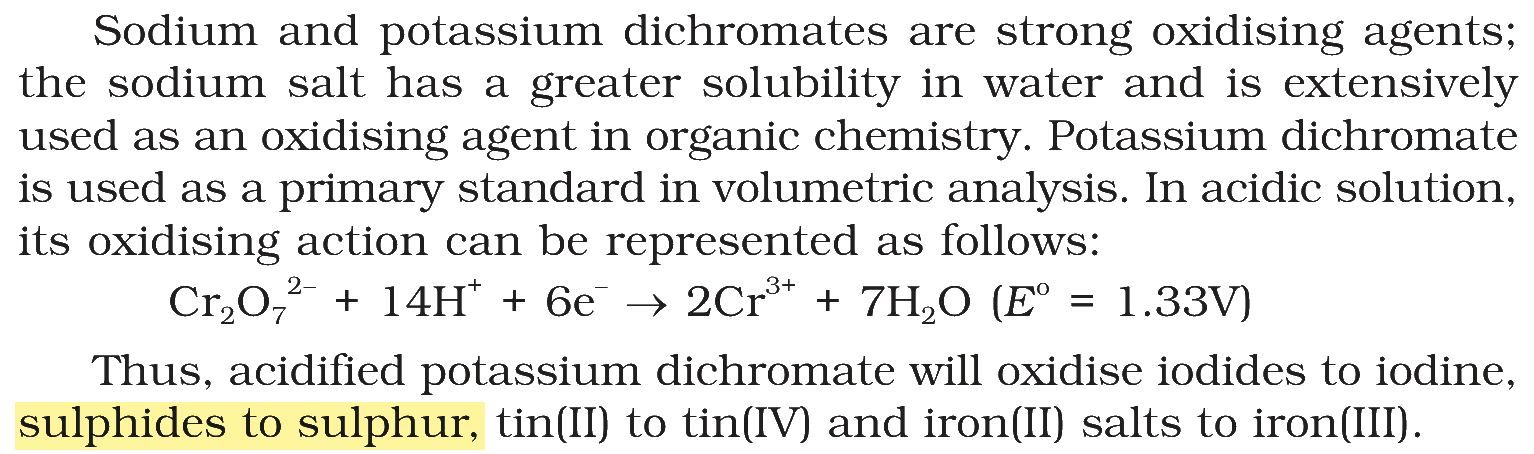
In acidic solution the dichromate ion is a strong oxidising agent; each chromium goes from +6 to +3:
\( \displaystyle \ce{Cr2O7^2- + 14H+ + 6e- -> 2Cr^3+ + 7H2O} \)
The sulphide ion is oxidised only as far as elemental sulphur, which separates as a pale yellow solid:
\( \displaystyle \ce{S^2- -> S + 2e-} \)
Multiplying the sulphide half-reaction by 3, so that 6 electrons are given and taken, and adding:
\( \displaystyle \ce{Cr2O7^2- + 3S^2- + 14H+ -> 2Cr^3+ + 3S v + 7H2O} \)
So acidified potassium dichromate oxidises sulphides to sulphur.
Why the other options are incorrect
Option (1) \({SO_4}^{2-}\) — Incorrect. Oxidation to sulphate (+6) needs a much stronger oxidant or harsher conditions; dichromate stops at sulphur (0).
Option (2) \({SO_3}^{2-}\) — Incorrect. Sulphite is itself easily oxidised by dichromate (to sulphate), so it is not the product from sulphide.
Option (4) \({SO_2}\) — Incorrect. Sulphur dioxide is also a reducing agent that dichromate oxidises (this is the test that turns dichromate paper green); it is not formed from sulphide.
NCERT (2026-27 edition):
Oxides and Oxoanions of Metals – …