
CUETMOCK
  • Pricing
  • Mentors
Log inStart freeStart free mocks→

First test, then trust

Try a free CUET mock test.

Join 5,00,000+ students who rehearsed exam day on the exact NTA screen before sitting CUET. On the web and on Android.

Start free mocks →Get the Android app
CUETMOCK

India's #1 CUET Mock Test Platform. Original NCERT-based questions on the exact NTA exam screen — trusted by 5,00,000+ students since CUET 2022.

Get it onGoogle PlayScan to download the CUETMOCK app

Mock tests

  • CUET mock test series
  • Browse all papers
  • Commerce mocks
  • Humanities (Arts) mocks
  • Science mocks
  • Languages & GAT mocks
  • Free practice questions
  • Pricing

Resources

  • CUET exam guide
  • CUET syllabus
  • Universities accepting CUET
  • Expert blogs
  • News & notifications
  • Webinars & counselling
  • CUET score calculator
  • How we estimate your rank
  • FAQs

Company

  • About us
  • Our leadership & team
  • Our toppers
  • Mentors
  • For schools
  • Contact us
  • Terms
  • Privacy
  • Refund policy

Talk to us

+91 7696 6630 56info@cuetmock.comWhatsApp us

Our other platforms

  • JEE Mock — For IIT-JEE aspirants
  • NEET Mock — For NEET aspirants

Newsletter

Exam updates, study material and offers — no spam.

© 2026 NYC Ventures Pvt. Ltd.

701-702, Royal Business Park, Zirakpur, Punjab - 140603

  • Terms of use
  • Privacy policy
  • Refund policy
  • Contact us

iCUETMOCK is an independent preparation platform, not affiliated with the National Testing Agency (NTA). Always check exam details on the official NTA website.

  • Home
  • Mock tests
  • CUET guide
  • Pricing
  • Log in
Home/Practice questions/Chemistry
ChemistryOrganic: Aldehydes, Ketones and Carboxylic Acids

Which of the following compounds most readily undergoes nucleophilic…

Answer the question on the basis of passage given below:

Aldehydes and ketones are two important classes of organic compounds which are widely used in the synthesis of a variety of other organic compounds. Due to the polarity of the carbonyl group, they undergo nucleophilic addition reactions. Broadly speaking, these addition reactions are of two types- one in which simply the addition of the nucleophilic reagent occurs across \(>C=O\) bond and the other in which addition is followed by the elimination of a molecule of water. A number of ammonia derivatives such as hydroxylamine, hydrazine, phenylhydrazine, 2,4-dinitrophenylhydrazine and semicarbazide belong to the second category of reactions. These derivatives are used for the identification and characterization of aldehydes/ketones. Both types of nucleophilic addition reactions are influenced by steric and electronic factors. In general, aliphatic aldehydes are more reactive than aromatic aldehydes. The aliphatic aldehydes reduce both Fehling's solution and Tollen's reagent but aromatic aldehydes reduce only Tollen's reagent. Like aldehydes, aromatic ketones are less reactive than aliphatic ketones towards nucleophilic addition reactions.

Phenols and carboxylic acids are acidic in nature. Both dissolve in \(NaOH\) solution and turn blue litmus red. However carboxylic acids are much stronger acids than phenols and decompose \(NaHCO_3\) with the evolution of \(CO_2\) but phenols do not. Both electron-donating and electron-withdrawing substituents influence the acid strength of aliphatic as well as aromatic acids. Unlike all other aliphatic acids, formic acid has reducing properties and also does not show reactions of the alkyl group.

Which of the following compounds most readily undergoes nucleophilic addition reaction?

Answer & explanation+

Correct answer: option 1

The correct answer is Option (1) → Formaldehyde

The ease of nucleophilic addition depends on two things. Steric factor: bulky groups on the carbonyl carbon hinder the approach of the nucleophile. Electronic factor: alkyl groups push electrons towards the carbonyl carbon (+I effect) and lower its positive charge. So aldehydes are more reactive than ketones, and the reactivity falls as the groups on the carbonyl carbon get larger or more numerous.

Formaldehyde, HCHO, has two hydrogen atoms and no alkyl group on the carbonyl carbon. It is the least hindered and its carbonyl carbon is the most electrophilic, so it undergoes nucleophilic addition most readily:

    \( \displaystyle \text{HCHO} \gt \ce{CH3CHO} \gt \ce{CH3COCH3} \gt \ce{(CH3)3C-CO-C(CH3)3} \)

Why the other options are incorrect

  • Option (2) Acetone — Incorrect. It is a ketone with two methyl groups on the carbonyl carbon; they hinder the nucleophile and lower the positive charge on the carbon, so it is less reactive than both aldehydes.

  • Option (3) Acetaldehyde — Incorrect. Its methyl group adds some bulk and lowers the positive charge on the carbonyl carbon by its +I effect, so it is less reactive than formaldehyde.

  • Option (4) Di-tert-butyl ketone — Incorrect. The two very bulky tert-butyl groups crowd the carbonyl carbon most and also push electrons towards it, so it is the least reactive of the four.

NCERT (2026-27 edition):
Reactivity
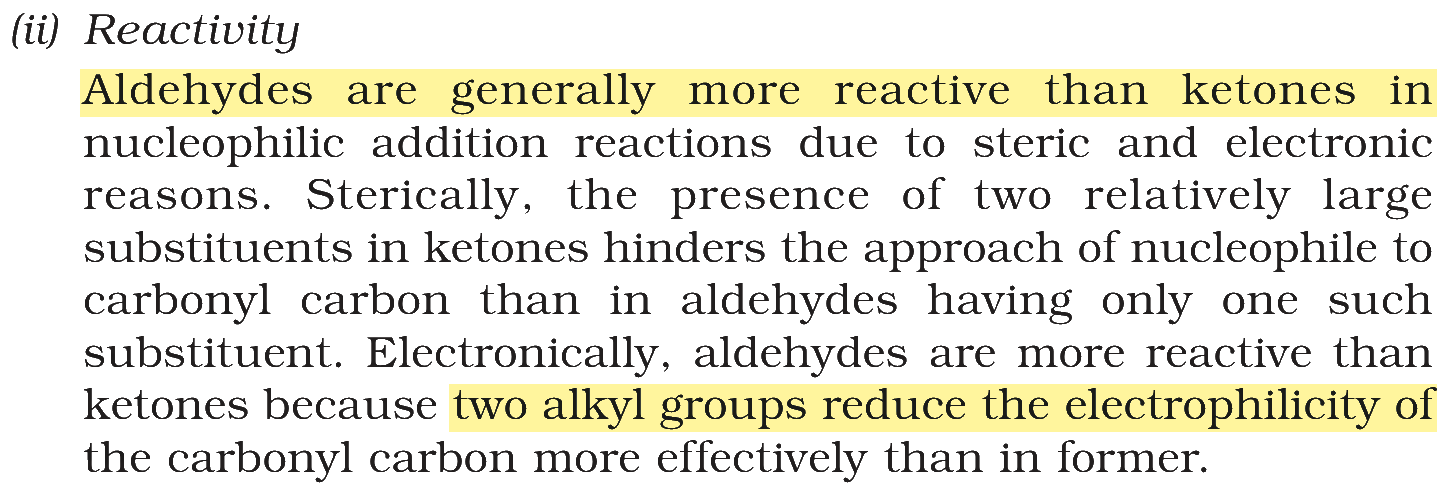
Textbook extract

Note: The same/similar question has been asked in different years by NTA as per the details given below:

20262025202420232022
–14-05 S1–02-06 S2–

Advertisement

Practise more on Organic: Aldehydes, Ketones and Carboxylic Acids

Chapter-wise mocks on the real NTA exam screen, with solutions and your rank. Your first mocks are free.

Start free mocks →

Advertisement

Next questions

  1. Which of the following combination of statements are true about dissolution? (A). A firm is compulsorily dissolved when a partner decide to…Accountancy Part A · Dissolution of Partnership Firm
  2. The sum of present age of P and Q is 48 years. Today Q is 4 years older than R . The respective ratio of present age of P and R is 4 : 7. W…General Aptitude Test · General Ability
  3. In which of the following years was the civil disobedience campaign completely ceased?General Aptitude Test · General Knowledge
  4. The average thermal energy for a mono-atomic gas is : (kB is Boltzmann constant and T, absolute temperature)Physics · Kinetic Theory
  5. In a compound microscope the focal length of objective lens and eye lens are 4 cm and 10 cm respectively. An object is placed at 6 cm from…Physics · Ray Optics
  6. A 14.0 μF capacitor is connected to a 220 V, 50 Hz source. The value of peak current in the circuit is(Given: π = 22/7 and √2 = 1.414 )Physics · Alternating Current
  7. Complete the following sentence using the correct Determiner. There is ____ water left, so drink only if you must.English · Grammar: Determiner
  8. Match List-I with List-II. List-IList-II(A) What managers do in India, the USA, Germany or Japan is the same(I) Management is multidimensio…Business Studies · Nature and significance of Management
  9. There are two statements marked as Assertion (A) and Reason (R). Mark your answer as per the options given below. Assertion (A): In China,…Economics · Indian Economic Development: Comparative Development Experiences of India and its Neighbours
  10. What was the focus of Anandpur Sahib Resolution?Political Science · Politics in India Since Independence: Regional Aspirations