In a market with free entry and exit of identical firms, each firm’s supply curve is qf = 2p – 20 for p ≥ 20 (and zero below Rs 20). The market demand curve shifts from qD = 400 – 4p to qD = 480 – 4p. Consider the following statements:
(A) The equilibrium price is Rs 20 both before and after the shift.
(B) The equilibrium quantity rises by 80 units.
(C) The number of firms rises by 4.
(D) The output of each firm rises after the shift.
(E) Before the shift, there were 20 firms in the market.
Choose the correct answer from the options given below:
Answer & explanation
Correct answer: option 4
The correct answer is Option (4) → (A), (B) and (C) only
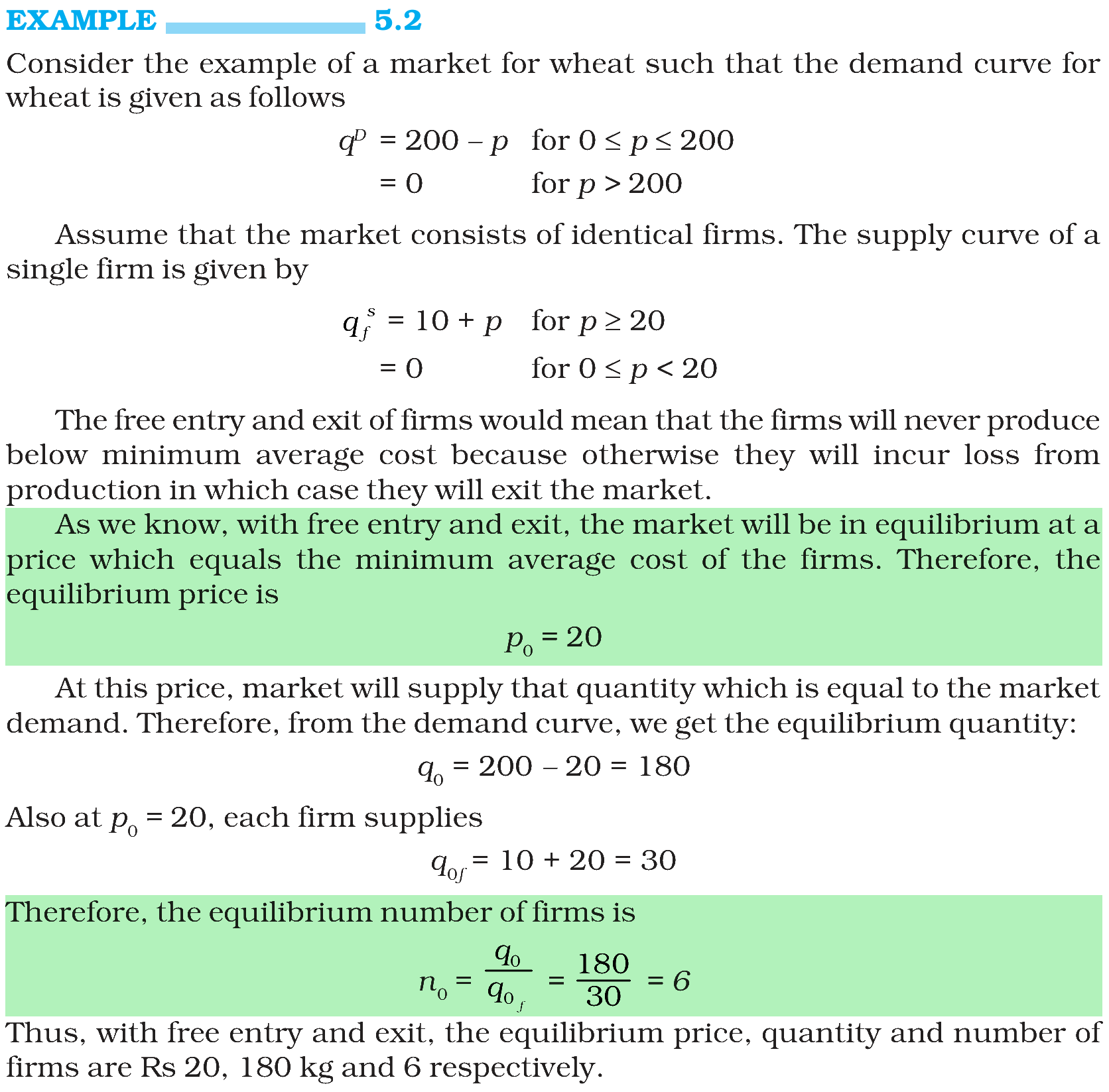
Firms supply nothing below Rs 20, so Rs 20 is the minimum average cost. With free entry and exit, it is the price before and after the shift. At p = 20, each firm supplies 2(20) − 20 = 20 units.
Before the shift:
\( q_0 = 400 - 4(20) = 320 \)
\( n_0 = \displaystyle\frac{320}{20} = 16 \)
After the shift:
\( q_1 = 480 - 4(20) = 400 \)
\( n_1 = \displaystyle\frac{400}{20} = 20 \)
(A) The equilibrium price is Rs 20 both before and after the shift. — Correct. The price stays at min AC = Rs 20; new firms enter until it is back there.
(B) The equilibrium quantity rises by 80 units. — Correct. The quantity rises from 320 to 400, by 80 units.
(C) The number of firms rises by 4. — Correct. The number of firms rises from 16 to 20, by 4.
(D) The output of each firm rises after the shift. — Incorrect. Each firm still sells at Rs 20, so it still supplies 20 units. The extra output comes from new firms.
(E) Before the shift, there were 20 firms in the market. — Incorrect. Before the shift there were 16 firms; 20 is the number after the shift.
NCERT (2026-27): “Shifts in Demand … Thus, due to a shift in demand rightwards (leftwards), the equilibrium quantity and number of firms will increase (decrease) whereas the equilibrium price will remain unchanged. Here, we should note that with free entry and exit, shift in demand has a larger effect on quantity than it does with the fixed number of firms. But unlike with fixed number of firms, here, we do not have any effect on equilibrium price at all.” |