
Given below are V versus I graphs for different types of p-n junction diodes marked A, B, C and D.
(A)
(B)
(C)
(D)
The correct sequence of graphs corresponding to forward biased p-n junction; Zener diode; Photo diode and Solar cell in order is _______________________
Fill in the blank with the correct answer from the options given below.
Answer & explanation
Correct answer: option 1
The correct answer is Option (1) → (D), (C), (A), (B)
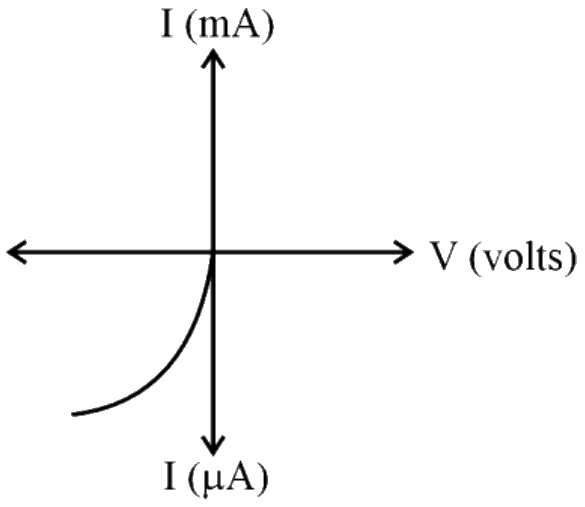
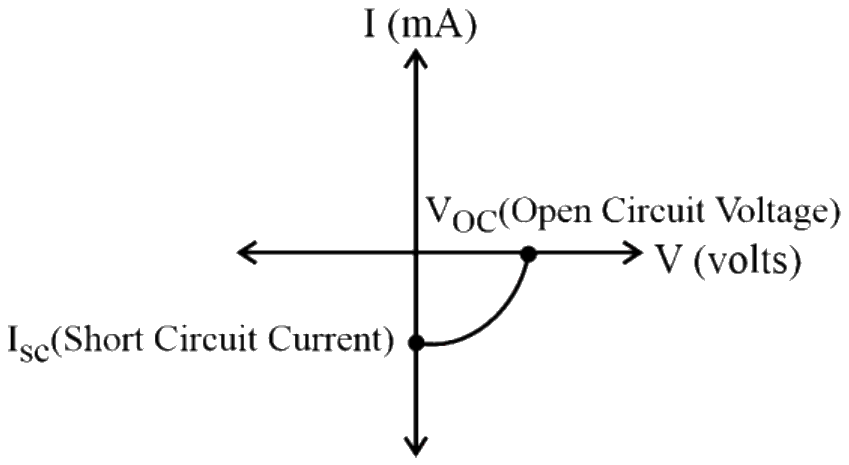
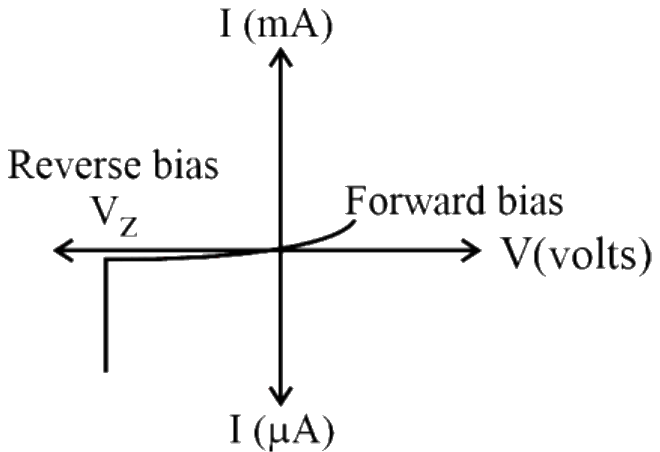
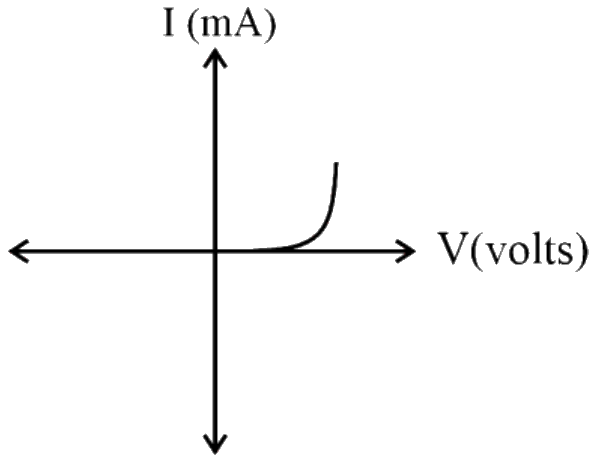
Each device is recognised by the quadrant in which it works and by the scale of its current (mA or \( \mu \)A).
Forward biased p-n junction — graph (D). The current is almost zero up to the knee voltage and then rises steeply (in mA) in the first quadrant.
Zener diode — graph (C). It shows a small forward curve and, in reverse bias, a sudden vertical rise of current at the breakdown voltage \( V_Z \).
Photo diode — graph (A). It is operated in reverse bias, so it works in the third quadrant with a small reverse current in \( \mu \)A that depends on the light falling on it.
Solar cell — graph (B). It generates power, so its curve lies in the fourth quadrant between the open-circuit voltage \( V_{OC} \) and the short-circuit current \( I_{SC} \).
The sequence is (D), (C), (A), (B).
Note: This question is from the pre-rationalised NCERT book (2022-23). The topic was removed from the latest NCERT book (2026-27), and it also appears to be out of the CUET 2026 syllabus.
NCERT (Pre-rationalised edition, 2022-23):
Zener Diode – “… It is designed to operate under reverse bias in the breakdown region and used as a voltage regulator.”
Optoelectronic Junction Devices – “… (i) Photodiode A Photodiode is again a special purpose p-n junction diode fabricated with a transparent window to allow light to fall on the diode. It is operated under reverse bias.”
Optoelectronic Junction Devices – “… Note that the I – V characteristics of solar cell is drawn in the fourth quadrant of the coordinate axes.”