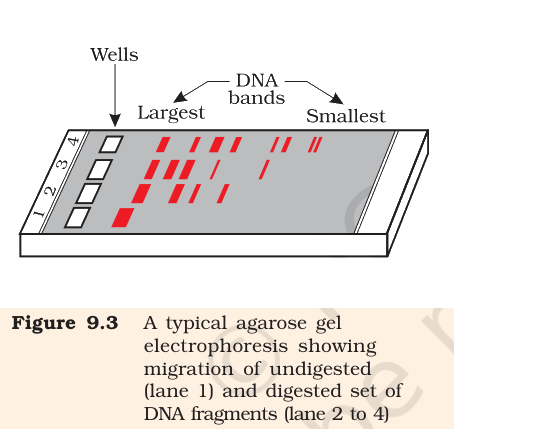
Answer the following questions from the diagram given below:-
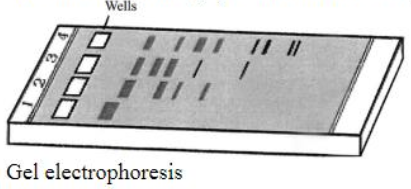
The technique shown in the picture is used to:
Answer & explanation
Correct answer: option 2
The correct answer is Option (2) → Separate the nucleic acid fragments according to their size.
Option (1) Visualise nucleic acids — Incorrect. Staining and UV light visualise the DNA; the technique itself separates it.
Option (2) Separate the nucleic acid fragments according to their size. — Correct. The picture shows gel electrophoresis. DNA fragments, being negatively charged, move towards the anode through the agarose gel, and the gel’s sieving effect separates them according to their size; smaller fragments move farther.
Option (3) Separate the nucleic acid fragments according to their charge. — Incorrect. All DNA fragments carry negative charge; they separate by size.
Option (4) Visualise RNA and proteins only — Incorrect. It is used here for DNA, not only RNA and proteins.
NCERT Extract:
Restriction Enzymes – “… Separation and isolation of DNA fragments : The cutting of DNA by restriction endonucleases results in the fragments of DNA. These fragments can be separated by a technique known as gel electrophoresis. Since DNA fragments are negatively charged molecules they can be separated by forcing them to move towards the anode under an electric field through a medium/matrix. Nowadays the most commonly used matrix is agarose which is a natural polymer extracted from sea weeds. The DNA fragments separate (resolve) according to their size through sieving effect provided by the agarose gel. Hence, the smaller the fragment size, the farther it moves. … The separated DNA fragments can be visualised only after staining the DNA with a compound known as ethidium bromide followed by exposure to UV radiation (you cannot see pure DNA fragments in the visible light and without staining). You can see bright orange coloured bands of DNA in a ethidium bromide stained gel exposed to UV light (Figure 9.3). The separated bands of DNA are cut out from the agarose gel and extracted from the gel piece. This step is known as elution.”