
Two complexes of nickel have same geometry but different magnetic behaviour are:
(A) \([Ni(CN)_4]^{2-}\)
(B) \([Ni(CO)_4]\)
(C) \([NiCl_4]^{2-}\)
(D) \([Ni(NH_3)_6]^{2+}\)
Choose the correct answer from the options given below:
Answer & explanation
Correct answer: option 3
The correct answer is option 3. (B) and (C) only.
Let us look at the hybridization, structure and magnetic character of each of the given compounds:
(A) \([Ni(CN)_4]^{2-}\):
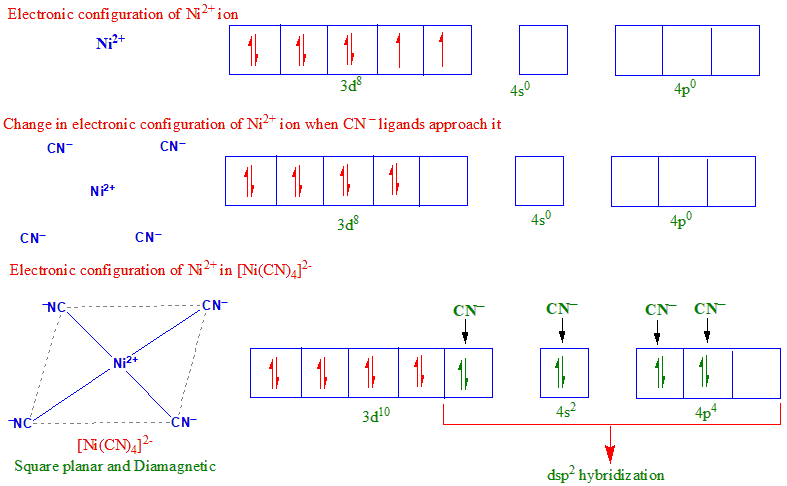
In \([Ni(CN)_4]^{2-}\), there is \(Ni^{2+}\) ion for which the electronic configuration in the valence shell is \(3d^8 4s^0\).
In presence of strong field \(CN^-\) ions, all the electrons are paired up. The empty \(3d\), \(3s\) and two \(4p\) orbitals undergo \(dsp^2\) hybridization to make bonds with \(CN^-\) ligands in square planar geometry. Thus \([Ni(CN)_4]^{2-}\) is diamagnetic. It is said to be a low spin inner orbital complex.
(B) \([Ni(CO)_4]\):
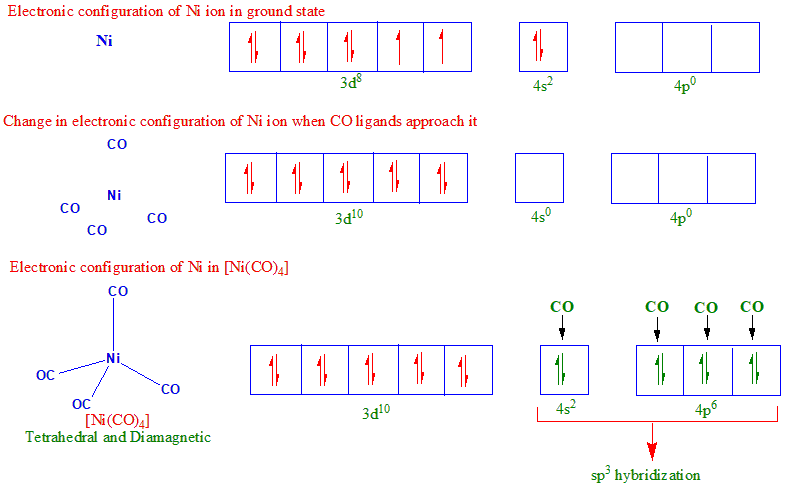
The valence shell electronic configuration of ground state \(Ni\) atom is \(3d^8 4s^2\). All of these \(10\) electrons are pushed into 3d orbitals and get paired up when strong field \(CO\) ligands approach \(Ni\) atom. The empty \(4s\) and three \(4p\) orbitals undergo \(sp^3\) hybridization and form bonds with \(CO\) ligands to give \(Ni(CO)_4\) having tertrahedral structure. Thus \(Ni(CO)_4\) is diamagnetic.
(C) \([Ni(Cl)_4]^{2-}\):
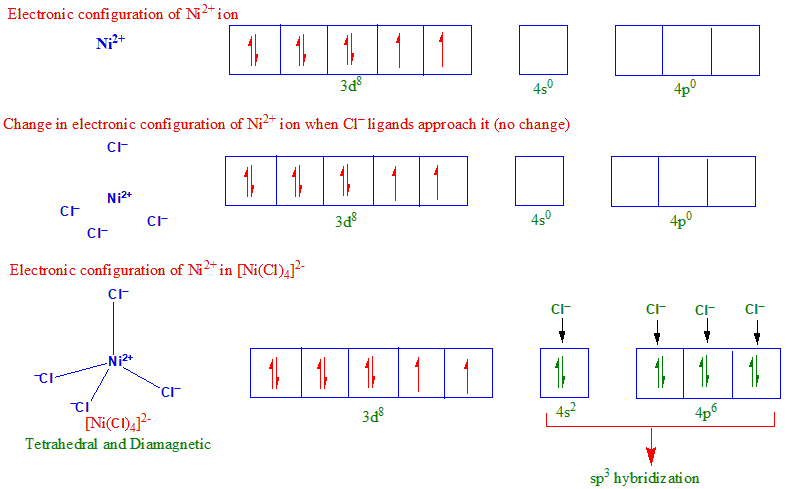
In \([NiCl_4]^{2-}\), there is \(Ni^{2+}\) ion, However, in presence of weak field \(Cl^-\) ligands, No pairing of d-electrons occurs. Therefore, \(Ni^{2+}\) undergoes \(sp^3\) hybridization to make bonds with \(Cl^-\) ligands in tetrahedral geometry. As there are unpaired electrons in the d-orbitals, \([NiCl_4]^{2-}\) is paramagnetic and is referred to as a high spin outer orbital complex.
(D) \([Ni(NH_3)_6]^{2+}\):
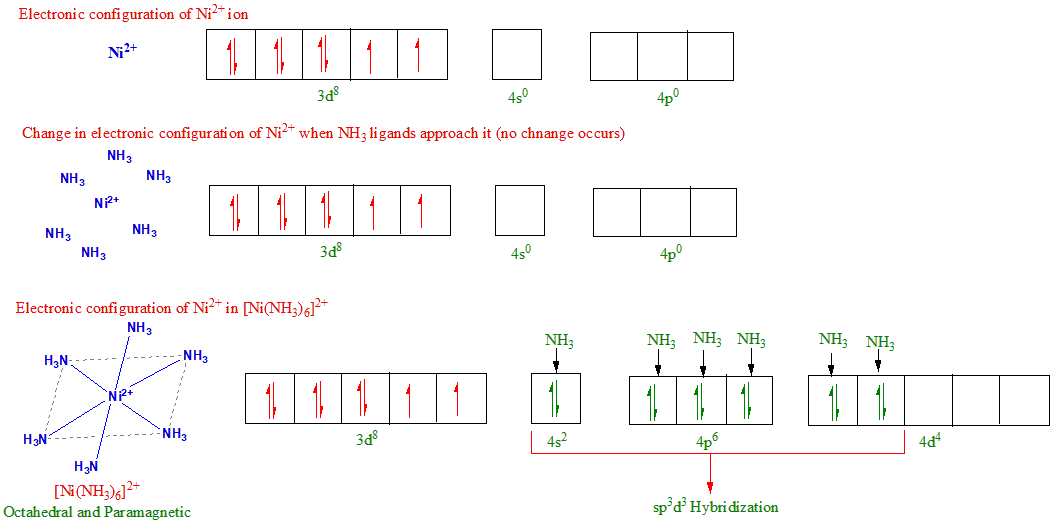
In \([Ni(NH_3)_6]^{2+}\), there is \(Ni^{2+}\) ion, However, in presence of weak field \(NH_3\) ligands, No pairing of d-electrons occurs. Therefore, \(Ni^{2+}\) undergoes \(sp^3d^2\) hybridization to make bonds with \(NH_3\) ligands in octhedral geometry. As there are unpaired electrons in the d-orbitals, \([Ni(NH_3)_6]^{2+}\) is paramagnetic and is outer orbital complex.
From the above data it is clear that (B) \([Ni(CO)_4]\) and (C) \([NiCl_4]^{2-}\) have same geometry but different magnetic behaviour.