
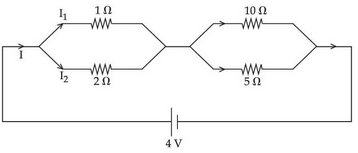
The value of current \( I_1 \), in the circuit diagram given below is:
Answer & explanation
Correct answer: option 4
The correct answer is Option (4) → \( \displaystyle\frac{2}{3}\,\mathrm{A} \)
The circuit is two parallel groups in series. First find the total resistance, then the total current, and then divide the current between 1 Ω and 2 Ω.
Left group (1 Ω and 2 Ω in parallel):
\( \displaystyle R_1 = \frac{1\times2}{1+2} = \frac{2}{3}\,\Omega \)
Right group (10 Ω and 5 Ω in parallel):
\( \displaystyle R_2 = \frac{10\times5}{10+5} = \frac{10}{3}\,\Omega \)
\( \displaystyle R_{\mathrm{total}} = \frac{2}{3}+\frac{10}{3} = 4\,\Omega,\qquad I = \frac{4\,\mathrm{V}}{4\,\Omega} = 1\,\mathrm{A} \)
In a current divider the current in a branch is the total current times the other resistance divided by the sum.
\( \displaystyle I_1 = I\times\frac{2}{1+2} = \frac{2}{3}\,\mathrm{A} \)