
The figure shows a dielectric slab placed in a uniform external electric field \(\mathbf{E}\).
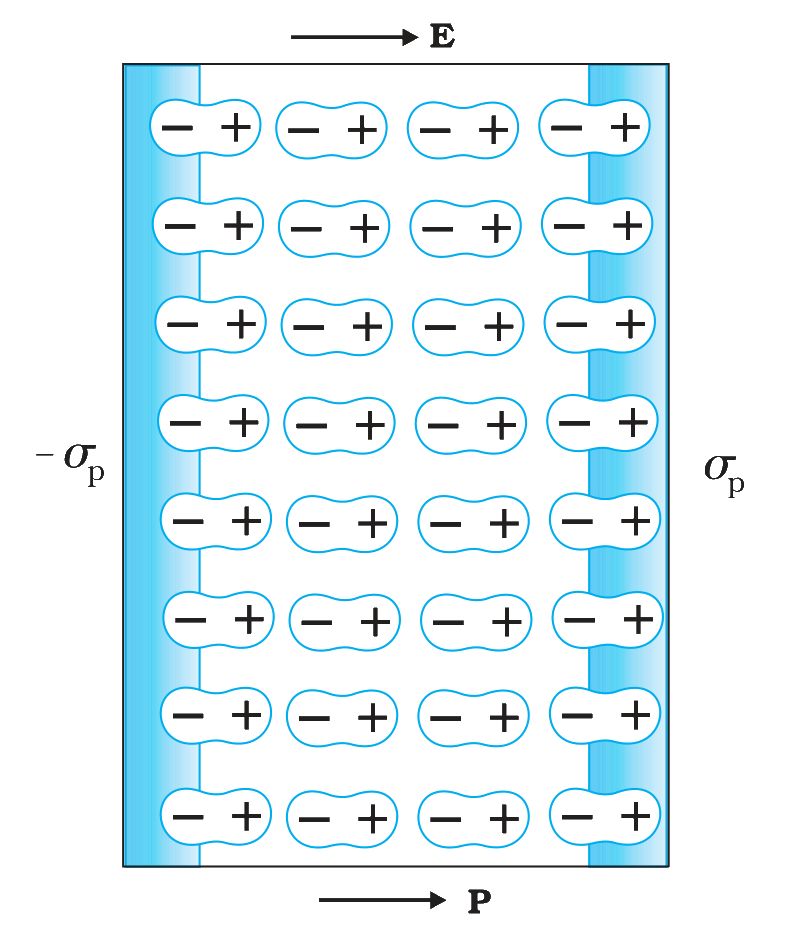
Which of the following statements is correct?
Answer & explanation
Correct answer: option 1
The correct answer is Option (1) → A small volume inside the slab has no net charge, but the two faces normal to the field carry net charge.
The field lines up the molecular dipoles of the slab. Inside, the positive end of one dipole sits next to the negative end of the next one.
Option (1) A small volume inside the slab has no net charge, but the two faces normal to the field carry net charge. — Correct. Inside the slab the dipole charges neutralise each other, so any small volume has no net charge. At the faces the end charges are left unbalanced, giving \( -\sigma_p \) on one face and \( +\sigma_p \) on the other.
Option (2) The field due to the charges on the faces acts along \(\mathbf{E}\), so the field inside the slab becomes larger. — Incorrect. The face charges produce a field opposite to \( \mathbf{E} \). So the total field inside the slab becomes smaller than \( E \).
Option (3) If the external field is made stronger, the charge density on each face stays the same. — Incorrect. A stronger field polarises the slab more. For a linear dielectric the polarisation is proportional to the field, so \( \sigma_p \) also increases.
Option (4) The charges on the faces are free electrons that have moved through the slab. — Incorrect. A dielectric has no free electrons that can move through it. The face charges come from bound charges of the molecules.
NCERT (2026-27):
Dielectrics and Polarisation – “… Anywhere inside the dielectric, the volume element Δv has no net charge (though it has net dipole moment). This is, because, the positive charge of one dipole sits close to the negative charge of the adjacent dipole. However, at the surfaces of the dielectric normal to the electric field, there is evidently a net charge density. …”
FIGURE 2.23 A uniformly polarised dielectric amounts to induced surface charge density, but no volume charge density.