
CUETMOCK
  • Pricing
  • Mentors
Log inStart freeStart free mocks→

First test, then trust

Try a free CUET mock test.

Join 5,00,000+ students who rehearsed exam day on the exact NTA screen before sitting CUET. On the web and on Android.

Start free mocks →Get the Android app
CUETMOCK

India's #1 CUET Mock Test Platform. Original NCERT-based questions on the exact NTA exam screen — trusted by 5,00,000+ students since CUET 2022.

Get it onGoogle PlayScan to download the CUETMOCK app

Mock tests

  • CUET mock test series
  • Browse all papers
  • Commerce mocks
  • Humanities (Arts) mocks
  • Science mocks
  • Languages & GAT mocks
  • Free practice questions
  • Pricing

Resources

  • CUET exam guide
  • CUET syllabus
  • Universities accepting CUET
  • Expert blogs
  • News & notifications
  • Webinars & counselling
  • CUET score calculator
  • How we estimate your rank
  • FAQs

Company

  • About us
  • Our leadership & team
  • Our toppers
  • Mentors
  • For schools
  • Contact us
  • Terms
  • Privacy
  • Refund policy

Talk to us

+91 7696 6630 56info@cuetmock.comWhatsApp us

Our other platforms

  • JEE Mock — For IIT-JEE aspirants
  • NEET Mock — For NEET aspirants

Newsletter

Exam updates, study material and offers — no spam.

© 2026 NYC Ventures Pvt. Ltd.

701-702, Royal Business Park, Zirakpur, Punjab - 140603

  • Terms of use
  • Privacy policy
  • Refund policy
  • Contact us

iCUETMOCK is an independent preparation platform, not affiliated with the National Testing Agency (NTA). Always check exam details on the official NTA website.

  • Home
  • Mock tests
  • CUET guide
  • Pricing
  • Log in
Home/Practice questions/General Aptitude Test
General Aptitude TestQuantitative ReasoningData Interpretation & Stats

The bar graph given below shows the sales of bikes and cars of five c…

The bar graph given below shows the sales of bikes and cars of five companies.
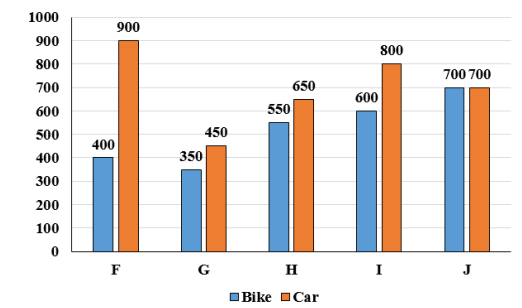
P1 = The difference between the average sales of bikes and average sales of cars of all 5 companies.

P2 = The total value of the sales of bikes and cars of all 5 companies. What is the value of (P2 - P1)?

Answer & explanation+

Correct answer: option 4

P1 = The difference between the average sales of bikes and average sales of cars of all 5 companies.

Average sale of Bikes = \(\frac{400 + 350 + 550 + 600 + 700}{5}\)

= \(\frac{ 2600}{5}\)

= 520

Average sale of Cars = \(\frac{900 + 450 + 650 + 800 + 700}{5}\)

= \(\frac{3500}{5}\)

= 700

P1 = 700 - 520 = 180

P2 = The total value of the sales of bikes and cars of all 5 companies

= 2600 + 3500

= 6100

Now , ( P2 - P1 ) = 6100 - 180

= 5920

Advertisement

Practise more on Quantitative Reasoning

Chapter-wise mocks on the real NTA exam screen, with solutions and your rank. Your first mocks are free.

Start free mocks →

Advertisement

Next questions

  1. If tan ≤ft( (x+y)/(x-y) ) = k, then dy/dx is equal to:Maths. Section B1 · Continuity and Differentiability
  2. What is the name given to the reaction when an acid reacts with a base?General Aptitude Test · General Knowledge
  3. If each of the letters of the English alphabet is assigned odd numerical value beginning with A = 1, B = 3 and so on, then what will be the…General Aptitude Test · Verbal Reasoning
  4. Consider the following statements about changes in aggregate demand in the two-sector model:(A) A rise in the rate of interest raises aggre…Economics · Macro Economics: Determination of Income and Employment
  5. The total production of India as a whole will be studied under which branch of economics?Economics · Macro Economics: Introduction
  6. 21st VARUNA Naval Exercise has been carried out by India with the naval force of which country in Jan 2023?General Aptitude Test · Current Affairs
  7. Which of the following gives rise to the problem of choice ?Economics · Micro Economics: Introduction
  8. Find the difference between a discount of 30% on ₹2,000 and a discount of 40% on ₹5,000.General Aptitude Test · Numerical Ability
  9. The interval in which f(x)=cot^-1 x+ x increases isMaths. Section A · Applications of Derivatives
  10. Which of the following is a correct pair of singular and plural?English · Grammar: Singular/Plural