
Tasmanian tiger cat is a marsupial while Bobcat is a placental mammal. This shows:
Answer & explanation
Correct answer: option 2
The correct answer is Option (2) → Convergent evolution.
Convergent evolution happens when organisms that are not closely related evolve separately but come to look alike, because they adapted to similar habitats and ways of life. Australia has marsupials (pouched mammals), and other continents have placental mammals. Many Australian marsupials look like a placental mammal found elsewhere.
Option (1) Divergent evolution. — Incorrect. Divergent evolution is the opposite process. One ancestral structure changes in different ways in related animals to suit different needs, giving homologous organs such as the forelimbs of whales, bats, cheetahs and humans. Here two unrelated animals became similar, not different.
Option (2) Convergent evolution. — Correct. The tiger cat and the bobcat belong to different groups of mammals, yet they look alike because they adapted to a similar way of life. This similarity of unrelated forms is convergent evolution.
Option (3) Mimicry. — Incorrect. Mimicry is when one species copies the look of another species to fool a predator or prey. The tiger cat and the bobcat live on different continents and are not copying each other; their likeness comes from similar adaptation.
Option (4) Adaptive radiation. — Incorrect. Adaptive radiation is the evolution of different forms from one ancestral stock, radiating into different habitats, as in Darwin’s finches or the Australian marsupials. The tiger cat and the bobcat belong to two different groups (a marsupial and a placental mammal), so their likeness is not the spreading out of one group.
Note: The bobcat never appears in the text, only in Figure 6.7. Read the figure labels too, because NTA does.
NCERT Extract:
What is Adaptive Radiation? – “… When more than one adaptive radiation appeared to have occurred in an isolated geographical area (representing different habitats), one can call this convergent evolution. Placental mammals in Australia also exhibit adaptive radiation in evolving into varieties of such placental mammals each of which appears to be ‘similar’ to a corresponding marsupial (e.g., Placental wolf and Tasmanian wolf-marsupial). (Figure 6.7).”
What are the Evidences for Evolution? – “… Homology is based on divergent evolution whereas analogy refers to a situation exactly opposite. Wings of butterfly and of birds look alike. They are not anatomically similar structures though they perform similar functions. Hence, analogous structures are a result of convergent evolution - different structures evolving for the same function and hence having similarity.”
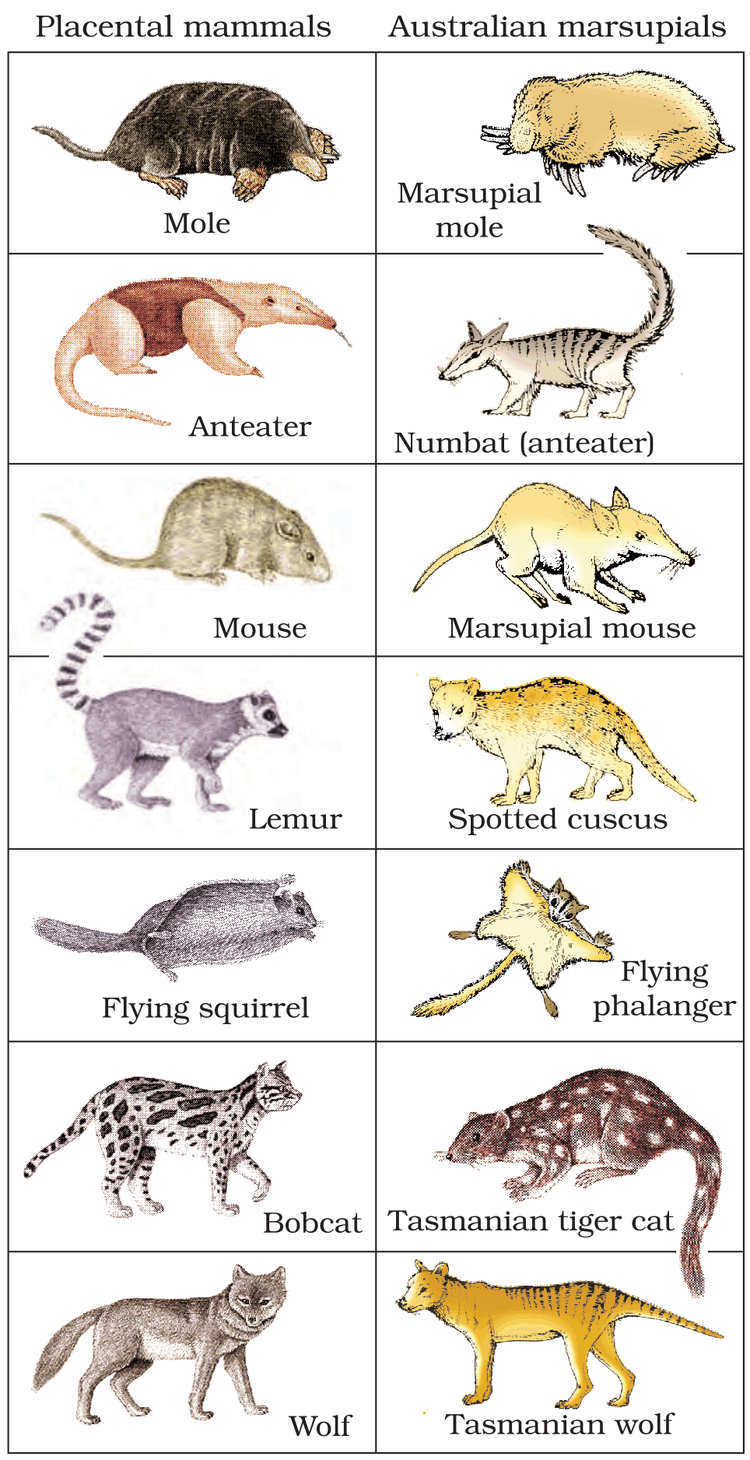
Figure 6.7 Picture showing convergent evolution of Australian Marsupials and placental mammals