
CUETMOCK
  • Pricing
  • Mentors
Log inStart freeStart free mocks→

First test, then trust

Try a free CUET mock test.

Join 5,00,000+ students who rehearsed exam day on the exact NTA screen before sitting CUET. On the web and on Android.

Start free mocks →Get the Android app
CUETMOCK

India's #1 CUET Mock Test Platform. Original NCERT-based questions on the exact NTA exam screen — trusted by 5,00,000+ students since CUET 2022.

Get it onGoogle PlayScan to download the CUETMOCK app

Mock tests

  • CUET mock test series
  • Browse all papers
  • Commerce mocks
  • Humanities (Arts) mocks
  • Science mocks
  • Languages & GAT mocks
  • Free practice questions
  • Pricing

Resources

  • CUET exam guide
  • CUET syllabus
  • Universities accepting CUET
  • Expert blogs
  • News & notifications
  • Webinars & counselling
  • CUET score calculator
  • How we estimate your rank
  • FAQs

Company

  • About us
  • Our leadership & team
  • Our toppers
  • Mentors
  • For schools
  • Contact us
  • Terms
  • Privacy
  • Refund policy

Talk to us

+91 7696 6630 56info@cuetmock.comWhatsApp us

Our other platforms

  • JEE Mock — For IIT-JEE aspirants
  • NEET Mock — For NEET aspirants

Newsletter

Exam updates, study material and offers — no spam.

© 2026 NYC Ventures Pvt. Ltd.

701-702, Royal Business Park, Zirakpur, Punjab - 140603

  • Terms of use
  • Privacy policy
  • Refund policy
  • Contact us

iCUETMOCK is an independent preparation platform, not affiliated with the National Testing Agency (NTA). Always check exam details on the official NTA website.

  • Home
  • Mock tests
  • CUET guide
  • Pricing
  • Log in
Home/Practice questions/Chemistry
ChemistryOrganic: Haloalkanes and Haloarenes

Identify the enantiomer of the molecule given below:
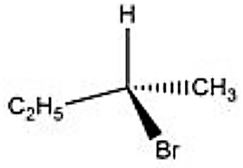
Identify the enantiomer of the molecule given below:

Figure for Q34

Answer & explanation+

Correct answer: option 1

The correct answer is Option (1) → Structure (1)

Enantiomers are stereoisomers that are non-superimposable mirror images of each other. The molecule drawn is 2-bromobutane, \( \ce{CH3-CH(Br)-C2H5} \). Its C-2 carries four different groups (H, Br, \( \ce{CH3} \) and \( \ce{C2H5} \)), so it is a chiral centre and the compound exists as two enantiomers, (R) and (S), which differ only in the direction in which they rotate plane polarised light.

To find the configuration, rank the groups by atomic number: Br > \( \ce{C2H5} \) > \( \ce{CH3} \) > H. In the given drawing H is in the plane (up), \( \ce{C2H5} \) in the plane (left), \( \ce{CH3} \) on the dashed bond (behind) and Br on the wedge (in front). Interchanging H and \( \ce{CH3} \) puts H behind the page; then Br (bottom) → \( \ce{C2H5} \) (left) → \( \ce{CH3} \) (top) runs clockwise, which is R. One interchange inverts the configuration, so the given molecule is (S)-2-bromobutane, and its enantiomer is (R)-2-bromobutane.

A quicker check is the interchange rule: a drawing that differs from the given one by an odd number of interchanges of two groups is the enantiomer; an even number gives the same molecule. All the structures use the same four positions (top, left, dashed, wedge).

  • Option (1) Top \( \ce{C2H5} \), left Br, dashed H, wedge \( \ce{CH3} \). With H behind the page, Br (left) → \( \ce{C2H5} \) (top) → \( \ce{CH3} \) (bottom right) runs clockwise: (R). Every group has moved one place round (H top to dashed, \( \ce{CH3} \) dashed to wedge, Br wedge to left, \( \ce{C2H5} \) left to top), which equals three interchanges, an odd number. So this is the enantiomer.

  • Option (2) Top \( \ce{CH3} \), left Br, dashed H, wedge \( \ce{C2H5} \). Compared with the given drawing, H and \( \ce{CH3} \) are interchanged, and so are \( \ce{C2H5} \) and Br: two interchanges, so it is the same molecule, (S).

  • Option (3) Top \( \ce{C2H5} \), left H, dashed Br, wedge \( \ce{CH3} \). H and \( \ce{C2H5} \) are interchanged, and so are \( \ce{CH3} \) and Br: two interchanges, the same molecule, (S).

  • Option (4) This is the given molecule itself, drawn the same way, (S).

So the only enantiomer among the options is the structure in Option (1).

NCERT (2026-27 edition):
Molecular Asymmetry, Chirality and Enantiomers – “… The stereoisomers related to each other as non-superimposable mirror images are called enantiomers … Enantiomers possess identical physical properties namely, melting point, boiling point, refractive index, etc. They only differ with respect to the rotation of plane polarised light. If one of the enantiomer is dextro rotatory, the other will be laevo rotatory.”

Advertisement

Practise more on Organic: Haloalkanes and Haloarenes

Chapter-wise mocks on the real NTA exam screen, with solutions and your rank. Your first mocks are free.

Start free mocks →

Advertisement

Next questions

  1. Fredrick Winslow Taylor was an American...............who sought to improve industrial efficiency.Business Studies · Principles of Management
  2. In which year 'Hampi' was recognised as a site of national importance?History · Medieval India: An Imperial Capital: Vijayanagara
  3. The following table shows the marks (in percentages) obtained by six students in six different subjects in an examination. The maximum mark…General Aptitude Test · Quantitative Reasoning
  4. The Governor General who introduced Enfield rifles using greased cartridges was __________.History · Modern India: Rebels and the Raj
  5. A certain amount of N_2O_5 decomposes to half of its initial amount in 50 minutes. If the decomposition is a first order reaction, the rate…Chemistry · Physical: Chemical Kinetics
  6. Two trains cross a pole in 4 sec and 6 sec respectively. Running in same direction in how much time will they take to cross each other if t…General Aptitude Test · Numerical Ability
  7. The Adi Dharma Movement in India belonged to which category of social movement?Sociology · Social Change and Development in India: Social Movements
  8. If all the people in economy increase savings, what will happen in the economy?Economics · Macro Economics: Determination of Income and Employment
  9. What do Lantana, Eichhornia, and African catfish have in common?Biology · Biodiversity and Conservation
  10. ∫displaystyle3/(√(3x - 2)) dx is equal to (where C is a constant of integration)Maths. Section A · Indefinite Integration (Section A)