
When 0.1 mol of CoCl3.6NH3 is treated with excess of silver nitrate solution, 0.3 mol of silver chloride is obtained. The conductivity of the solution corresponds to (cation:anion):
Answer & explanation
Correct answer: option 3
The correct answer is Option (3) → 1 : 3
According to Werner’s theory, a metal in a coordination compound has two kinds of valency. The secondary valency is satisfied by ligands bound directly to the metal inside the coordination sphere; these do not ionise. The primary valency is satisfied by ions outside the sphere; these ionise in water. Only the chloride ions outside the sphere are free to react with silver nitrate:
\( \displaystyle \ce{Ag^+ + Cl^- -> AgCl v} \)
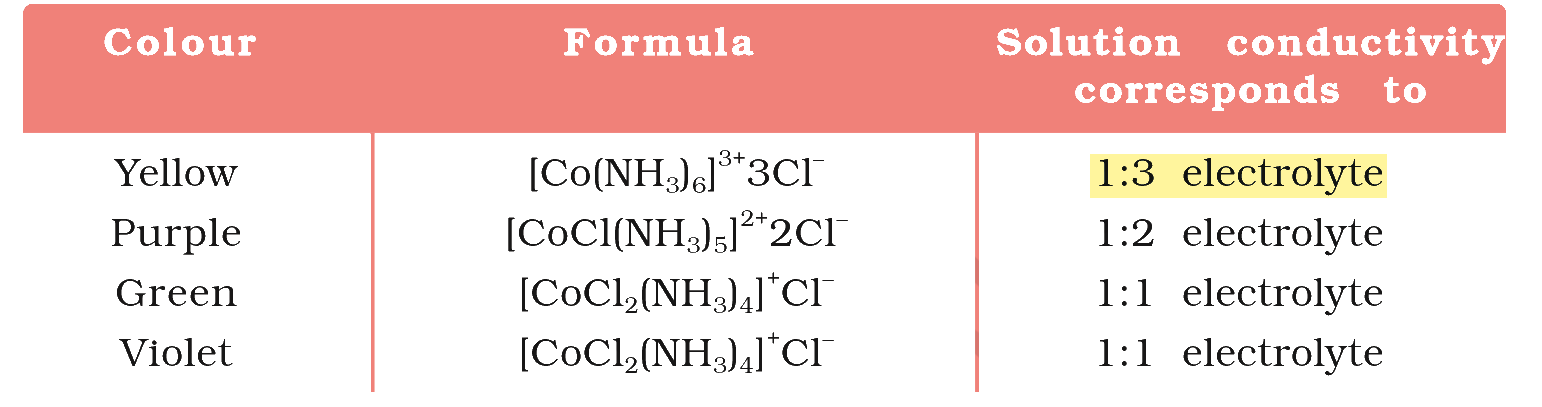
Here 0.1 mol of the compound gives 0.3 mol of AgCl, so each formula unit has 0.3/0.1 = 3 ionisable Cl−. All three chlorides are outside the coordination sphere and all six \( \ce{NH3} \) are inside it, so the compound is \( \ce{[Co(NH3)6]Cl3} \):
\( \displaystyle \ce{[Co(NH3)6]Cl3 -> [Co(NH3)6]^3+ + 3Cl^-} \)
It gives one cation and three anions, so its conductivity corresponds to a 1 : 3 electrolyte.
Why the other options are incorrect
Option (1) 1 : 1 — Incorrect. This would be \( \ce{CoCl3} \).\( \ce{4NH3} \), i.e. \( \ce{[Co(NH3)4Cl2]Cl} \), which gives only 1 mol AgCl per mol.
Option (2) 1 : 2 — Incorrect. This would be \( \ce{CoCl3} \).\( \ce{5NH3} \), i.e. \( \ce{[Co(NH3)5Cl]Cl2} \), which gives 2 mol AgCl per mol.
Option (4) 3 : 1 — Incorrect. This has the ratio the wrong way round: the compound gives one complex cation, \( \ce{[Co(NH3)6]^3+} \), and three chloride anions, not three cations and one anion.
NCERT (2026-27 edition):
Werner’s Theory of Coordination Compounds – …
Note: The same/similar question has been asked in different years by NTA as per the details given below:
| 2026 | 2025 | 2024 | 2023 | 2022 |
|---|---|---|---|---|
| 07-06 S2 19-05 S2 | – | – | – | – |