
Six people P, Q, R, S, T and U are seated around a round table. Every chair is spaced equidistant from adjacent chairs. R is seated next to T. S is seated second to the left of T. P is sitting between U and R.
Which of the following must be true?
(A) P is seated opposite to Q.
(B) U is seated adjacent to T.
(C) R is seated third to the left of S.
(D) Q and T are not neighbors.
Choose the correct answer from the options given below:
Answer & explanation
Correct answer: option 4
The correct answer is Option (4) → (A) and (C) only
People seated round a table are taken to face the centre, so a person’s left is the clockwise direction round the table. Fix T first and place the others clue by clue:
S is second to the left of T, so one seat lies between T and S, clockwise from T.
R is next to T. If R took the seat just to T’s left, P (between U and R) would need either T’s or S’s seat. So R sits on T’s right.
P sits between U and R, so P takes the next seat after R and U the one after P, which brings U next to S.
The only seat left, between T and S, goes to Q.
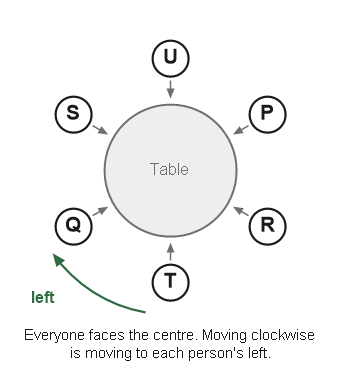
(A) P is seated opposite to Q. Correct. With six seats, the person opposite is three seats away; from Q, going clockwise, come S, U and then P, so P faces Q across the table.
(B) U is seated adjacent to T. Incorrect. T’s neighbours are Q and R; U sits between S and P.
(C) R is seated third to the left of S. Correct. Moving clockwise (to the left) from S, the first seat is U, the second P and the third R.
(D) Q and T are not neighbors. Incorrect. Q sits in the seat immediately to T’s left, so they are neighbours.