
Choose the correct answer from the following options:
Answer & explanation
Correct answer: option 3
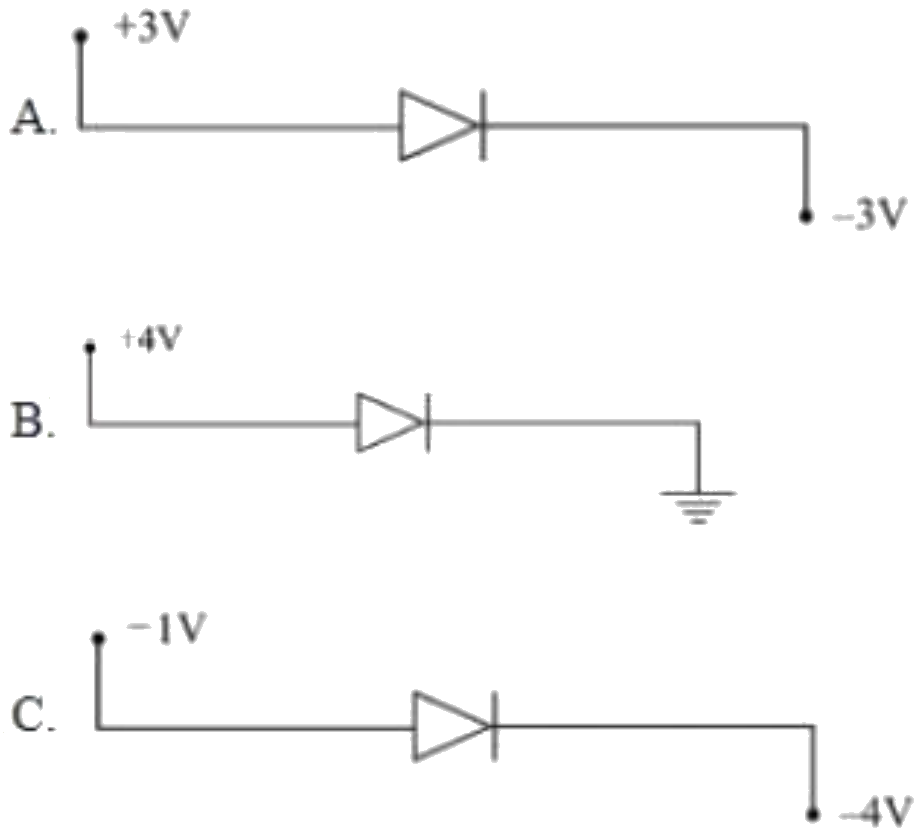
The correct answer is Option (3) → All diodes A, B and C are in forward biasing.
A p-n junction diode is forward biased when its p-side (the triangle, anode) is at a higher potential than its n-side (the bar, cathode). In all three figures the triangle is on the left, so compare the left potential with the right one.
\( \text{A: } +3\,\mathrm{V} \gt -3\,\mathrm{V} \Rightarrow \text{forward biased} \)
\( \text{B: } +4\,\mathrm{V} \gt 0\,\mathrm{V}\ (\text{earth}) \Rightarrow \text{forward biased} \)
\( \text{C: } -1\,\mathrm{V} \gt -4\,\mathrm{V} \Rightarrow \text{forward biased} \)
So all three diodes are forward biased.
NCERT (2026-27):
p-n Junction Diode Under Forward Bias – “When an external voltage V is applied across a semiconductor diode such that p-side is connected to the positive terminal of the battery and n-side to the negative terminal [Fig. 14.13(a)], it is said to be forward biased.”