
CUETMOCK
  • Pricing
  • Mentors
Log inStart freeStart free mocks→

First test, then trust

Try a free CUET mock test.

Join 5,00,000+ students who rehearsed exam day on the exact NTA screen before sitting CUET. On the web and on Android.

Start free mocks →Get the Android app
CUETMOCK

India's #1 CUET Mock Test Platform. Original NCERT-based questions on the exact NTA exam screen — trusted by 5,00,000+ students since CUET 2022.

Get it onGoogle PlayScan to download the CUETMOCK app

Mock tests

  • CUET mock test series
  • Browse all papers
  • Commerce mocks
  • Humanities (Arts) mocks
  • Science mocks
  • Languages & GAT mocks
  • Free practice questions
  • Pricing

Resources

  • CUET exam guide
  • CUET syllabus
  • Universities accepting CUET
  • Expert blogs
  • News & notifications
  • Webinars & counselling
  • CUET score calculator
  • How we estimate your rank
  • FAQs

Company

  • About us
  • Our leadership & team
  • Our toppers
  • Mentors
  • For schools
  • Contact us
  • Terms
  • Privacy
  • Refund policy

Talk to us

+91 7696 6630 56info@cuetmock.comWhatsApp us

Our other platforms

  • JEE Mock — For IIT-JEE aspirants
  • NEET Mock — For NEET aspirants

Newsletter

Exam updates, study material and offers — no spam.

© 2026 NYC Ventures Pvt. Ltd.

701-702, Royal Business Park, Zirakpur, Punjab - 140603

  • Terms of use
  • Privacy policy
  • Refund policy
  • Contact us

iCUETMOCK is an independent preparation platform, not affiliated with the National Testing Agency (NTA). Always check exam details on the official NTA website.

  • Home
  • Mock tests
  • CUET guide
  • Pricing
  • Log in
Home/Practice questions/Chemistry
ChemistryOrganic: Haloalkanes and Haloarenes

Which of the following compound reacts with chlorobenzene to produce…

Which of the following compound reacts with chlorobenzene to produce DDT?

Answer & explanation+

Correct answer: option 4

The correct answer is option 4. Trichloroacetaldehyde.

DDT is produced by the reaction of chlorobenzene with trichloroacetaldehyde in the presence of a catalyst, such as anhydrous \(AlCl_3\). The reaction proceeds through a Friedel-Crafts acylation reaction.

The reaction is illustrated below:
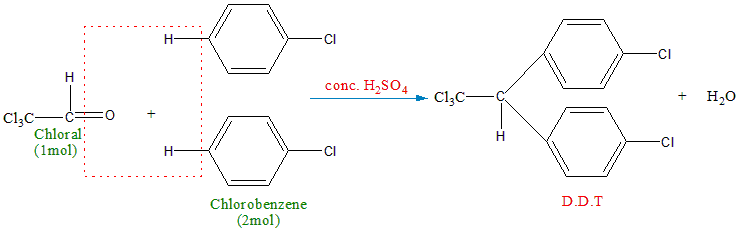
DDT is a colorless, odorless, tasteless solid with a melting point of 109.5°C. It is a very effective insecticide, but it is also highly toxic to humans and other animals.

The other options are incorrect.

Option (1), acetaldehyde, does not react with chlorobenzene to produce DDT.

Option (2), nitrobenzene, does not react with chlorobenzene to produce DDT.

Option (3), m-chlorobenzaldehyde, does not react with chlorobenzene to produce DDT.

Advertisement

Practise more on Organic: Haloalkanes and Haloarenes

Chapter-wise mocks on the real NTA exam screen, with solutions and your rank. Your first mocks are free.

Start free mocks →

Advertisement

Next questions

  1. Arrange the major constituents of a communication system in proper sequence:(A) Channel(B) Receiver(C) Information source(D) User of inform…Physics · Communication
  2. In India, China and Pakistan, which sector is emerging as a major player of development and a prospective employer?Economics · Indian Economic Development: Comparative Development Experiences of India and its Neighbours
  3. The greatest football player 'Pele' belongs to _____.General Aptitude Test · General Knowledge
  4. The deceased partner's capital account includes the following amount/balances: (A) Opening balance of his capital (B) His share of profit/l…Accountancy Part A · Reconstitution of Partnership Firm: Retirement and Death
  5. Formal demography is a largely a _____________Sociology · Indian Society: Demographic Structure of Indian Society
  6. At which number third party debts of the firm paid out of assets at the time of dissolution of the firm?Accountancy Part A · Dissolution of Partnership Firm
  7. In which stage of demographic transition, fertility remains high in the beginning but it declines with, time?Geography · Fundamentals of Human Geography: World Population-Distribution, Density and growth
  8. Select the option that best expresses the sentence in Indirect Speech. The father said to his son, "Why were you crying yesterday?"English · Direct/indirect
  9. Match the methods of preparing halogen compounds in List-I with their features in List-II.List-I(Method)List-II(Feature)(A) Free radical ch…Chemistry · Organic: Haloalkanes and Haloarenes
  10. Suppose a consumer can afford to buy 8 units of good X and 10 units of good Y. She spends her entire income. The prices of two goods are ₹7…Economics · Micro Economics: Theory of Consumer behaviour