CUETMOCK
  • Pricing
  • Mentors
Log inStart freeStart free mocks→

First test, then trust

Try a free CUET mock test.

Join 5,00,000+ students who rehearsed exam day on the exact NTA screen before sitting CUET. On the web and on Android.

Start free mocks →Get the Android app
CUETMOCK

India's #1 CUET Mock Test Platform. Original NCERT-based questions on the exact NTA exam screen — trusted by 5,00,000+ students since CUET 2022.

Get it onGoogle PlayScan to download the CUETMOCK app

Mock tests

  • CUET mock test series
  • Commerce mocks
  • Humanities (Arts) mocks
  • Science mocks
  • Languages & GAT mocks
  • Free practice questions
  • Pricing

Resources

  • CUET exam guide
  • CUET syllabus
  • Universities accepting CUET
  • Expert blogs
  • News & notifications
  • Webinars & counselling
  • CUET score calculator
  • How we estimate your rank
  • FAQs

Company

  • About us
  • Our leadership & team
  • Our toppers
  • Mentors
  • For schools
  • Contact us
  • Terms
  • Privacy
  • Refund policy

Talk to us

+91 7696 6630 56info@cuetmock.comWhatsApp us

Our other platforms

  • JEE Mock — For IIT-JEE aspirants
  • NEET Mock — For NEET aspirants

Newsletter

Exam updates, study material and offers — no spam.

© 2026 NYC Ventures Pvt. Ltd.

701-702, Royal Business Park, Zirakpur, Punjab - 140603

  • Terms of use
  • Privacy policy
  • Refund policy
  • Contact us

iCUETMOCK is an independent preparation platform, not affiliated with the National Testing Agency (NTA). Always check exam details on the official NTA website.

  • Home
  • Mock tests
  • CUET guide
  • Pricing
  • Log in
Home/Practice questions/History
HistoryMedieval India: Peasants, Zamindars and the State

Match the LIST-I with LIST-II:LIST-ITermsLIST-IIMeaningsA.KifayatI.Im…

Match the LIST-I with LIST-II:

LIST-I
Terms
LIST-II
Meanings
A.KifayatI.Imperial order
B.SanadII.Financial interests
C.SubasIII.Foot-soldiers
D.PiyadaIV.Provinces

Choose the correct answer from the options given below:

Answer & explanation+

Correct answer: option 4

The correct answer is Option (4) → A - II, B - I, C - IV, D - III

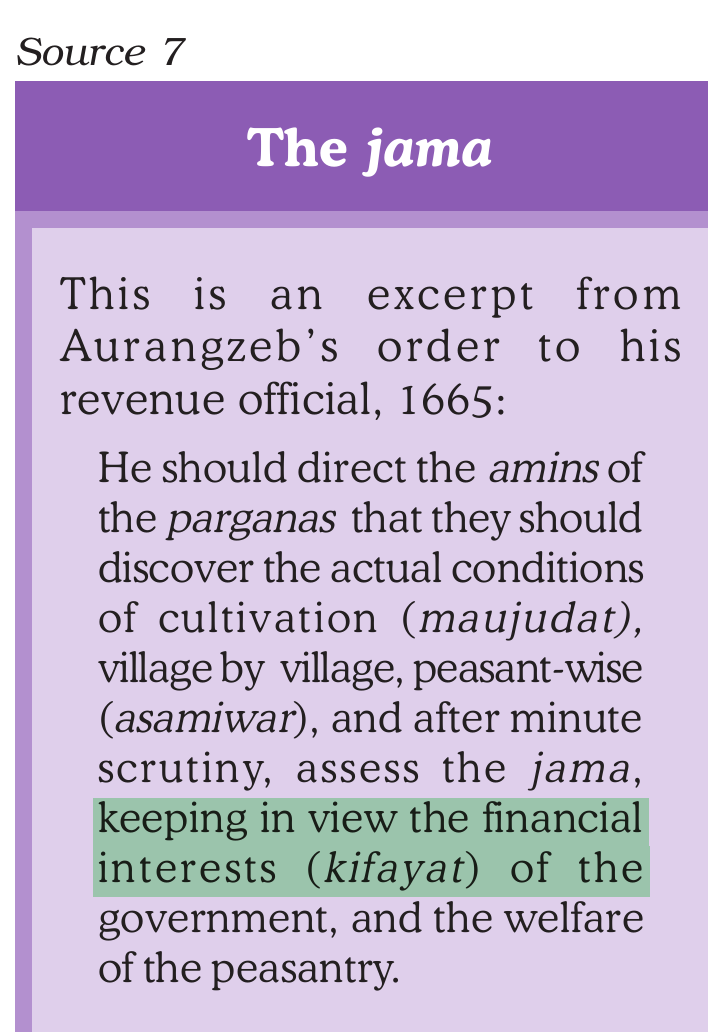
(A) Kifayat — this matches (II) Financial interests. In his order of 1665, Aurangzeb told his revenue officials to assess the revenue keeping in view the financial interests (kifayat) of the government and the welfare of the peasantry.

(B) Sanad — this matches (I) Imperial order. A zamindar who seized land from weaker people needed the state’s approval, a confirmation by an imperial order (sanad).

(C) Subas — this matches (IV) Provinces. The Mughal empire was divided into provinces (subas); the Ain-i Akbari gives an “Account of the Twelve Provinces” with the details of every suba.

(D) Piyada — this matches (III) Foot-soldiers. The tables of the Ain list the troops of the zamindars: horsemen (sawar), foot-soldiers (piyada) and elephants (fil).


NCERT (2025-26): “5. The Zamindars … The dispossession of weaker people by a powerful military chieftain was quite often a way of expanding a zamindari. It is, however, unlikely that the state would have allowed such a show of aggression by a zamindar unless he had been confirmed by an imperial order (sanad ). More important were the slow processes of zamindari consolidation, which are also documented in sources. These involved colonisation of new lands, by transfer of rights, by order of the state and by purchase.…

8. The Ain-i Akbari of Abu’l Fazl Allami … Along with a description of the various departments of Akbar’s government and elaborate descriptions of the … various provinces (subas) of the empire, the Ain gives us intricate quantitative information of those provinces. Collecting and compiling this information systematically was an important imperial exercise.…

8. The Ain-i Akbari of Abu’l Fazl Allami … The third book, mulk-abadi, is the one which deals with the fiscal side of the empire and provides rich quantitative information on revenue rates, followed by the ‘Account of the Twelve Provinces’. This section has detailed statistical information, which includes the geographic, topographic and economic profile of all subas and their administrative and fiscal divisions (sarkars, parganas and mahals), total measured area, and assessed revenue ( jama ).…

8. The Ain-i Akbari of Abu’l Fazl Allami … This it does in the form of tables, which have eight columns giving the following information: (1) parganat/mahal; (2) qila (forts); (3) arazi and zamin-i paimuda (measured area); (4) naqdi, revenue assessed in cash; (5) suyurghal, grants of revenue in charity; (6) zamindars; columns 7 and 8 contain details of the castes of these zamindars, and their troops including their horsemen (sawar), foot-soldiers (piyada) and elephants (fil ).…”

NCERT extract

Advertisement

Practise more on Medieval India: Peasants, Zamindars and the State

Chapter-wise mocks on the real NTA exam screen, with solutions and your rank. Your first mocks are free.

Start free mocks →

Advertisement

Next questions

  1. ∫ e^x≤ft(tan^-1x+displaystyle1/(1+x^2))dx is equal to:Maths. Section B1 · Indefinite Integration
  2. Where is 'Borah Bazaar' located?History · Modern India: Colonial cities
  3. Select the word which means the same as the group of words given. Come in the way ofEnglish · One Word
  4. Select the most appropriate ANTONYM of the given word. AscentEnglish · Antonyms
  5. Naked debentures are also known as:Accountancy Part A · Issue and Redemption of Debentures
  6. 'A' and 'B' start from the same place and walk in opposite directions, each traveling 20 m. 'A' then turns right and walks 15 m. 'B' turns…General Aptitude Test · Verbal Reasoning
  7. Read the following statements - Assertion (A) and Reason (R):Assertion (A): The minimum point of SAC curve lies to the right of the minimum…Economics · Micro Economics: Production and Costs
  8. Match the words in List - I with their meanings in List - II. List – I (Word) List – II (Meaning) (A) lively (I) series (B) splendid (II) s…English · Comprehension - (Narrative / Factual)
  9. Which programme of the Government of India is described as an important effort in the actualisation of a gender-just society?Sociology · Social Change and Development in India: Social Movements
  10. A first order reaction is found to have a rate constant, k = 5.5 × 10^-14s^-1 . Find the half life of the reaction.Chemistry · Physical: Chemical Kinetics