
Match List - I with List - II.
|
List – I |
List – II |
|
(A) Adenine |
(I) Purine |
|
(B) Thymine |
(II) Pyrimidine |
|
(C) Uracil |
(III) DNA |
|
(D) Deoxyribose |
(IV) RNA |
Choose the correct answer from the options given below:
Answer & explanation
Correct answer: option 2
The correct answer is Option (2) → (A)-(I), (B)-(II), (C)-(IV), (D)-(III)
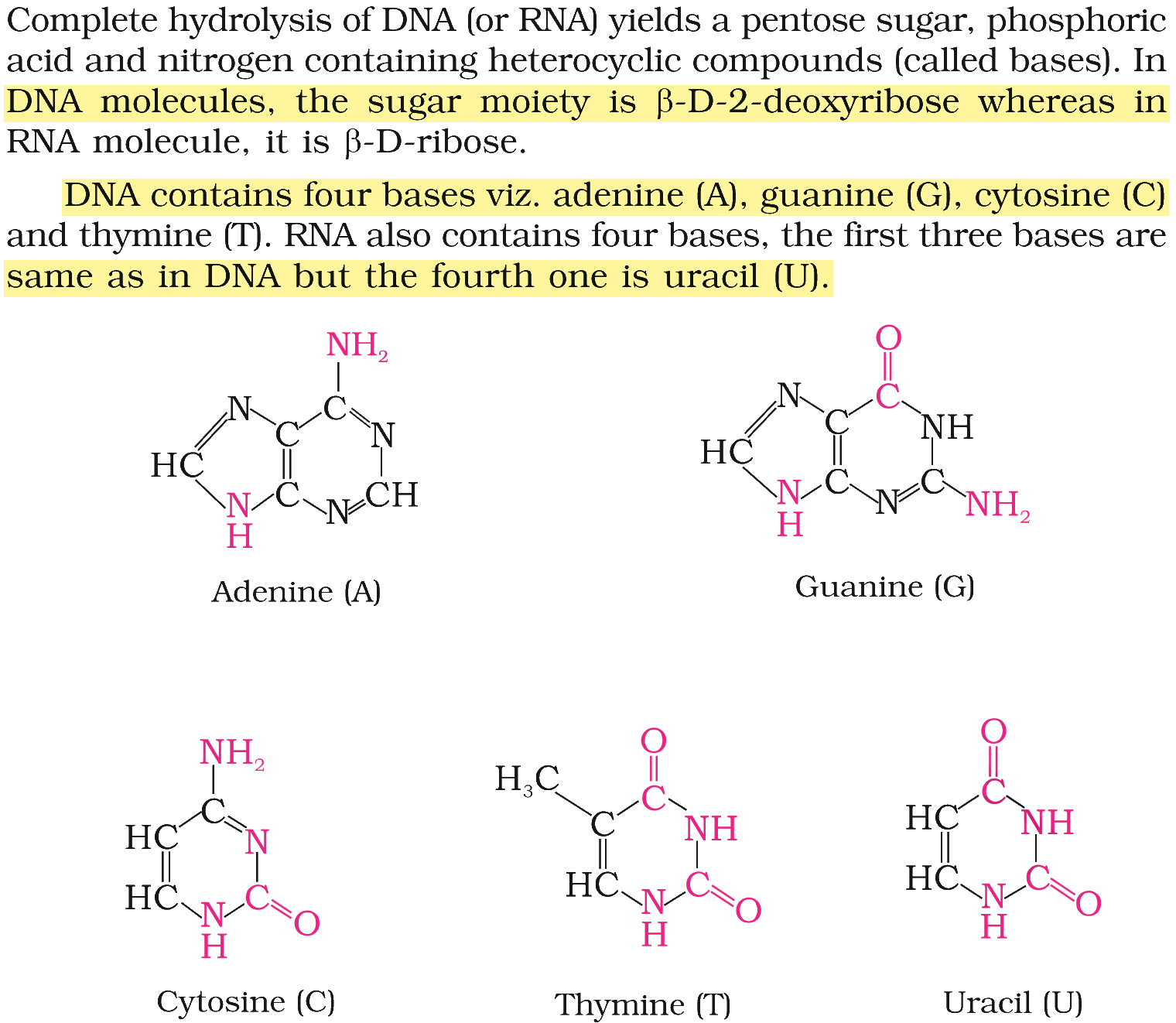
Hydrolysis of a nucleic acid gives a pentose sugar, phosphoric acid and nitrogen bases. The bases are of two kinds: purines (two fused rings: adenine, guanine) and pyrimidines (one ring: cytosine, thymine, uracil). DNA contains A, G, C and thymine, with the sugar β-D-2-deoxyribose; RNA contains A, G, C and uracil, with β-D-ribose.
(A) Adenine — This matches (I) Purine. Adenine has the fused two-ring purine skeleton.
(B) Thymine — This matches (II) Pyrimidine. Thymine is a single-ring pyrimidine base (found in DNA).
(C) Uracil — This matches (IV) RNA. Uracil takes the place of thymine in RNA and is not present in DNA.
(D) Deoxyribose — This matches (III) DNA. 2-Deoxyribose is the sugar of DNA; RNA contains ribose.
Shortcut: (A)-(I) appears only in Option (2).
In the structures in the book, adenine (like guanine) has the fused two-ring purine skeleton, while thymine, cytosine and uracil have the single-ring pyrimidine skeleton.
NCERT (2026-27 edition):
Chemical Composition of Nucleic Acids
Note: The same/similar question has been asked in different years by NTA as per the details given below:
| 2026 | 2025 | 2024 | 2023 | 2022 |
|---|---|---|---|---|
| – | – | – | 09-06 S3 07-06 S3 | – |