CUETMOCK
  • Pricing
  • Mentors
Log inStart freeStart free mocks→

First test, then trust

Try a free CUET mock test.

Join 5,00,000+ students who rehearsed exam day on the exact NTA screen before sitting CUET. On the web and on Android.

Start free mocks →Get the Android app
CUETMOCK

India's #1 CUET Mock Test Platform. Original NCERT-based questions on the exact NTA exam screen — trusted by 5,00,000+ students since CUET 2022.

Get it onGoogle PlayScan to download the CUETMOCK app

Mock tests

  • CUET mock test series
  • Browse all papers
  • Commerce mocks
  • Humanities (Arts) mocks
  • Science mocks
  • Languages & GAT mocks
  • Free practice questions
  • Pricing

Resources

  • CUET exam guide
  • CUET syllabus
  • Universities accepting CUET
  • Expert blogs
  • News & notifications
  • Webinars & counselling
  • CUET score calculator
  • How we estimate your rank
  • FAQs

Company

  • About us
  • Our leadership & team
  • Our toppers
  • Mentors
  • For schools
  • Contact us
  • Terms
  • Privacy
  • Refund policy

Talk to us

+91 7696 6630 56info@cuetmock.comWhatsApp us

Our other platforms

  • JEE Mock — For IIT-JEE aspirants
  • NEET Mock — For NEET aspirants

Newsletter

Exam updates, study material and offers — no spam.

© 2026 NYC Ventures Pvt. Ltd.

701-702, Royal Business Park, Zirakpur, Punjab - 140603

  • Terms of use
  • Privacy policy
  • Refund policy
  • Contact us

iCUETMOCK is an independent preparation platform, not affiliated with the National Testing Agency (NTA). Always check exam details on the official NTA website.

  • Home
  • Mock tests
  • CUET guide
  • Pricing
  • Log in
Home/Practice questions/Economics
EconomicsIndian Economic Development: Poverty

Arrange the following events in the order of their occurrence.A. Prad…

Arrange the following events in the order of their occurrence.

A. Pradhan Mantri Jan Dhan Yojana

B. Poverty alleviation programme approach

C. Mahatma Gandhi National Rural Employment Guarantee scheme

D. Food for work

E. First five year plan

Choose the correct answer from the options given below:

Answer & explanation+

Correct answer: option 3

The correct answer is Option (3) → E, B, D, C, A

(E) First five year plan — 1951–56. The early plans expected growth itself to reduce poverty.

(B) Poverty alleviation programme approach — from the Third Five Year Plan (1961–66). Under this approach the government ran special programmes that create work and assets for the poor.

(D) Food for work — a noted programme of this approach, started in the 1970s.

(C) Mahatma Gandhi National Rural Employment Guarantee scheme — based on the Act of 2005. It promises 100 days of wage employment a year to rural households.

(A) Pradhan Mantri Jan Dhan Yojana — from 2014. It encourages people to open bank accounts.

Note: This question is taken from the chapter ‘Poverty’ which was there in the pre-rationalised NCERT and has been deleted from subsequent editions of NCERT, including the NCERT book (2026-27). The chapter was also not in the CUET (UG) 2026 syllabus.

NCERT (Pre-rationalised): Indian Economic Development — Chapter 4: Poverty

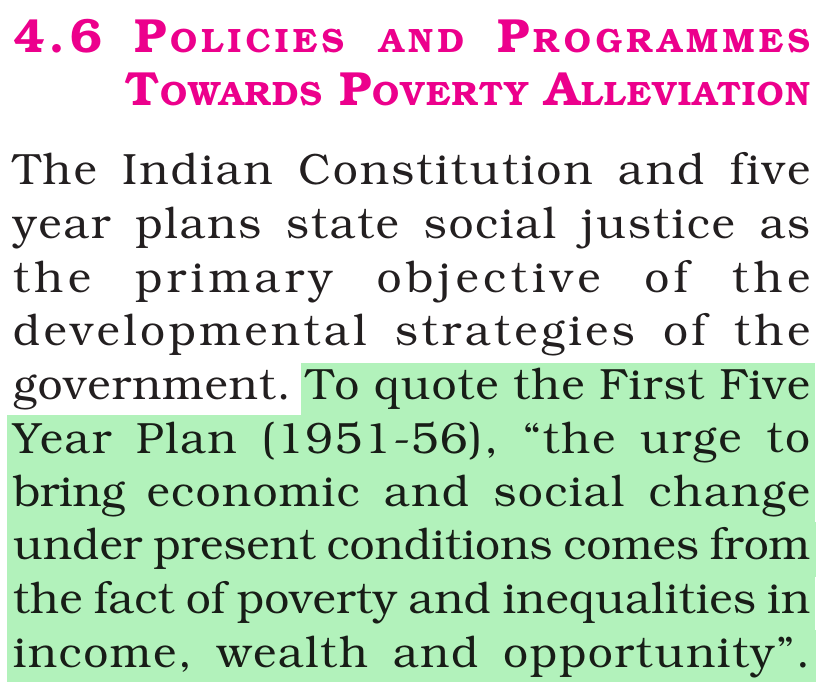
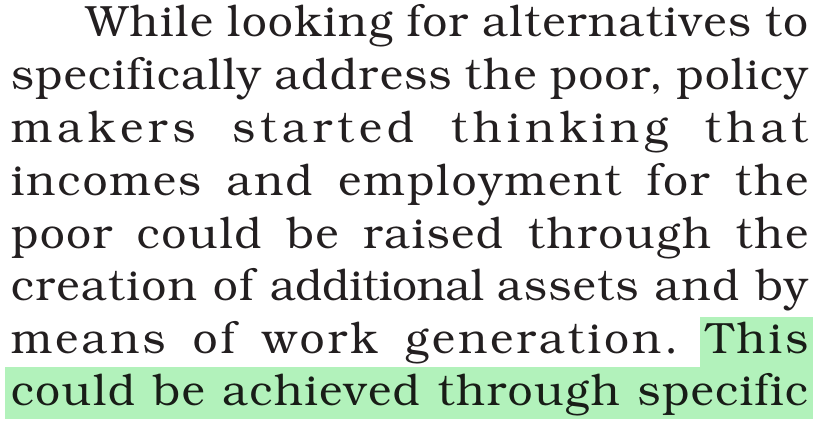
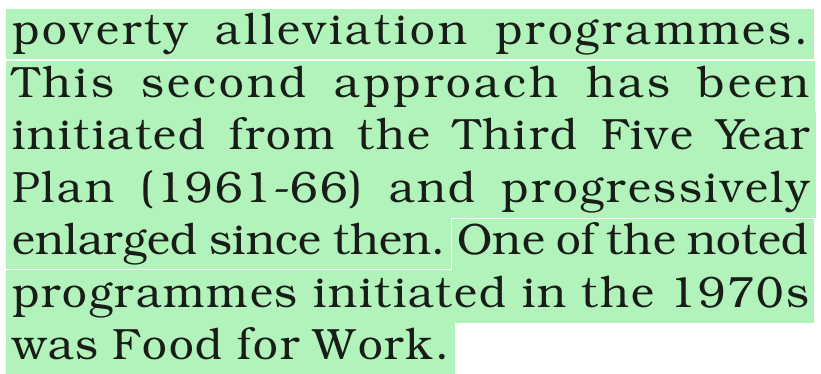
NCERT extract

NCERT extractNCERT extract

NCERT (Pre-rationalised): “…The government has a variety of programmes to generate wage employment for the poor unskilled people living in rural areas. In August 2005, the Parliament passed a new Act to provide guaranteed wage employment to every rural household whose adult volunteer is to do unskilled manual work for a minimum of 100 days in a year. This is known as Mahatma Gandhi National Rural Employment Guarantee Act (MNREGA).…

…From 2014, a scheme called Pradhan Mantri Jan-Dhan Yojana is available in which people in India are encouraged to open bank accounts.…”

Advertisement

Practise more on Indian Economic Development: Poverty

Chapter-wise mocks on the real NTA exam screen, with solutions and your rank. Your first mocks are free.

Start free mocks →

Advertisement

Next questions

  1. Which of the following best explains why a demographic dividend may fail to translate into economic growth?Sociology · Indian Society: Demographic Structure of Indian Society
  2. Which of the following are features of “Trade and Investment Policy Reforms”, 1991? 1. Increase international competitiveness of industrial…Economics · Indian Economic Development: Liberalisation, Privatisation and Globalisation - An Appraisal
  3. Assertion (A) : When ultraviolet light is incident on a photocell, its stopping potential is V 0 and the maximum kinetic energy of the phot…Physics · Dual Nature of Radiation and Matter
  4. Fill in the blank with the correct pronoun:Every year in March, the old peepal tree outside the temple sheds ________ leaves all over the s…English · Grammar: Pronoun
  5. Who among the following has been appointed as Chief Vigilance Commissioner in India in Aug 2022?General Aptitude Test · Current Affairs
  6. A zener diode is to be used as a voltage regulator. Identify the correct set up -Physics · Semiconductors and Electronic Devices
  7. The most basic species in the following isChemistry · Organic: Amines
  8. The concept that the aggregate value of goods and services produced in an economy keeps going round, either as factor payments, or as expen…Economics · Macro Economics: National Income Accounting
  9. Which of the following techniques is used in the test-tube baby program?Biology · Reproductive Health
  10. Name the sociologist who argues the use of machinery deskills workers.Sociology · Social Change and Development in India: Change and Development in industrial Society